Have you ever paused mid-sentence, unsure whether to write wonder or wander? You’re not alone. These two words sound almost identical, but they carry completely different meanings and using the wrong one can subtly change the message you’re trying to convey.
In this guide, we’ll break down wonder vs wander in a simple, human-friendly way. By the end, you’ll not only understand the difference but also feel confident using both words naturally in everyday writing and conversation.
Quick Answer
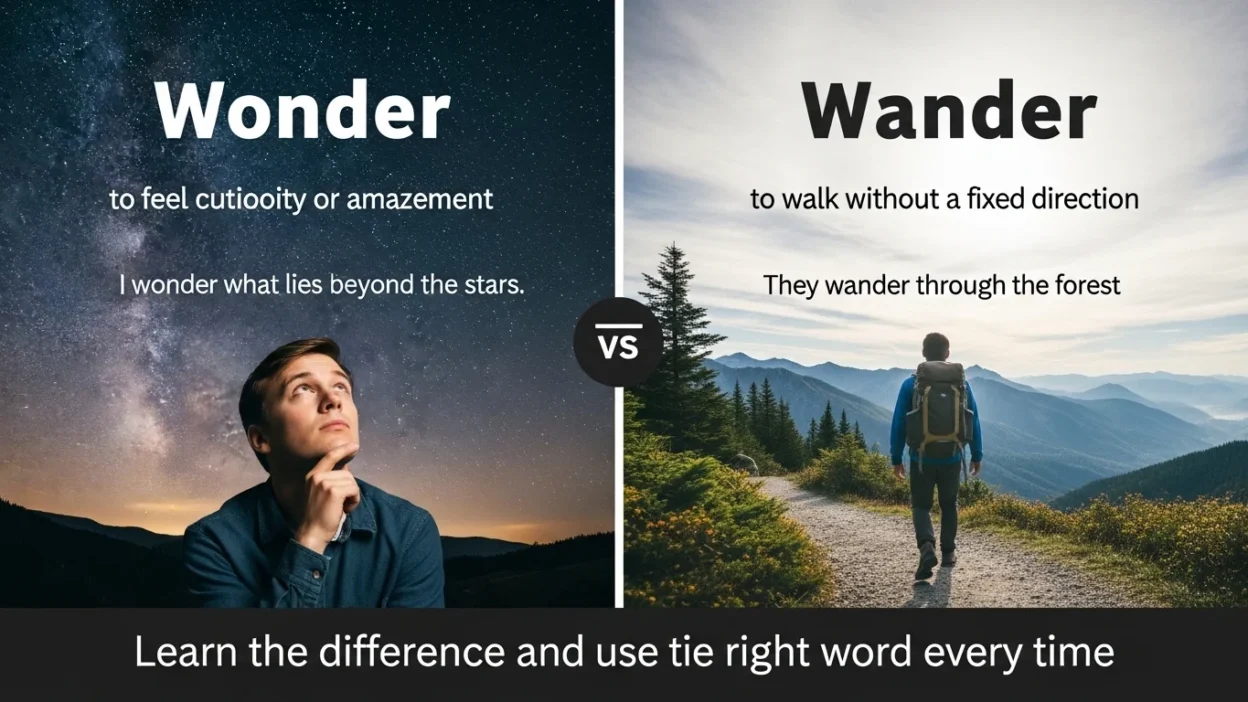
- Wonder = to think, feel curiosity, or be amazed
- Wander = to move around without a fixed direction
👉 Think of it this way:
- Wonder happens in your mind.
- Wander happens with your feet.
What Does “Wonder” Mean?
The word wonder relates to thoughts, curiosity, and emotions. It often describes a sense of questioning or amazement.
Common meanings of “wonder”:
- To feel curiosity: “I wonder what she’s doing.”
- To think about something: “He wondered if it would rain.”
- To feel awe or amazement: “The view filled them with wonder.”
Example sentences:
- I wonder why the sky changes color at sunset.
- She wondered if she made the right decision.
- The child looked at the stars in pure wonder.
Synonyms for “wonder”:
- Curiosity
- Amazement
- Ponder
- Question
- Marvel
What Does “Wander” Mean?
The word wander refers to physical movement usually without a clear direction or purpose. It can also describe thoughts drifting aimlessly.
Common meanings of “wander”:
- To walk without a plan: “They wandered through the forest.”
- To drift mentally: “His mind began to wander.”
Example sentences:
- We decided to wander around the old town.
- She likes to wander through bookstores on weekends.
- During the lecture, his thoughts began to wander.
Synonyms for “wander”:
- Roam
- Drift
- Meander
- Stroll
- Stray
Wonder vs Wander: Key Differences
Here’s a clear side-by-side comparison to help you remember:
| Feature | Wonder | Wander |
| Meaning | Curiosity or amazement | Moving without direction |
| Type | Mental/emotional | Physical (or mental drifting) |
| Usage | Thinking, questioning | Walking, roaming |
| Example | I wonder what’s next | I wander through the park |
| Memory Tip | “Wonder = mind” | “Wander = walk” |
Easy Trick to Remember the Difference
A simple memory hack can save you from confusion:
- Wonder → “One-der” → One thought in your mind
- Wander → “Wan-der” → Walking and drifting
Or even easier:
👉 If it involves thinking, use wonder
👉 If it involves moving, use wander
Common Mistakes to Avoid
Even experienced writers mix these up sometimes. Here are the most common mistakes and how to fix them:
1. Using “wander” instead of “wonder”
❌ I wander what he meant
✔️ I wonder what he meant
👉 Fix: If it’s about thinking or questioning, use wonder.
2. Using “wonder” instead of “wander”
❌ We wondered around the city
✔️ We wandered around the city
👉 Fix: If it involves movement, use wander.
3. Confusing figurative uses
Both words can be used metaphorically:
- My mind began to wander (drifting thoughts)
- I wonder about the future (thinking deeply)
👉 Always focus on whether the action is mental curiosity or aimless movement.
Wonder vs Wander in Everyday Contexts
Understanding how these words appear in real-life situations can make them easier to remember.
In conversations:
- “I wonder if she’ll call.”
- “Let’s wander around and explore.”
In writing:
- “He sat quietly, lost in wonder.”
- “They wandered through the narrow streets.”
In storytelling:
- “Her heart filled with wonder as she saw the ocean for the first time.”
- “The traveler continued to wander, searching for meaning.”
American vs British English Differences
Good news there’s no difference between American and British English when it comes to wonder vs wander. Both words are spelled and used the same way in both versions of English.
However, pronunciation may vary slightly depending on accent:
- In American English, the difference may sound subtle.
- In British English, the vowel sounds can be more distinct.
Still, the meanings remain exactly the same.
Related Words and Phrases (LSI Keywords)
To deepen your understanding and improve your writing, here are some related terms often used alongside wonder and wander:
Related to “wonder”:
- Curiosity
- Awe
- Amazement
- Pondering
- Questioning
Related to “wander”:
- Roaming
- Exploring
- Meandering
- Drifting
- Traveling aimlessly
Using these variations can make your writing more natural and engaging.
FAQs
1. Can “wander” be used for thoughts?
Yes. While it mainly refers to physical movement, it can also describe mental drifting, like “my mind began to wander.”
2. Is “wondering” always about questions?
Mostly, yes. It often expresses curiosity or uncertainty, but it can also convey amazement.
3. How do I quickly check which word to use?
Ask yourself:
- Am I thinking? → wonder
- Am I moving? → wander
4. Are “wonder” and “wander” homophones?
They are near-homophones, meaning they sound very similar but not exactly the same.
5. Can both words appear in the same sentence?
Yes! For example:
“I wondered where he had gone as he continued to wander through the streets.”
6. Is one more formal than the other?
No. Both words are commonly used in both formal and informal English.
7. Why do people confuse wonder vs wander?
Because they sound similar and differ by just one letter, making them easy to mix up in writing.
8. Can “wonder” be a noun and a verb?
Yes.
- Verb: “I wonder why.”
- Noun: “The world is full of wonder.”
Summary:
At its core, the difference between wonder vs wander is simple yet important. Wonder lives in your thoughts it’s about curiosity, questioning, and amazement.
Wander, on the other hand, describes movement whether you’re physically exploring or letting your mind drift without direction. Keeping this distinction in mind will instantly improve your clarity and confidence in writing.
Both words add richness to language in their own way. One invites reflection, while the other encourages exploration. When used correctly, they can make your sentences more vivid and expressive.
Actionable Takeaway
Next time you’re unsure, pause and ask yourself one question:
👉 “Am I thinking or moving?”
If you’re thinking, go with wonder. If you’re moving, choose wander. Practice with a few sentences daily, and soon the difference will feel completely natural.

Edward Axel is the administrator of SyntaxlyHub, responsible for overseeing site operations, content management, and technical performance. He ensures accuracy, consistency, and smooth functionality while supporting the team in delivering reliable, high-quality grammar resources and a user-friendly learning experience for readers worldwide.