If you’ve ever paused while writing and wondered whether to use “whole day” or “all day,” you’re not alone. These two phrases look similar, but they carry slightly different meanings and are used in different contexts. Choosing the right one can make your writing sound more natural and polished.
In this guide, you’ll clearly understand the difference between whole day and all day, learn when to use each, and avoid common mistakes. If you’re writing emails, blog posts, or everyday messages, this simple distinction can elevate your English.
Quick Answer
- “All day” is the most common and natural phrase in everyday English.
- “Whole day” is less common and usually needs “the” (→ the whole day).
- Use “all day” for general duration.
- Use “the whole day” when emphasizing completeness.
Meaning of “Whole Day” and “All Day”
What Does “All Day” Mean?
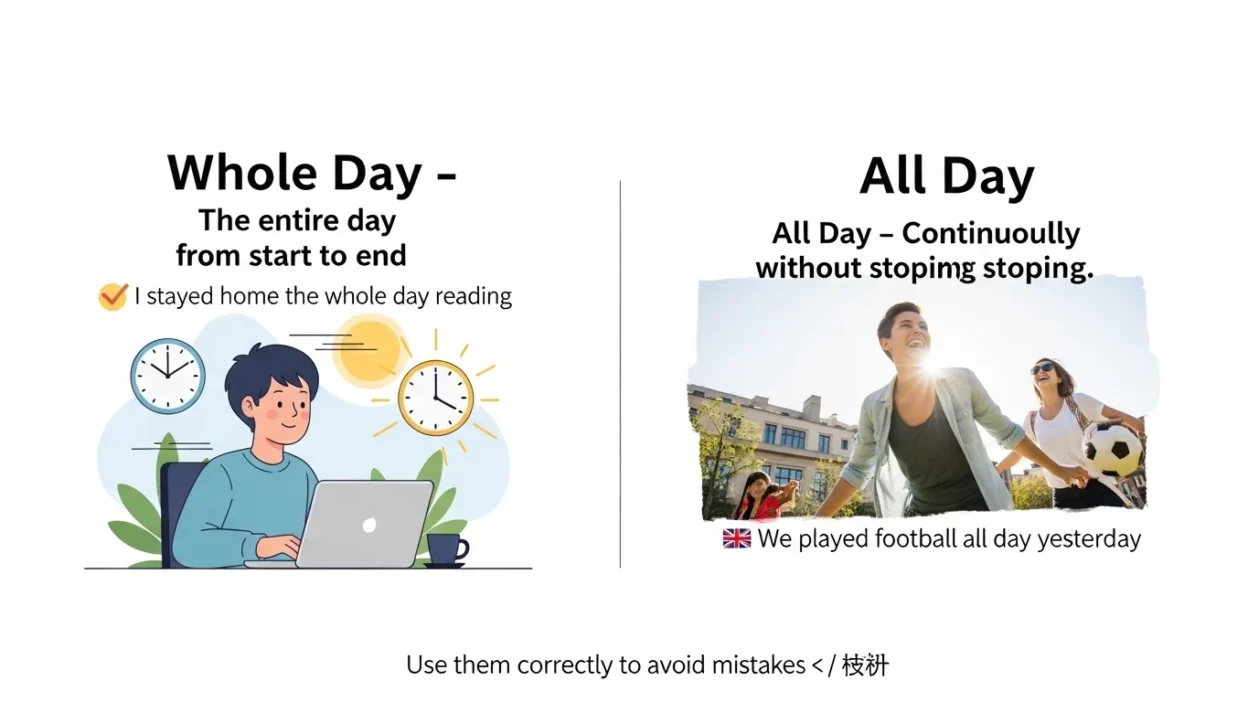
“All day” refers to something that continues throughout the entire day without interruption. It focuses on duration and is widely used in both spoken and written English.
Examples:
- I was busy all day.
- She studied all day for her exams.
- It rained all day yesterday.
👉 This is the more natural and commonly preferred phrase.
What Does “Whole Day” Mean?
“Whole day” usually appears as “the whole day” and emphasizes the entirety or completeness of the day.
Examples:
- I spent the whole day cleaning my room.
- He waited for her the whole day.
- We traveled the whole day without stopping.
👉 Without “the,” it often sounds unnatural.
Key Difference Between Whole Day and All Day
| Feature | All Day | The Whole Day |
| Usage Frequency | Very common | Less common |
| Tone | Natural, conversational | Slightly more emphatic |
| Grammar | Used without article | Usually needs “the” |
| Focus | Duration | Completeness |
| Example | I worked all day. | I worked the whole day. |
When to Use “All Day”
Use “all day” when you want to describe something happening continuously throughout the day.
Best situations:
- Daily conversation
- Informal writing
- General descriptions
Examples:
- I’ve been waiting all day.
- They played games all day.
- She felt tired all day.
💡 Tip: If you’re unsure, “all day” is almost always the safe choice.
When to Use “The Whole Day”
Use “the whole day” when you want to emphasize that something covered every part of the day completely.
Best situations:
- Emphasis or storytelling
- Slightly formal tone
- When highlighting effort or intensity
Examples:
- He worked hard the whole day.
- We spent the whole day at the beach.
- She cried the whole day after hearing the news.
💡 Tip: Always include “the” before “whole day” for correct grammar.
Common Mistakes to Avoid
Many learners mix these phrases incorrectly. Here are some mistakes to watch out for:
❌ I was busy whole day.
✔️ I was busy all day.
✔️ I was busy the whole day.
❌ She slept whole day.
✔️ She slept all day.
✔️ She slept the whole day.
❌ We worked for whole day.
✔️ We worked all day.
✔️ We worked for the whole day.
👉 Key takeaway: Never use “whole day” alone without “the.”
American vs British English Usage
Both American English and British English prefer “all day” in everyday usage. It is universally understood and sounds natural across regions.
- 🇺🇸 American English: “I was working all day.”
- 🇬🇧 British English: “I was working all day.”
“The whole day” is also correct in both, but slightly less common in casual conversation. There is no major regional difference just a difference in tone and emphasis.
Synonyms and Related Phrases (LSI Keywords)
Using variations can make your writing richer and more engaging:
- Throughout the day
- Entire day
- Full day
- Day long
- From morning till night
- All through the day
- Every hour of the day
Examples:
- She was busy throughout the day.
- He worked the entire day without rest.
Real-Life Examples for Better Understanding
Here are practical examples showing how both phrases work in context:
- I was on calls all day, so I couldn’t reply.
- We explored the city the whole day.
- The baby cried all day.
- He stayed in bed the whole day due to illness.
👉 Notice how “all day” sounds more natural in most everyday situations.
FAQs
1. Is “whole day” correct English?
Yes, but it should usually be used as “the whole day.” Without “the,” it sounds incorrect.
2. Which is more common: whole day or all day?
“All day” is much more common and widely used in everyday English.
3. Can I use “whole day” without “the”?
No, it is grammatically incorrect in most cases.
4. Is there a difference in meaning?
Yes. “All day” focuses on duration, while “the whole day” emphasizes completeness.
5. Which one should I use in writing?
Use “all day” for general writing. Use “the whole day” when you want to add emphasis.
6. Are both phrases acceptable in formal English?
Yes, both are correct, but “all day” is still more natural even in formal contexts.
7. What is a better alternative to “whole day”?
You can use “the entire day” or “the full day.”
8. Do native speakers prefer one over the other?
Yes, native speakers overwhelmingly prefer “all day.”
Summary
Understanding the difference between whole day and all day is simple once you know the rule. “All day” is your go-to phrase for most situations it’s natural, widely used, and easy to apply.
On the other hand, “the whole day” adds a layer of emphasis and highlights completeness, making it useful in storytelling or when you want to stress duration more strongly.
To avoid mistakes, remember this: never use “whole day” alone. Either use “all day” or “the whole day.” With this small adjustment, your English will sound more fluent and confident.
Actionable Takeaway
Next time you write or speak, default to “all day” unless you specifically want to emphasize the full span of the day then choose “the whole day.” Practice using both in sentences, and you’ll quickly build a natural feel for when each fits best.
Consistency and awareness are key. The more you notice these phrases in real-life conversations, the easier it becomes to use them correctly without thinking twice.