
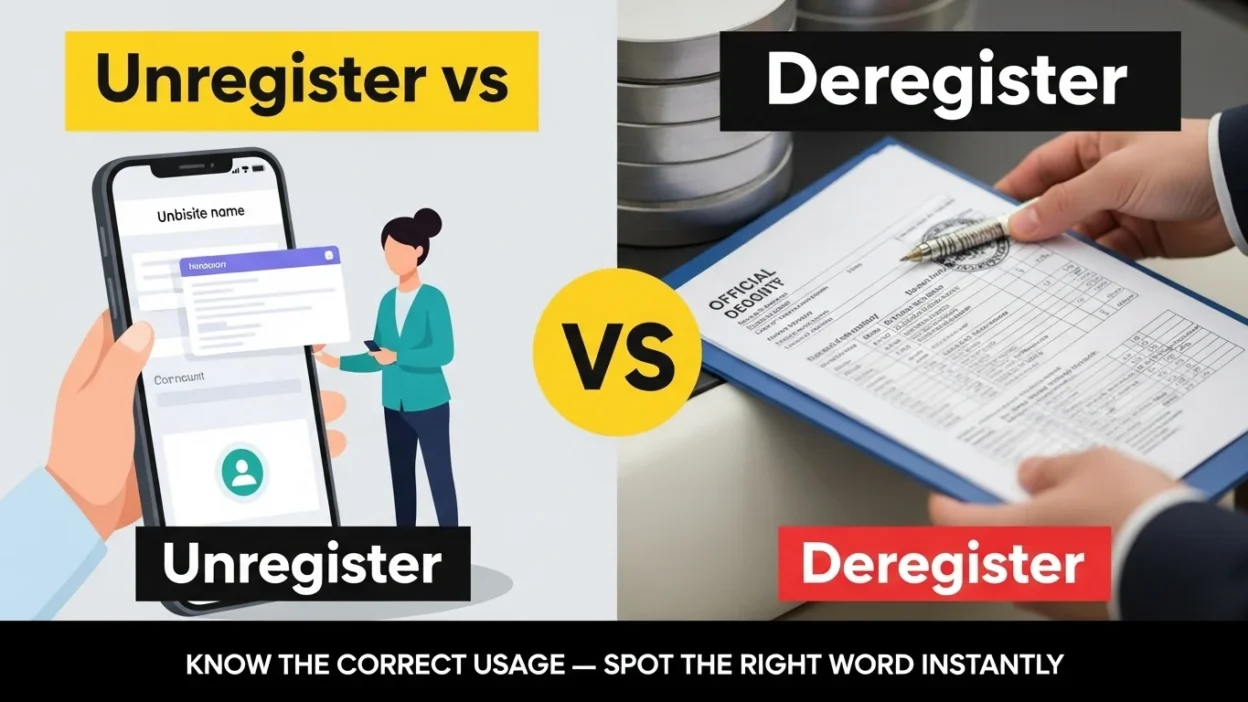
Understanding the difference between unregister vs deregister can be confusing because both words relate to removing something from a list or system. Many people assume they are interchangeable, but in real-world usage especially in legal, technical, and administrative contexts there are subtle differences.
If you’ve ever tried to cancel a service, remove a device from a system, or legally close a business, you might have seen both terms used. Knowing which one fits the situation helps you communicate clearly and professionally. This guide explains their meanings, examples, mistakes to avoid, and how to choose the correct word.
Quick Answer
Unregister and deregister both mean removing something from an official register or system.
- Unregister is more common in technology and general usage.
- Deregister is often used in legal, administrative, or formal contexts, such as business or vehicles.
In simple terms:
- Use unregister for accounts, devices, or software.
- Use deregister for organizations, vehicles, or legal records.
What Does “Unregister” Mean?
Unregister means to remove something from a system, database, or digital service where it was previously registered.
It is frequently used in technology, apps, and online services.
Common contexts for unregister
- Removing a device from a system
- Canceling an account
- Deleting a product registration
- Removing a user from software
Examples of unregister
- I decided to unregister my phone from the security app.
- Please unregister your device before selling it.
- She had to unregister from the webinar because of a schedule conflict.
- The user forgot to unregister the old email account.
Key idea
The word unregister focuses on removing something from a digital or service-based registry.
What Does “Deregister” Mean?
Deregister means to officially remove something from a formal or legal register maintained by an authority.
It is commonly used in government, legal, business, and administrative contexts.
Common contexts for deregister
- Closing a business
- Removing a vehicle from a national registry
- Canceling a company registration
- Ending official legal recognition
Examples of deregister
- The company decided to deregister the business after liquidation.
- You must deregister the vehicle before exporting it.
- The organization was deregistered by the regulatory authority.
- The charity failed to comply and was deregistered.
Key idea
Deregister usually involves official authorities or legal records.
Unregister vs Deregister: Key Differences
Although both terms relate to removing something from a register, the context in which they are used is different.
| Feature | Unregister | Deregister |
| Primary Use | Technology and digital systems | Legal or administrative systems |
| Context | Apps, devices, accounts | Businesses, vehicles, organizations |
| Formality | Less formal | More formal |
| Authority Involved | Usually user-controlled | Often government or official body |
| Common Example | Unregister a device | Deregister a company |
Simple way to remember
- Unregister → user or software action
- Deregister → official or legal action
When to Use Unregister
Use unregister when the action involves removing something from a system or platform, usually controlled by the user.
Typical situations
- Removing a device from an app
- Canceling a webinar registration
- Deleting a software license
- Opting out of a digital platform
Example sentences
- Make sure to unregister your account before deleting the app.
- He forgot to unregister the device from the network.
- Students can unregister from the course online.
When to Use Deregister
Use deregister when the action involves official removal from a government or institutional record.
Typical situations
- Closing a company
- Removing a vehicle from a national registry
- Canceling a trademark registration
- Removing an organization from a legal database
Example sentences
- They chose to deregister the corporation after restructuring.
- The car must be deregistered before it can be scrapped.
- Authorities may deregister companies that fail compliance checks.
American vs British English Usage
Both American English and British English use unregister and deregister, but their frequency differs slightly.
American English
- Unregister is common in technology and user interfaces.
- Deregister is used in legal or governmental contexts.
British English
- Deregister appears more often in official contexts like VAT deregistration or vehicle registration.
- Unregister still appears in digital environments.
In most cases, the meaning remains the same in both varieties of English.
Common Mistakes with Unregister and Deregister
Many writers misuse these words because their meanings overlap. Here are the most common mistakes.
1. Using deregister for simple app actions
❌ Incorrect
Please deregister your email from the newsletter.
✅ Correct
Please unregister your email from the newsletter.
2. Using unregister for legal processes
❌ Incorrect
The company decided to unregister the business legally.
✅ Correct
The company decided to deregister the business.
3. Assuming both words always mean exactly the same
While they share a similar idea, context determines the correct choice.
Quick tip
If government or legal authority is involved → deregister
If it’s technology or user action → unregister
Related Words and Synonyms
Understanding related terms can also help clarify usage.
Similar words
- Remove from registry
- Cancel registration
- Opt out
- Withdraw registration
- Deactivate account
- Terminate registration
LSI keywords related to unregister vs deregister
- cancel registration
- remove from register
- deregister a company
- unregister device
- registration cancellation
- delete registration record
These phrases appear frequently in technical documentation, legal guides, and user manuals.
Real-World Examples
Here are real-world scenarios showing how the words differ.
Example 1: Technology
You bought a new phone and want to remove the old one from your account.
Correct usage:
Unregister the old device from the system.
Example 2: Business
A company stops operating and files paperwork with the government.
Correct usage:
Deregister the company.
Example 3: Webinar
A participant decides not to attend.
Correct usage:
Unregister from the event.
Example 4: Vehicle ownership
A car is exported to another country.
Correct usage:
Deregister the vehicle from the national registry.
FAQs
1. Are unregister and deregister the same?
They are similar but not identical. Unregister usually refers to removing something from a digital system, while deregister often involves official or legal removal from a registry.
2. Which word is more formal?
Deregister is generally more formal and commonly used in legal or administrative settings.
3. Can I use unregister for a business?
Not usually. Businesses are typically deregistered, not unregistered, because the process involves government records.
4. Is deregister used in technology?
Yes, but less often. Technology platforms typically use unregister instead.
5. What is deregistration?
Deregistration is the noun form of deregister and refers to the official process of removing something from a register.
6. What is the noun form of unregister?
The noun form is unregistration, although it is less commonly used than deregistration.
7. Do both words mean cancel registration?
Yes, both can mean canceling registration, but the context determines the appropriate term.
8. Which word should I use in writing?
Use unregister for digital or personal actions, and deregister for legal or official processes.
Summary
The difference between unregister vs deregister mainly lies in context and formality. Both words involve removing something from a register, but unregister is commonly used in digital or user-controlled systems, while deregister is typically used in legal, governmental, or administrative settings.
Understanding this distinction improves clarity in writing and communication. When the action involves an app, account, device, or event, the correct choice is usually unregister. When the action involves official records, businesses, vehicles, or organizations, deregister is the better term.
Actionable Takeaway
Whenever you’re unsure which word to use, ask yourself one simple question: Is this an official legal record or just a system account? If it’s a system or platform, choose unregister. If it involves authorities, regulations, or formal documentation, choose deregister.
By remembering this rule, you can confidently use the correct term in emails, documentation, articles, and professional communication.