If you’ve ever paused mid-sentence wondering whether to write unalienable or inalienable, you’re not alone. These two words look nearly identical, sound similar, and are often used interchangeably yet they carry subtle historical and stylistic differences that matter, especially in formal or legal writing.
In this guide, you’ll get a clear, no-confusion breakdown of unalienable vs inalienable, including meanings, examples, common mistakes, and when to use each word confidently. By the end, you’ll know exactly which one fits your context and why.
Quick Answer
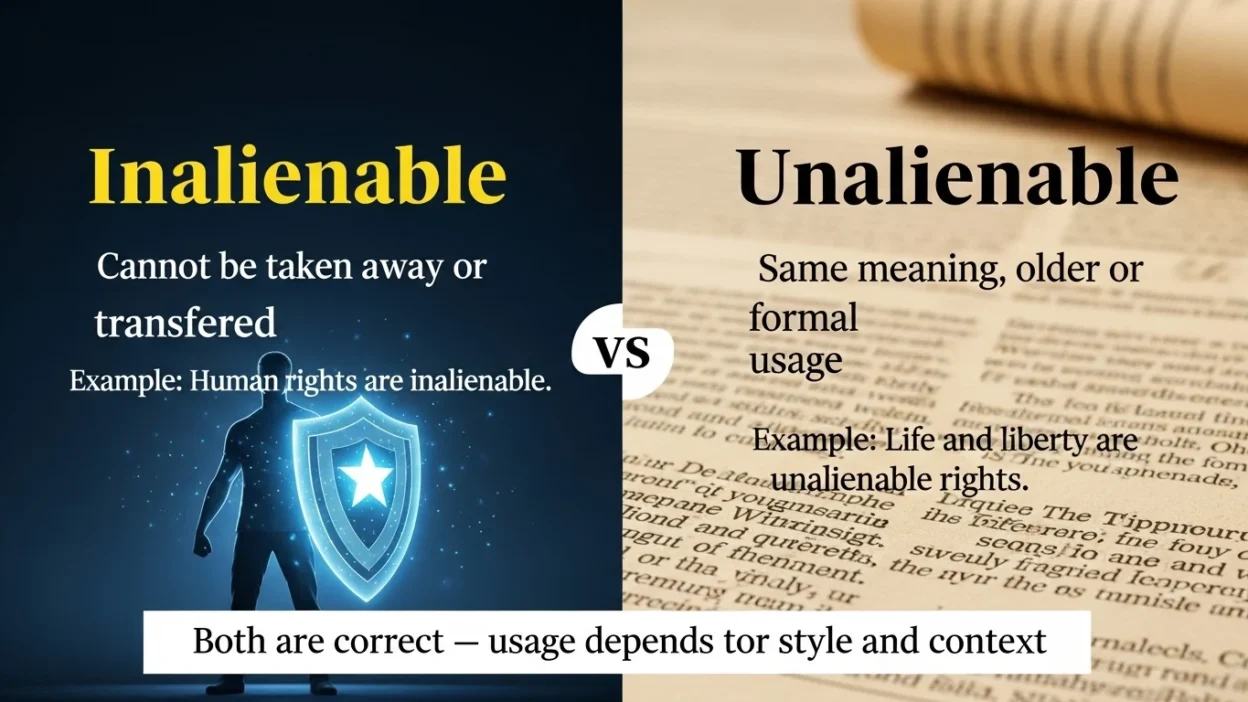
Both unalienable and inalienable mean the same thing: something that cannot be taken away, transferred, or denied.
- Unalienable → Traditionally used in historical or philosophical contexts (e.g., U.S. founding documents)
- Inalienable → More commonly used in modern English, especially in legal and formal writing
In most cases, you can use either but inalienable is preferred today.
Meaning of Unalienable vs Inalienable
At their core, both words describe rights or qualities that are permanent and cannot be removed.
What Does “Unalienable” Mean?
Unalienable refers to something that cannot be given away or taken away. It’s strongly tied to natural rights those believed to be inherent to all humans.
- Often seen in historical texts
- Carries a slightly more philosophical or traditional tone
Example:
- “All people are born with unalienable rights.”
What Does “Inalienable” Mean?
Inalienable has the exact same definition but is more widely used in modern English.
- Common in legal, academic, and general writing
- Considered the standard form today
Example:
- “Freedom is an inalienable human right.”
Key Difference Between Unalienable and Inalienable
The difference is more about usage and style than meaning.
| Aspect | Unalienable | Inalienable |
| Meaning | Cannot be taken away | Cannot be taken away |
| Usage | Historical, philosophical | Modern, general use |
| Popularity | Less common | More common |
| Tone | Formal, traditional | Neutral, widely accepted |
Simple takeaway:
- Use inalienable for everyday writing
- Use unalienable for historical or stylistic emphasis
Real-Life Examples
Seeing both words in context makes the difference clearer.
Using “Unalienable”
- “The document emphasized unalienable rights granted to all individuals.”
- “Life and liberty are unalienable values.”
Using “Inalienable”
- “Education is an inalienable right for every child.”
- “Human dignity is inalienable and must be respected.”
Common Mistakes to Avoid
Even experienced writers sometimes misuse these words. Here are the most common pitfalls:
1. Thinking They Have Different Meanings
They don’t. The meaning is identical only usage differs.
2. Using “Unalienable” in Casual Writing
While not wrong, it can sound overly formal or outdated.
✔ Better: “inalienable rights” in blogs, articles, and emails
3. Mixing Tone Inconsistently
Switching between both words in the same piece can confuse readers.
✔ Stick to one form throughout your content
4. Assuming One Is Incorrect
Both are correct English words. One is just more common today.
American vs British English Differences
Interestingly, there is no major difference between American and British English when it comes to these terms.
- Inalienable → Preferred in both US and UK
- Unalienable → Rare but still understood globally
However, in American historical contexts, unalienable appears more often due to its traditional use in foundational texts.
When Should You Use Each Word?
Here’s a practical guide to help you decide quickly:
Use “Inalienable” When:
- Writing blog posts or articles
- Creating academic or legal content
- Communicating with a general audience
- You want clarity and modern tone
Use “Unalienable” When:
- Referencing historical documents
- Writing philosophical or classical content
- You want a formal or traditional feel
Why Do Two Words Exist for the Same Meaning?
This comes down to language evolution.
Both words formed using different prefixes:
- “un-” = not
- “in-” = not
Over time, English adopted both forms, but usage shifted. Modern English favors inalienable, while unalienable remains tied to tradition.
Related Words and Synonyms (LSI Keywords)
To strengthen your understanding and SEO relevance, here are closely related terms:
- inherent rights
- natural rights
- fundamental rights
- non-transferable
- irrevocable
- permanent rights
- absolute rights
Using these variations can make your writing richer and more natural.
FAQs
1. Are unalienable and inalienable interchangeable?
Yes, they have the same meaning and can usually be used interchangeably, though inalienable is more common today.
2. Which word is more correct?
Both are correct, but inalienable is preferred in modern English.
3. Why is “unalienable” still used?
It’s mainly preserved in historical, philosophical, and traditional contexts.
4. Is “inalienable” used in legal writing?
Yes, it is widely used in legal and academic texts.
5. Does using “unalienable” sound outdated?
In casual or modern writing, it can sound slightly formal or old-fashioned.
6. Can I use both words in the same article?
It’s better to stick to one for consistency unless you’re comparing them.
7. Are there spelling differences in British English?
No, both forms are spelled the same in British and American English.
Summary
The debate around unalienable vs inalienable is less about meaning and more about context. Both words describe something that cannot be taken away, making them equally correct.
However, inalienable has become the standard choice in modern English, while unalienable retains a more traditional and historical flavor.
If you want your writing to feel current, clear, and widely understood, go with inalienable. But if you’re referencing classical ideas or aiming for a timeless tone, unalienable can add that extra depth.
Understanding this subtle distinction helps you write with precision and confidence.
Actionable Takeaway
- Use inalienable in most modern writing
- Reserve unalienable for historical or stylistic contexts
- Stay consistent within your content
- Choose based on tone, audience, and purpose
Mastering small differences like this can elevate your writing and make your content more professional and trustworthy.