If you’ve ever paused mid-sentence wondering whether to write too or to, you’re not alone. These two tiny words look similar, sound identical, and confuse even confident writers.
The good news? Once you understand the difference, choosing the right one becomes quick and automatic.
In this friendly, easy-to-follow guide, you’ll learn exactly when to use too vs to, how to avoid common mistakes, and simple memory tricks to make the correct choice every time.
Let’s clear the confusion once and for all.
Quick Answer:
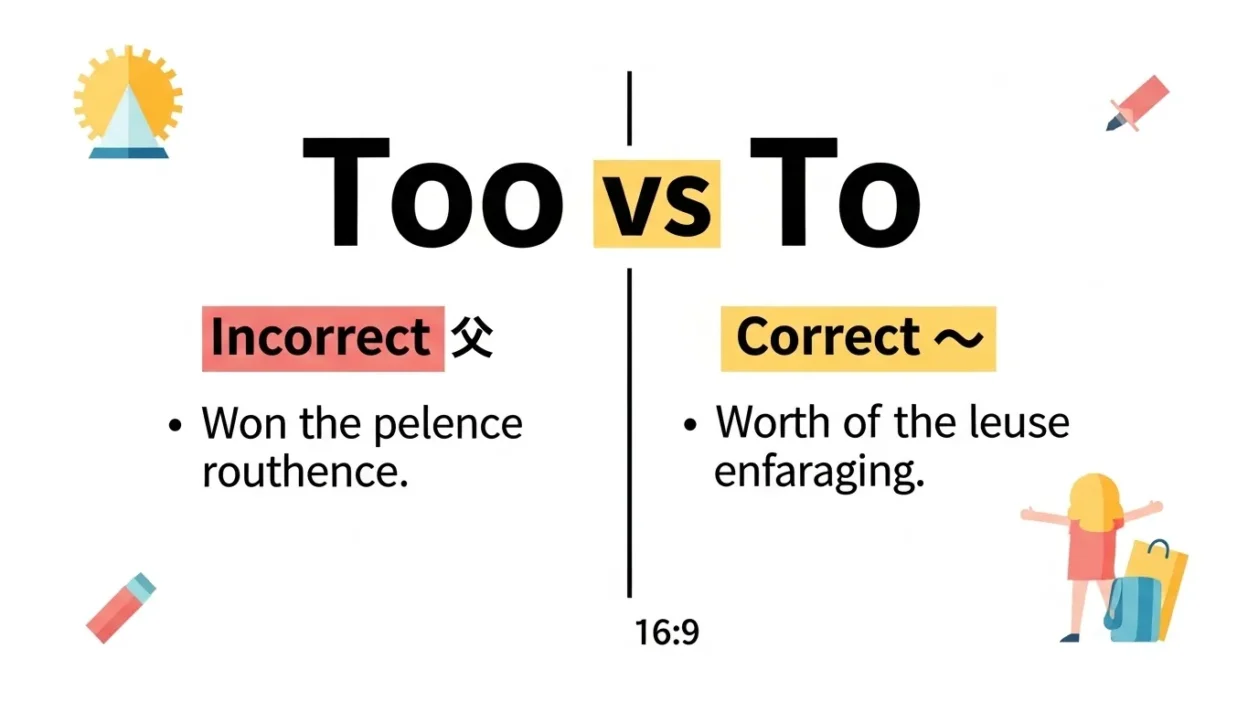
- To = direction, purpose, or part of a verb (e.g., go to school, want to eat).
- Too = also or excessively (e.g., I want pizza too, too hot).
If you can replace the word with “also” or “very/excessively,” use it too. Otherwise, it’s usually too.
What Does “To” Mean?
To is one of the most commonly used words in English. It has several grammatical roles:
1. Shows direction or movement
- She walked to the store.
- Send this letter to John.
2. Forms infinitive verbs
- I want to learn.
- They plan to travel.
3. Indicates relationship or range
- It’s ten to six.
- This belongs to me.
Helpful tip: If the word connects something or leads somewhere (physically or grammatically), it’s almost always to.
What Does “Too” Mean?
Too has a much narrower meaning, which makes it easier to identify once you know what to look for.
1. Means “also” or “as well”
- I want coffee too.
- She’s coming too.
2. Means “more than enough” or “excessively”
- This bag is too heavy.
- You’re speaking too fast.
Memory trick: The extra “o” in too = extra meaning (also or excessively).
Key Differences Between Too and To
| Word | Function | Meaning | Example |
| To | Preposition / infinitive marker | Direction, purpose, relation | She wants to dance. |
| Too | Adverb | Also or excessively | I want cake too. |
| To | Connector | Links verbs or objects | Give it to him. |
| Too | Intensifier | More than needed | Too loud to sleep. |
Examples in Everyday Sentences
Seeing words in context makes the difference much clearer.
Using “To” correctly
- I’m going to call her.
- He handed the keys to me.
- We need to leave now.
Using “Too” correctly
- I’m tired too.
- It’s too cold outside.
- That movie was too long.
Mixed examples
- I want to go too.
- She was too tired to drive.
Notice how both words can appear in the same sentence with completely different functions.
Common Mistakes People Make
Even experienced writers mix them up sometimes. Here are the most frequent errors and how to fix them.
Mistake #1: Using “to” instead of “too” for “also”
❌ I want pizza to.
✅ I want pizza too.
Mistake #2: Using “too” when showing direction
❌ She went too the store.
✅ She went to the store.
Mistake #3: Overusing “too” for emphasis
❌ I am too excited (when you mean just excited).
✅ I am very excited.
Mistake #4: Forgetting “too” implies excess
If you say too loud, it means louder than acceptable, not just loud.
Easy Memory Tricks
If grammar rules feel overwhelming, these quick tricks help instantly.
- Extra O trick: Too has an extra “o,” meaning extra or also.
- Replace test: If “also” works, use too.
- Verb test: If a verb follows, it’s usually to (e.g., to run, to eat).
Too vs To in Questions
Questions often confuse learners because both words can appear naturally.
- Do you want to come?
- Are you coming too?
- Is it too late to call?
Tip: Identify whether the word shows direction/action (to) or emphasis/addition (too).
Formal vs Informal Usage
There is no difference between American and British English in the meanings or spelling of too vs to. Both varieties use them identically in grammar and writing.
However, stylistic preferences differ:
- Informal writing may be used too often for emphasis.
- Formal writing may replace it with also, excessively, or as well for clarity.
Example:
- Informal: I’m tired too.
- Formal: I am tired as well.
Related Words Often Confused
Writers frequently mix these up with similar-sounding words:
- Two – the number 2
- Too – also/excessively
- To – direction or verb marker
Example:
I have two dogs, and I love them too.
Practice Sentences (Try Yourself)
Fill in the blank with to or too:
- I want ___ travel.
- It’s ___ bright outside.
- She gave it ___ me.
- I’m coming ___.
Answers: to, too, to, too
When Both Words Appear Together
Some sentences naturally require both words.
- It’s too late to apologize.
- She’s too young to drive.
- I want to go too.
Understanding their roles makes these sentences easy to write correctly.
Why This Confusion Happens
English contains many homophones that sound the same but have different meanings. Because to and too sound identical in speech, people rely on context rather than pronunciation.
This confusion is especially common when:
- Typing quickly
- Writing informally
- Learning English as a second language
The solution isn’t memorization alone, it’s understanding function.
FAQs
1. Is “me too” correct or should it be “me to”?
Always me too, because it means me also.
2. Can “too” start a sentence?
Yes. Example: Too many people ignore grammar basics.
3. Is it wrong to end a sentence with “too”?
No. Ending with too is grammatically correct and natural.
4. How do I quickly check which word to use?
Replace it with also or very. If it still makes sense, use it too.
5. Do professional writers still confuse them?
Occasionally especially in fast typing but editors usually catch it.
6. Is “too much” different from “very much”?
Yes. Too much means excessive; very much just means a lot.
7. Why is “to” used before verbs?
Because it forms the infinitive, the base verb structure in English.
8. Which is more common, to or too?
To is far more common because it serves multiple grammatical roles.
Summary
Understanding too vs to is less about memorizing rules and more about recognizing purpose. To connect ideas, shows direction, or forms verbs, while too adds meaning either also or excessively.
Once you link each word to its function, mistakes become rare and easy to spot.
The best way to master them is practice and awareness. Read your sentences aloud, test substitutions, and use the memory tricks above.
With just a little attention, you’ll write with clarity, confidence, and zero hesitation when choosing between too and to.
Actionable takeaway:
Next time you write, pause for one second and ask: Do I mean also/excessively or direction/action? That single question guarantees you pick the correct word every time.