Have you ever paused mid-text wondering whether to write “to bad” or “too bad”? You’re not alone. This tiny spelling difference causes big confusion especially in casual writing, emails, and social media posts.
The good news? The rule is simple once you understand it.
In this friendly, easy-to-follow guide, you’ll learn the correct usage, real-life examples, common mistakes to avoid, and even how American and British English treat these words.
Let’s clear it up for good.
Quick Answer:
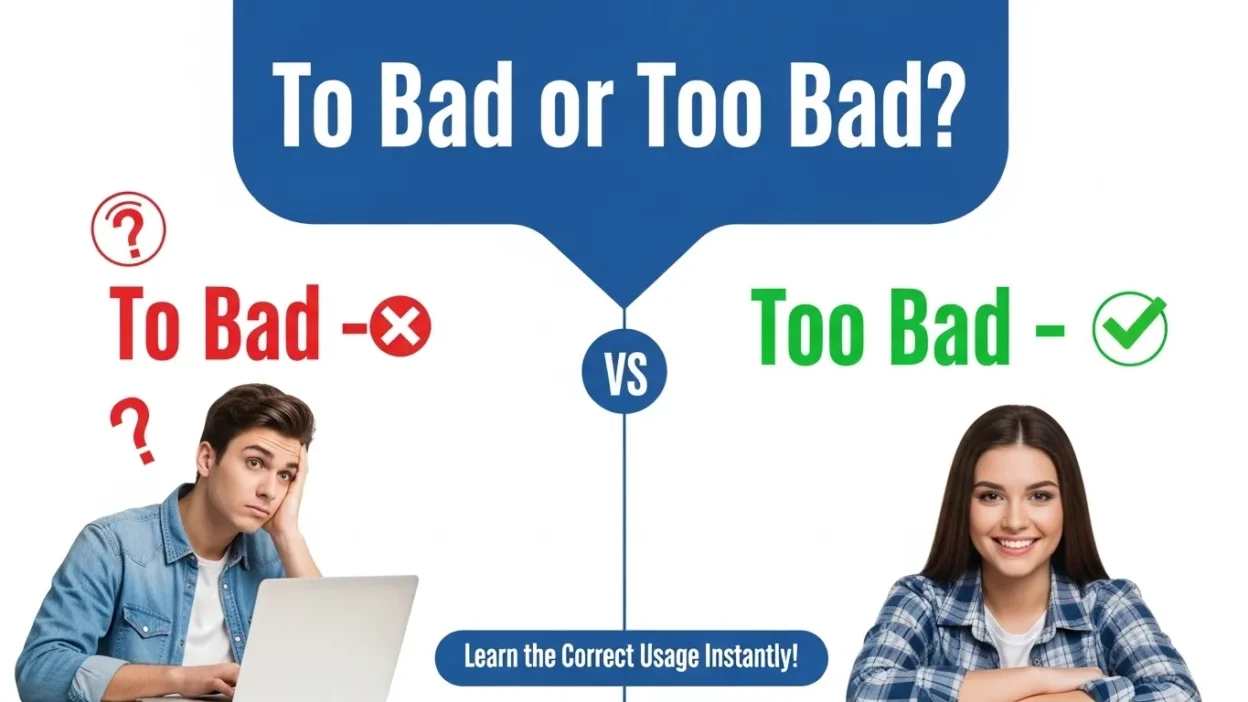
“Too bad” is correct.
“Too bad” means unfortunate, regrettable, or expresses mild sympathy.
❌ To bad – Incorrect
✅ Too bad – Correct
Example:
- It’s too bad you can’t come to the party.
- That’s too bad we missed the train.
If you remember that “too” often means “excessively” or “also,” you’ll avoid this mistake easily.
What Does “Too Bad” Mean?
“Too bad” is a common English expression used to:
- Show sympathy
- Express disappointment
- Indicate something unfortunate
- Sometimes show mild indifference
It works as an informal phrase in conversations and writing.
1. Expressing Sympathy
When someone shares disappointing news:
- “I failed my test.”
- “Oh, that’s too bad. I’m sorry to hear that.”
2. Showing Disappointment
- It’s too bad the weather ruined our picnic.
- That’s too bad you didn’t get the job.
3. Expressing Mild Indifference (Tone Matters!)
Sometimes, “too bad” can sound slightly dismissive:
- You didn’t study? Too bad.
Tone changes everything. In writing, context helps avoid sounding insensitive.
Why “To Bad” Is Incorrect
“To” is a preposition or part of an infinitive verb.
Examples of correct “to” usage:
- I want to go home.
- She gave the gift to him.
But “to bad” does not form a grammatically correct phrase in standard English. It’s simply a spelling mistake caused by confusing “to” and “too.”
This is similar to other commonly confused words like:
- your vs. you’re
- their vs. there vs. they’re
- affect vs. effect
Small differences, big impact.
The Difference Between “To” and “Too”
Understanding the difference makes everything easier.
| Word | Meaning | Example |
| To | Shows direction or part of verb | I’m going to school. |
| Too | Means “also” or “excessively” | It’s too hot. |
| Too (in “too bad”) | Means “excessively” or intensifies “bad” | That’s too bad. |
Think of it this way:
If you can replace it with “very” or “excessively,” you probably need too.
Example:
- That’s very bad.
- That’s too bad.
Real-Life Examples of “Too Bad”
Here are practical sentence examples you can relate to:
Casual Conversation
- It’s too bad we can’t meet today.
- That’s too bad your phone broke.
- Too bad! Maybe next time.
Workplace Writing
- It’s too bad the client declined the proposal.
- That’s too bad we missed the deadline.
Academic Writing (Informal Contexts)
While “too bad” is slightly informal, it may appear in reflective or narrative writing:
- It’s too bad the opportunity was overlooked.
In formal writing, alternatives like “unfortunate,” “regrettable,” or “disappointing” are often preferred.
Common Mistakes to Avoid
Even confident English speakers slip up. Here are the most common errors:
❌ Writing “To Bad” in Text Messages
Autocorrect sometimes misses this. Always double-check.
❌ Confusing “Too” with “Very”
While “too” can mean “very,” it often implies excess.
- It’s very cold. (Neutral)
- It’s too cold. (Colder than desired)
In “too bad,” it expresses emotional emphasis rather than literal excess.
❌ Using “Too Bad” in Very Formal Writing
In academic essays or professional reports, consider:
- “It is unfortunate that…”
- “It is regrettable that…”
American vs British English: Any Difference?
Good news there is no difference between American and British English in this case.
Both in the United States and the United Kingdom:
- “Too bad” is correct.
- “To bad” is incorrect.
Whether you’re writing in American English or British English, the spelling rule remains exactly the same.
Synonyms and Similar Expressions
If you want variety in your writing, here are alternatives to “too bad”:
- That’s unfortunate
- What a shame
- That’s disappointing
- Sadly
- Regrettably
- That’s a pity
- Tough luck (informal)
Each phrase carries slightly different emotional weight, so choose carefully.
When “Too Bad” Can Sound Rude
Tone matters.
Compare these:
Empathetic:
- I’m really sorry. That’s too bad.
Dismissive:
- You forgot your homework? Too bad.
If you want to sound warm and kind, add supportive language:
- That’s too bad. I hope things get better soon.
- That’s too bad. Let me know if I can help.
Context and compassion make a big difference.
Memory Trick to Remember the Rule
Here’s an easy tip:
“Too” has an extra ‘o’ just like it has extra meaning.
If you’re expressing something excessive, emotional, or additional, use too.
“Too bad” carries emotional weight so it needs the extra “o.”
FAQs
1. Is “to bad” ever correct?
No. “To bad” is grammatically incorrect in standard English.
2. What does “too bad” mean in slang?
It usually means something is unfortunate. In some contexts, it may imply indifference depending on tone.
3. Can I use “too bad” in formal writing?
It’s better suited for informal writing. In formal contexts, use “unfortunate” or “regrettable.”
4. Why do people confuse “to” and “too”?
They sound identical (homophones), which makes spelling tricky in fast typing or casual writing.
5. Is “too bad” negative?
Not necessarily. It expresses disappointment, but tone determines whether it sounds sympathetic or dismissive.
6. Can “too” mean “also” in other sentences?
Yes. Example:
- I want to come, too.
But in “too bad,” it intensifies the adjective “bad.”
7. Is it grammatically correct to say “that’s too bad”?
Yes. It’s a complete and grammatically correct expression.
8. What part of speech is “too” in “too bad”?
It functions as an adverb modifying the adjective “bad.”
Final Summary:
Let’s make it simple. “Too bad” is correct. “To bad” is always a spelling mistake. The word “too” adds emphasis and expresses something unfortunate, disappointing, or regrettable.
Since “to” is a preposition, it cannot correctly pair with “bad” in this expression.
Whenever you’re unsure, remember the extra “o” trick. If the sentence carries emotion, emphasis, or a sense of excess, you need too.
This small detail instantly improves your grammar, writing clarity, and credibility.
Actionable Takeaway
From now on, pause for one second before typing. Ask yourself:
- Am I expressing disappointment or sympathy?
- Can I replace it with “very bad” or “unfortunate”?
If yes, choose too bad.
Mastering small grammar differences like this strengthens your writing skills and boosts confidence in emails, essays, and everyday communication. Tiny corrections create powerful impressions.

Edward Axel is the administrator of SyntaxlyHub, responsible for overseeing site operations, content management, and technical performance. He ensures accuracy, consistency, and smooth functionality while supporting the team in delivering reliable, high-quality grammar resources and a user-friendly learning experience for readers worldwide.