
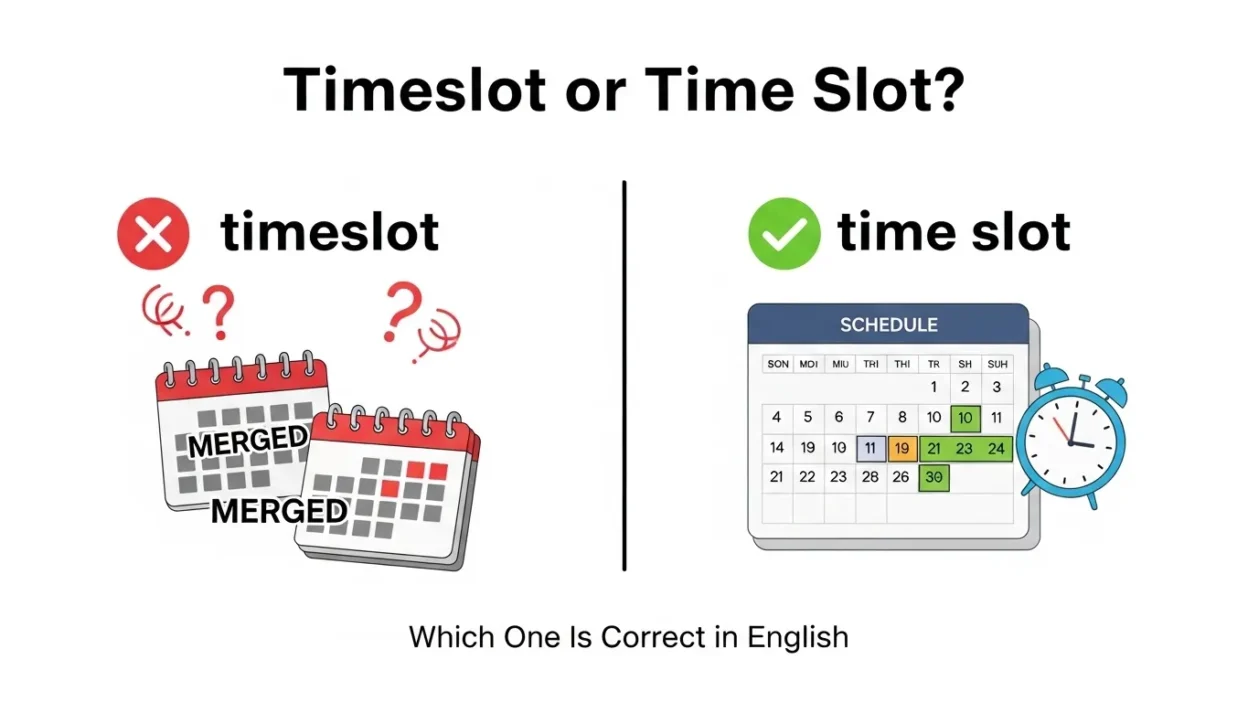
Choosing the correct spelling between time slot and timeslot can be confusing, especially when writing emails, scheduling meetings, or creating professional content.
Many people wonder which version is correct and whether both spellings are acceptable. The good news is that the difference is simple once you understand how the word developed and how modern English uses it.
In this guide, you’ll learn the correct usage, meanings, examples, and common mistakes so you can confidently use time slot or timeslot in your writing.
Quick Answer
The correct and most widely accepted spelling is time slot (two words).
- Time slot – Standard and widely used in both American and British English.
- Timeslot – Less common; sometimes used informally but generally avoided in formal writing.
If you want to stay safe in professional writing, academic work, or SEO content, use “time slot.”
What Does “Time Slot” Mean?
A time slot refers to a specific period of time reserved for a particular activity, appointment, event, or broadcast.
It is commonly used in contexts like scheduling, television programming, booking systems, and event planning.
Simple Definition
Time slot: A fixed period in a schedule allocated for a particular task or event.
Common Contexts Where It Is Used
- Meeting scheduling
- TV or radio programming
- Online appointment booking
- Event planning
- Classroom timetables
Because scheduling systems are everywhere today from medical appointments to online webinars the term time slot appears frequently in both business and everyday communication.
Examples of “Time Slot” in Sentences
Here are natural examples that show how the term is used in real situations.
- Please choose a time slot for your interview.
- The doctor has an available time slot at 3 PM tomorrow.
- Our presentation is scheduled for the 10:30 time slot.
- The show moved to a prime time slot on Friday night.
- Students must register for their exam time slot online.
In each example, the phrase refers to a specific reserved period of time.
Time Slot vs Timeslot: Key Differences
Although both versions appear online, they are not equally accepted.
| Feature | Time Slot | Timeslot |
| Correctness | Standard and preferred | Less common |
| Word Form | Two words | One word |
| Formal Writing | Recommended | Usually avoided |
| Dictionaries | Recognized widely | Sometimes listed as variant |
| Usage Frequency | Very common | Relatively rare |
Key Insight
Modern English tends to keep this phrase as two separate words, especially in formal or professional contexts.
American vs British English Usage
Unlike some spelling differences in English (like color vs colour), time slot does not significantly change between American and British English.
American English
The standard spelling is time slot, and it is the most commonly used form in business, technology, and media.
British English
British English also primarily uses time slot. The single-word version timeslot may occasionally appear in informal contexts, but it is still much less common.
So regardless of whether you write in American or British English, time slot is the safest and most accepted option.
Why People Sometimes Write “Timeslot”
There are a few reasons why the single-word version appears.
1. Word Combination Trend
English often merges phrases over time (for example: web site → website). Some writers assume time slot has already followed that pattern.
2. Fast Digital Writing
In informal writing like chat messages or quick emails, people sometimes combine words unintentionally.
3. Software Interfaces
Some apps or booking platforms occasionally display timeslot, which spreads the variant spelling.
However, most professional editors still recommend time slot.
Common Mistakes to Avoid
Even though the term is simple, writers often make small errors when using it.
Mistake 1: Writing “Timeslot” in Formal Documents
Incorrect:
- Please select your timeslot for the meeting.
Better:
- Please select your time slot for the meeting.
Mistake 2: Confusing It With “Timeline”
A time slot refers to a specific period, while a timeline shows a sequence of events over time.
Mistake 3: Using It Without Context
Avoid vague statements.
Weak:
- Choose a time slot.
Better:
- Choose a 30-minute time slot for your consultation.
Adding details makes scheduling clearer.
Situations Where “Time Slot” Is Commonly Used
The phrase appears across many industries and daily activities.
1. Appointment Booking
Doctors, consultants, and service providers often organize schedules using time slots.
Example:
- Each patient receives a 20-minute time slot.
2. Television and Media
Broadcast networks organize shows according to time slots.
Example:
- The show moved to a prime-time slot.
3. Event Scheduling
Conferences and workshops use time slots to organize sessions.
Example:
- Select your workshop time slot during registration.
4. Online Scheduling Tools
Apps like booking systems or calendar tools rely on time slots to prevent schedule conflicts.
Example:
- Available time slots appear in green.
Synonyms and Related Terms
If you want variety in writing, you can use related expressions depending on context.
Common alternatives include:
- Scheduled period
- Appointment window
- Time window
- Scheduled block
- Allocated time
However, none of these replace time slot exactly in every context, especially when referring to scheduling systems.
FAQs
1. Is “timeslot” a real word?
Yes, it sometimes appears as a variant spelling, but it is not the preferred standard form. Most professional writing uses a time slot.
2. Which spelling should I use in formal writing?
Always use a time slot. It is widely accepted and recognized in both American and British English.
3. Is “time-slot” with a hyphen correct?
Hyphenated forms occasionally appear, especially as adjectives (e.g., time-slot booking system), but time slot without a hyphen are most common.
4. What is a prime time slot?
A prime time slot refers to a period when the largest audience is expected, especially on television or streaming platforms.
5. Can “time slot” be used in business communication?
Yes. It is widely used in emails, meeting invitations, booking systems, and professional scheduling.
6. Is “time slot” one word in the future?
Language evolves, so it’s possible. However, major dictionaries and style guides still recommend two words.
7. What is another word for time slot?
Common alternatives include time window, scheduled block, or appointment window, depending on context.
Summary
The spelling time slot is the standard and widely accepted form in modern English. It refers to a specific period reserved for an activity, appointment, broadcast, or event.
While the variant timeslot occasionally appears online, it is less common and generally avoided in formal or professional writing. If you’re scheduling meetings, managing appointments, or writing content, using a timeslot ensures clarity and consistency.
It works equally well in both American and British English and is recognized across industries such as business, media, education, and technology.
Actionable Takeaway
Whenever you need to refer to a scheduled period, write the timeslot as two words. This keeps your writing professional, grammatically correct, and aligned with modern usage standards.
If you’re creating content, emails, or booking systems, consistently using time slots will improve both readability and credibility.