Choosing the right phrase to express gratitude can feel surprisingly tricky. If you’ve ever paused before writing “thank you both” or “thanks to both of you,” you’re not alone.
These two expressions look similar, but they serve slightly different purposes, tones, and contexts.
In this guide, you’ll learn exactly when to use thank you both vs thanks to both of you, with simple explanations, real-life examples, common mistakes, and expert language tips.
By the end, you’ll confidently know which phrase fits your situation perfectly.
Quick Answer
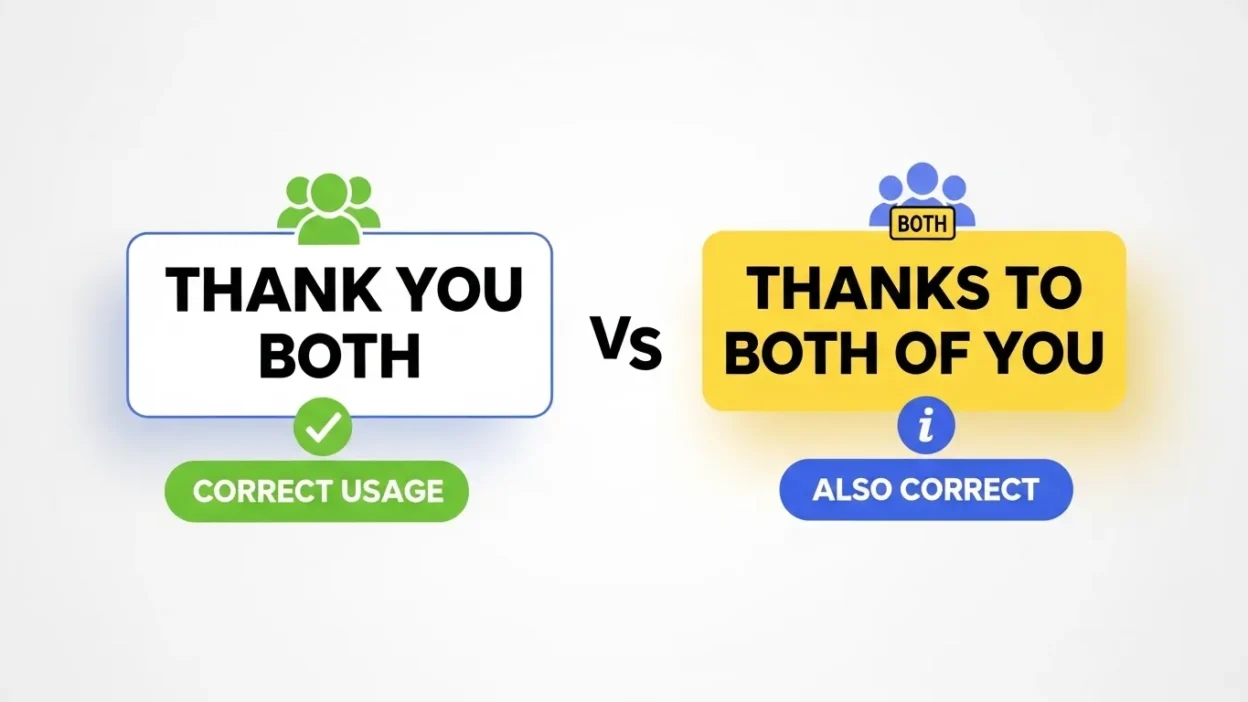
“Thank you both” is a direct expression of gratitude addressed to two people.
“Thanks to both of you” usually introduces a reason or explanation for a positive outcome caused by those two people.
Example:
- Thank you both for helping me move. ✔ (direct gratitude)
- Thanks to both of you, the project succeeded. ✔ (shows cause/result)
Meaning of “Thank You Both”
“Thank you both” is a polite, straightforward way to express appreciation to two people at the same time. It’s concise, warm, and commonly used in both formal and informal English.
It functions as a complete sentence or a standalone phrase, making it perfect for emails, speeches, messages, or conversations.
Tone: direct, personal, appreciative
Purpose: express gratitude
Examples:
- Thank you both for your support.
- Thank you both for attending.
- I truly appreciate it thank you both.
It’s often followed by a reason beginning with for:
- Thank you both for your patience.
- Thank you both for your guidance.
Meaning of “Thanks to Both of You”
“Thanks to both of you” is slightly different. Instead of directly thanking someone, it introduces a cause or explanation. It suggests that something positive happened because of those two people.
Tone: explanatory, reflective
Purpose: show credit or attribution
Examples:
- Thanks to both of you, I passed the exam.
- The event was successful thanks to both of you.
- Thanks to both of you, we finished early.
Notice how the phrase usually connects to a result clause. It often appears at the beginning or middle of a sentence rather than alone.
Key Difference Between the Two Phrases
The core difference lies in function:
| Phrase | Function | Grammar Role | Example |
| Thank you both | Direct gratitude | Complete expression | Thank you both for coming. |
| Thanks to both of you | Cause or credit | Prepositional phrase | Thanks to both of you, we won. |
Think of it this way:
- If you’re speaking to two people → use thank you both
- If you’re explaining a result because of two people → use thanks to both of you
When to Use “Thank You Both”
Use this phrase when your main goal is appreciation. It works well in nearly all contexts:
Formal situations
- Business emails
- Presentations
- Professional acknowledgments
Informal situations
- Text messages
- Conversations
- Social media comments
Example uses:
- Thank you both for your quick response.
- Thank you both for the lovely gift.
- Thank you both for being there when I needed support.
It’s ideal when you want your message to feel sincere, warm, and personal.
When to Use “Thanks to Both of You”
Use this phrase when describing how two people contributed to an outcome. It emphasizes their role in achieving something.
Best contexts:
- Giving credit
- Writing acknowledgments
- Explaining success
- Highlighting teamwork
Examples:
- Thanks to both of you, the deadline was met.
- The presentation went smoothly thanks to both of you.
- I’m more confident now thanks to both of you.
It subtly shifts focus from gratitude to results.
Tone and Formality Differences
Although both phrases are polite, they differ slightly in tone.
- Thank you both → warmer, more personal
- Thanks to both of you → more explanatory and sometimes more formal
If you’re unsure which to choose in a professional setting, “thank you both” is generally safer because it’s universally appropriate.
American vs British English Usage
There’s no significant difference between American and British English for these phrases. Both are standard and widely understood across dialects.
However, there is a small stylistic tendency:
- American English sometimes prefers shorter expressions like “thanks, both” in casual speech.
- British English speakers may use slightly more formal constructions in writing, such as “many thanks to both of you.”
These are stylistic preferences, not grammatical rules.
Common Mistakes to Avoid
Even fluent English speakers occasionally misuse these phrases. Here are typical errors and corrections:
1. Using the wrong phrase for the context
❌ Thanks to both of you for your help.
✔ Thank you both for your help.
Why? Because the sentence is expressing gratitude, not cause.
2. Using “thank to both of you”
❌ Thank to both of you.
✔ Thanks to both of you.
“Thanks to” is a fixed expression and must include the “s.”
3. Overusing “thanks to” in direct speech
Saying “Thanks to both of you!” directly to people sounds slightly awkward. Use “Thank you both!” instead.
4. Redundancy
❌ Thank you to both of you both.
✔ Thank you both.
✔ Thank you to both of you.
Avoid doubling “both.”
Simple Memory Trick
Use this quick rule:
Direct gratitude → thank you both
Credit or result → thanks to both of you
If your sentence can end after the phrase, choose thank you both.
If it must continue to explain something, choose thanks to both of you.
Synonyms and Related Phrases
To keep your writing natural and varied, you can use alternatives:
Instead of “Thank you both”
- I appreciate you both.
- My thanks to both of you.
- I’m grateful to you both.
- Many thanks to you both.
Instead of “Thanks to both of you”
- Because of both of you
- Owing to both of you
- Due to both of you
- With both of your help
Using synonyms improves clarity, tone variation, and readability especially in professional or academic writing.
Real-Life Usage Examples
Here are natural sentences showing correct usage in everyday contexts:
Workplace
- Thank you both for preparing the report.
- The client was impressed thanks to both of you.
Friendship
- Thank you both for supporting me yesterday.
- I finally solved it thanks to both of you.
Academic
- Thank you both for your guidance on my thesis.
- I completed my research successfully thanks to both of you.
FAQ Section
1. Is “thank you both” grammatically correct?
Yes. It’s fully correct and commonly used in spoken and written English.
2. Can I say “thanks to both of you” as a standalone sentence?
Grammatically yes, but it sounds incomplete unless the result is understood. It’s usually followed by a clause.
3. Which is more polite?
Both are polite, but thank you both feel warmer and more direct.
4. Can I use these phrases in professional emails?
Yes. “Thank you both” is especially appropriate in business communication.
5. Is “thanks to both of you” formal or informal?
It works in both contexts but often appears in semi-formal or written explanations.
6. Can I replace “both of you” with names?
Yes. Example: Thank you, Sarah and Ali.
7. What’s the difference between “thank you both” and “thank you to both of you”?
They mean the same thing. The shorter version sounds more natural in conversation.
8. Is it rude to just say “thanks both”?
Not rude, but casual. It’s best used with friends or colleagues, not in formal settings.
Expert Writing Tips for Natural Usage
If you want your English to sound fluent and natural:
- Use thank you both when speaking directly to people.
- Use thanks to both of you when writing explanations or stories.
- Keep tone consistent don’t mix formal and casual phrases in the same sentence.
- When in doubt, choose the simpler structure. Simplicity improves clarity and reader trust.
These small choices significantly improve communication quality and professionalism.
Summary
Understanding the difference between thank you both and thanks to both of you is simple once you know their roles. The first is a direct expression of appreciation addressed to two people.
The second explains that something positive happened because of those two people. While they look similar, they serve distinct grammatical and communicative purposes.
Choosing correctly strengthens your tone, clarity, and confidence in English.
Whether you’re writing an email, giving a speech, or chatting casually, using the right phrase helps your message sound natural, thoughtful, and polished.
Actionable takeaway:
When expressing gratitude directly → say thank you both.
When explaining a positive result caused by two people → say thanks to both of you.

Edward Axel is the administrator of SyntaxlyHub, responsible for overseeing site operations, content management, and technical performance. He ensures accuracy, consistency, and smooth functionality while supporting the team in delivering reliable, high-quality grammar resources and a user-friendly learning experience for readers worldwide.