If you’ve ever paused mid-sentence wondering whether to write targetted or targeted, you’re not alone.
This spelling confusion is incredibly common because English doubles some consonants in certain words but not always.
The result? Writers second-guess themselves, especially in professional writing, emails, or content creation.
The good news is that the difference is simple once you understand the rule.
In this guide, you’ll learn which spelling is correct, why it’s correct, when people make mistakes, and how to remember it instantly. By the end, you’ll never hesitate again.
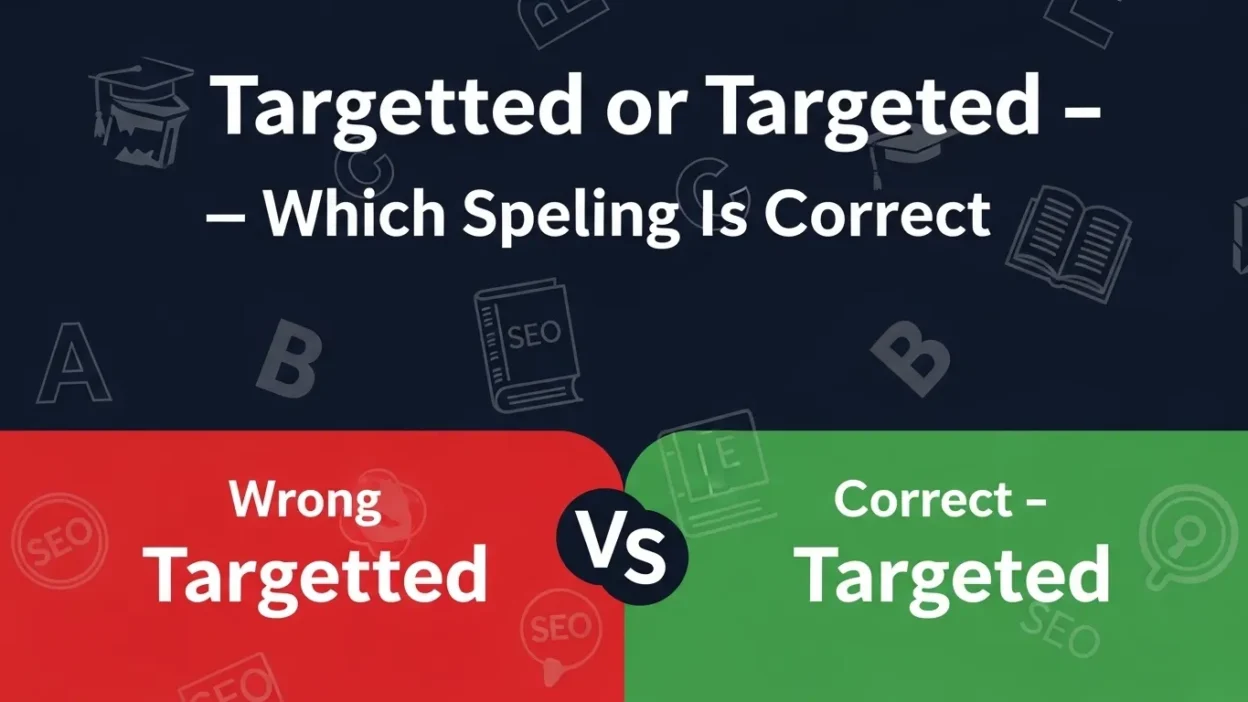
Quick Answer:
Targeted is the correct spelling.
Targetted is incorrect and considered a spelling mistake in both American and British English.
Meaning of “Targeted”
The word targeted is the past tense and past participle of target, meaning:
- Aimed at a specific person, group, or goal
- Directed toward a particular objective
- Focused intentionally
Examples
- The campaign was targeted at young professionals.
- She targeted her studies on medical research.
- The company launched targeted ads online.
In all these cases, the word shows intention and precision.
Why “Targetted” Is Incorrect
Many people assume targetted is correct because English often doubles consonants when adding endings (like commit → committed or regret → regretted). But the target doesn’t follow that pattern.
Here’s why:
- The stress in target is on the first syllable: TAR-get
- Words with stress on the first syllable usually don’t double the final consonant when adding -ed
So:
- target → targeted ✅
- target → targetted ❌
Simple Rule to Remember
If the stress is on the first syllable, don’t double the final consonant.
Compare:
| Word | Stress | Past Form |
| Target | TAR-get | Targeted |
| Visit | VIS-it | Visited |
| Open | O-pen | Opened |
But:
| Word | Stress | Past Form |
| Admit | ad-MIT | Admitted |
| Prefer | pre-FER | Preferred |
Stress placement determines doubling.
Targeted vs Targetted Comparison Table
| Feature | Targeted | Targetted |
| Correct spelling | ✔ Yes | ✘ No |
| Dictionary accepted | ✔ Yes | ✘ No |
| Used in formal writing | ✔ Yes | ✘ Avoid |
| American English | ✔ Standard | ✘ Incorrect |
| British English | ✔ Standard | ✘ Incorrect |
Bottom line: Targeted is always correct regardless of region.
American vs British English Differences
Unlike some spelling variations (like color/colour or traveling/travelling), targeted does not change between American and British English.
Both forms agree:
- American English → targeted
- British English → targeted
So if you’re writing for international readers, you don’t need to adjust this word at all.
Common Mistakes People Make
Here are typical errors writers make when using this word:
1. Doubling the T Automatically
People assume every verb ending in -et doubles the T. That’s not true.
❌ targetted campaign
✔ targeted campaign
2. Mixing With Similar Words
Some words really do double consonants:
- format → formatted
- regret → regretted
Seeing these can trick your brain into thinking targetted looks right.
3. Spellcheck Overconfidence
Occasionally, outdated or misconfigured spellcheck tools fail to flag errors. Always rely on dictionary-verified spelling.
Example Sentences Using “Targeted” Correctly
Seeing real usage helps lock in understanding:
- The teacher designed a targeted lesson for struggling students.
- The police conducted a targeted investigation.
- This skincare product is targeted toward sensitive skin.
- The scholarship is targeted at low-income applicants.
- The marketing strategy targeted local customers.
Notice the pattern: the word usually appears when something is focused or intentional.
Synonyms and Related Words
Using synonyms improves writing variety and SEO relevance. Words similar to targeted include:
- focused
- directed
- aimed
- intended
- specialized
- customized
- tailored
Example rewrite
- Original: The ad was targeted at teens.
- Variation: The ad was tailored for teens.
When Should You Use “Targeted”?
Use targeted when you want to emphasize precision or intention.
Common contexts
- Marketing → targeted advertising
- Education → targeted instruction
- Healthcare → targeted therapy
- Business → targeted strategy
- Technology → targeted notifications
If something is designed for a specific purpose or audience, targeted is the perfect word.
Memory Trick to Never Misspell It Again
Think of this phrase:
You aim at a target, not a targett.
Since the base word has one T at the end, the past form keeps just one.
Another quick trick:
Target + ed = Targeted
(No doubling needed.)
FAQs
1. Is “targetted” ever correct?
No. It’s considered a misspelling in all major dictionaries and style guides.
2. Why do people write “targetted”?
Because English sometimes doubles consonants before adding endings, leading to confusion.
3. Is “targeted” a verb or adjective?
Both. It can describe an action (She targeted the issue) or function as an adjective (targeted ads).
4. Do Americans and British spell it differently?
No. Both are targeted.
5. Is “targeting” spelled with one T or two?
One T. Correct form: targeting, not targetting.
6. What is the noun form?
The noun is targeting, meaning the act of aiming at something specific.
7. Can I use targeted in formal writing?
Yes. It’s standard and widely accepted in academic, business, and professional contexts.
8. What part of speech is “target”?
It can be both a noun (hit the target) and a verb (target the audience).
Summary
The correct spelling is targeted, and it never changes to targetted in any form of English.
The confusion happens because English spelling rules can be inconsistent, especially when adding suffixes like -ed or -ing. But since the target has stress on the first syllable, the final consonant stays single.
Understanding this rule helps you avoid a surprisingly common mistake and write with more confidence.
Small spelling details make a big difference in professional communication, academic writing, and online content.
Actionable takeaway:
Whenever you’re unsure, remember this formula:
Target + ed = Targeted (one T stays one).
Keep that in mind, and you’ll never misspell it again.