Have you ever typed “sweeped the floor” and felt unsure if it sounded right? You’re not alone. Many English learners and even native speakers pause when choosing between sweeped vs swept.
It’s one of those tricky verb forms that doesn’t follow the usual “add -ed” rule. In this guide, you’ll get a clear, simple explanation with real-life examples, common mistakes, and an easy comparison table.
By the end, you’ll confidently know which word to use and why.
Quick Answer
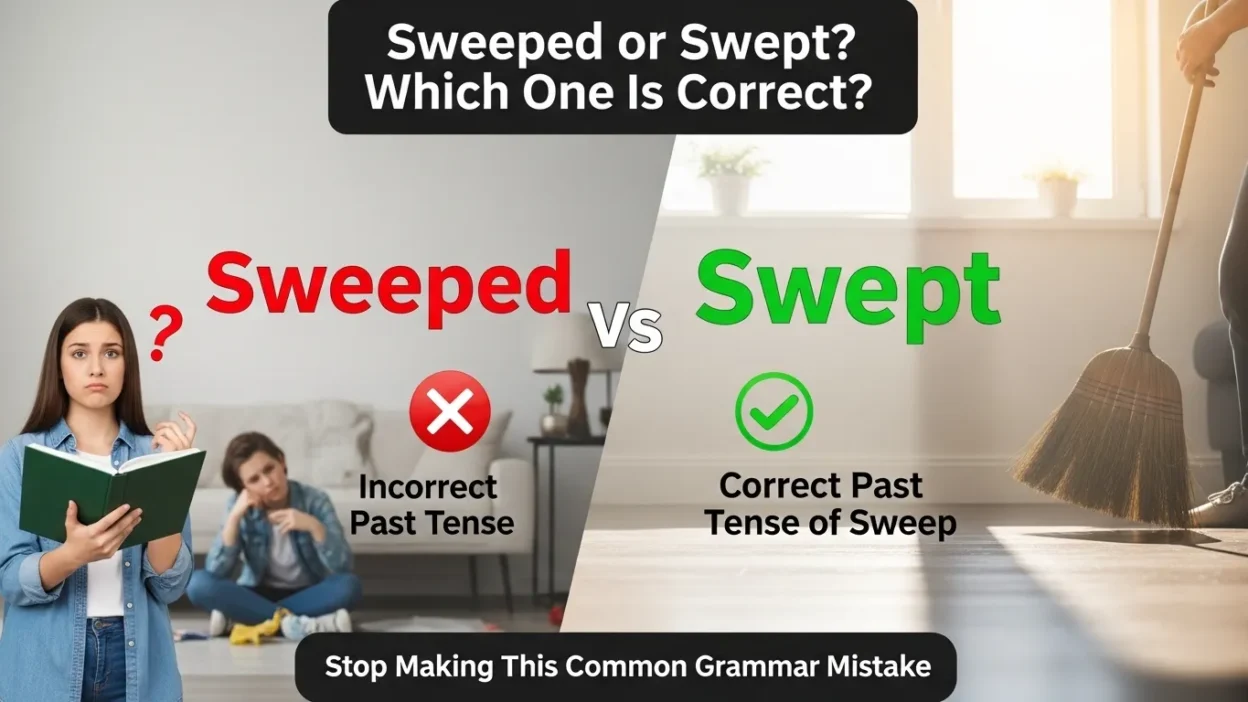
“Swept” is correct.
“Sweeped” is incorrect and not recognized in standard English.
- Present tense: sweep
- Past tense: swept
- Past participle: swept
Example:
✅ She swept the kitchen floor.
❌ She sweeped the kitchen floor.
What Does “Sweep” Mean?
The verb sweep means:
- To clean a surface using a broom
- To move something in a smooth, wide motion
- To win completely (in sports or competitions)
It is an irregular verb, which means it does not follow the standard pattern of adding “-ed” to form the past tense.
Correct verb forms:
- Base form: sweep
- Past tense: swept
- Past participle: swept
This is similar to other irregular verbs like:
- Keep → Kept
- Sleep → Slept
- Weep → Wept
Notice the pattern? The “-eep” often changes to “-ept.”
Why “Sweeped” Is Incorrect
Many English verbs form their past tense by adding “-ed”:
- Walk → Walked
- Jump → Jumped
- Clean → Cleaned
So it’s natural to think:
- Sweep → Sweeped
But English has many irregular verbs, and sweep is one of them. The correct past tense has been “swept” for centuries in both American and British English.
Using “sweeped” in formal writing, exams, blog posts, or professional emails will be considered a grammatical mistake.
Examples of “Swept” in Sentences
Here are practical examples in different contexts:
Cleaning Context
- She swept the porch before guests arrived.
- He swept the classroom after school.
- I swept the dust under the rug.
Figurative Meaning
- A wave of emotion swept over her.
- The storm swept through the village.
- The team swept the championship series.
Present Perfect Tense
- She has swept the floor already.
- They have swept the streets clean.
Passive Voice
- The floor was swept before the party.
- The leaves were swept into piles.
Sweeped vs Swept: Side-by-Side Comparison
| Feature | Sweeped | Swept |
| Correct in English? | ❌ No | ✅ Yes |
| Past Tense of Sweep | ❌ Incorrect | ✅ Correct |
| Past Participle | ❌ Incorrect | ✅ Correct |
| Used in American English | ❌ No | ✅ Yes |
| Used in British English | ❌ No | ✅ Yes |
| Accepted in Formal Writing | ❌ Never | ✅ Always |
The table makes it simple: “Swept” wins every time.
American vs British English Differences
Good news: there is no difference between American and British English for this word.
- 🇺🇸 American English: Swept
- 🇬🇧 British English: Swept
Both language systems follow the same irregular form. So no matter where you’re writing—US, UK, Canada, Australia—the correct form remains “swept.”
Common Mistakes People Make
Let’s look at typical grammar errors involving this word.
1. Adding “-ed” Automatically
❌ I sweeped the floor.
✅ I swept the floor.
This happens because learners apply regular verb rules to irregular verbs.
2. Confusing Past Tense with Present
❌ Yesterday, I sweep the floor.
✅ Yesterday, I swept the floor.
3. Using the Wrong Past Participle
❌ She has sweeped the house.
✅ She has swept the house.
4. Spelling Errors
Some people misspell “swept” as:
- Sweped
- Swepted
These are also incorrect.
Why Irregular Verbs Exist in English
English evolved from Germanic languages, and many irregular verbs come from Old English patterns. That’s why words like:
- Keep → Kept
- Sleep → Slept
- Sweep → Swept
don’t follow modern “-ed” rules.
While it may feel inconsistent, these forms are deeply rooted in English history and widely standardized today.
Easy Trick to Remember “Swept”
Here’s a memory tip:
Think of these together:
- Keep → Kept
- Sleep → Slept
- Sweep → Swept
If you remember one, you can remember all three.
Or think:
“After you sweep, you’ve swept.”
Short, simple, and effective.
Verb Forms of Sweep
Here’s a full verb breakdown:
- Base form: sweep
- Third person singular: sweeps
- Present participle: sweeping
- Past tense: swept
- Past participle: swept
Example in all tenses:
- I sweep every day.
- She sweeps the floor daily.
- They are sweeping the hall.
- He swept the kitchen yesterday.
- We have swept the house already.
When to Use “Swept” Beyond Cleaning
“Swept” is often used metaphorically. Here are some advanced examples that improve your writing:
- Fear swept across the nation.
- The company swept the market with its new product.
- Joy swept over the crowd.
Using it this way makes your writing more powerful and expressive.
FAQs
1. Is “sweeped” ever correct?
No. “Sweeped” is not grammatically correct in standard English.
2. Why do people say “sweeped”?
Because many English verbs add “-ed” in the past tense, and learners apply the same rule incorrectly.
3. What is the past participle of sweep?
The past participle is “swept.”
Example: She has swept the room.
4. Is “swept” used in both US and UK English?
Yes. Both American and British English use “swept.”
5. How do I remember the correct form?
Associate it with: Keep → Kept, Sleep → Slept, Sweep → Swept.
6. Is “swept” only used for cleaning?
No. It can also describe emotions, storms, movements, or complete victories.
7. What tense is “has swept”?
It is present perfect tense.
8. Can “swept” be used as an adjective?
Yes, in some contexts. Example: “The swept floor looked spotless.”
Final Summary
When comparing sweeped vs swept, the answer is clear: “Swept” is the only correct past tense and past participle form of “sweep.” “Sweeped” is a common mistake caused by applying regular verb rules to an irregular verb.
If you’re writing an academic paper, blog post, email, or exam answer, always choose swept. There is no American or British variation to worry about, and remembering similar patterns like keep → kept makes it easier to master.
Actionable Takeaway
Next time you write about cleaning, storms, emotions, or victories:
- Pause for a second.
- Ask yourself: Is this past tense?
- If yes, use swept.
Small grammar corrections like this instantly make your English sound polished, professional, and fluent.