If you’ve ever paused mid-sentence wondering whether to write spatter or splatter, you’re not alone. These two words sound similar, look similar, and even share overlapping meanings but they’re not always interchangeable. Choosing the right one can sharpen your writing and make your message clearer.
In this guide, you’ll learn exactly what spatter and splatter mean, how they differ, and when to use each correctly. If you’re writing creatively, academically, or casually, this breakdown will help you feel confident every time you use these words.
Quick Answer
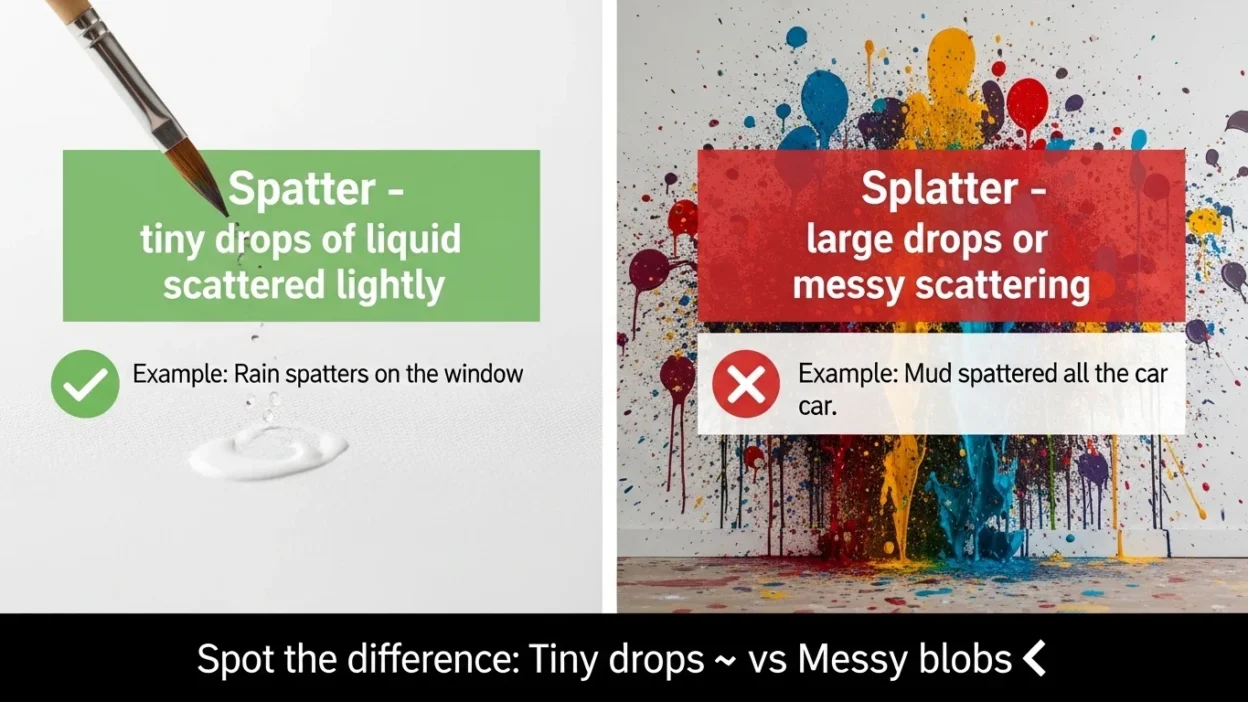
- Spatter: Refers to small, scattered drops of liquid or particles.
- Splatter: Suggests larger, more forceful, and messier spreading of liquid.
- In many casual contexts, they can overlap, but splatter often feels more vivid and dramatic.
What Does “Spatter” Mean?
Spatter describes the act of scattering small droplets, usually lightly and in a controlled or less intense way. It can be used as both a verb and a noun.
Examples:
- The rain began to spatter against the window.
- Tiny drops of paint spattered the canvas.
- There was a light spatter of mud on her shoes.
Key idea: small, fine, and scattered droplets.
What Does “Splatter” Mean?
Splatter carries more energy. It describes liquid hitting a surface with force, creating larger, messier, and more noticeable droplets.
Examples:
- The sauce splattered all over the stove.
- Paint splattered across the wall during the accident.
- He slipped into the puddle, causing water to splatter everywhere.
Key idea: forceful, messy, and more dramatic spreading.
Spatter or Splatter: The Core Difference
The difference mainly comes down to intensity and size.
- Spatter = lighter, finer, less forceful
- Splatter = heavier, bigger, more chaotic
Think of it like this:
- A few raindrops tapping your window → spatter
- A bucket of water thrown against a wall → splatter
Comparison Table
| Feature | Spatter | Splatter |
| Intensity | Light | Strong |
| Droplet Size | Small | Larger |
| Mess Level | Minimal | Messy |
| Tone | Subtle | Dramatic |
| Common Use Cases | Rain, light paint, small drops | Sauce, mud, accidents, impact |
Common Mistakes to Avoid
Even native speakers mix these up. Here are a few mistakes to watch out for:
- Using “spatter” for dramatic scenes
❌ The blood spattered everywhere (when describing a violent scene)
✔ The blood splattered everywhere - Using “splatter” for subtle actions
❌ Light rain splattered the window
✔ Light rain spattered the window - Assuming they always mean the same thing
While sometimes interchangeable, choosing the right one improves clarity and tone.
When Can You Use Them Interchangeably?
In casual conversation or informal writing, the difference isn’t always strict. For example:
- Paint spattered on the wall
- Paint splattered on the wall
Both can work, but splattered adds more visual intensity. If tone matters especially in storytelling choose carefully.
American vs British English Usage
Both spatter and splatter are used in American and British English, and there is no major spelling difference between regions. However:
- Splatter is slightly more common in American English, especially in media and entertainment (e.g., “splatter films”).
- Spatter is often preferred in more technical or scientific contexts, such as forensic analysis.
Real-Life Usage Examples
Here are practical examples to help you internalize the difference:
Spatter:
- Oil began to spatter gently in the pan.
- Mud spattered lightly on his jeans.
- The artist used a brush to spatter paint for texture.
Splatter:
- The car drove through a puddle and splattered water everywhere.
- Tomato sauce splattered across the kitchen wall.
- The balloon burst and splattered liquid all over the floor.
Tips to Remember the Difference
- “Spatter” = soft and subtle (think: sprinkle)
- “Splatter” = strong and splashy (think: splash)
A quick memory trick:
If it feels messy and dramatic, go with splatter.
FAQs
1. Is “spatter” or “splatter” more correct?
Both are correct it depends on context. Use spatter for lighter drops and splatter for heavier, messier ones.
2. Can I use “spatter” and “splatter” interchangeably?
Sometimes, yes. But they carry slightly different tones, so choosing the right one improves clarity.
3. Which word is more common in everyday English?
Splatter is more commonly used in casual speech because it feels more vivid and expressive.
4. Is there a difference in formal writing?
Yes. In formal or technical writing, spatter is often preferred for precise descriptions, especially in scientific contexts.
5. What about in creative writing?
In storytelling, splatter is great for dramatic scenes, while spatter works better for subtle imagery.
6. Are there any synonyms I can use?
Yes:
- For spatter: sprinkle, scatter, speckle
- For splatter: splash, spray, burst
7. Do these words have the same origin?
They are closely related and evolved from similar linguistic roots, which explains their overlap in meaning.
8. Which one should I use for SEO writing?
Use both naturally. Include variations like “difference between spatter and splatter” to capture search intent.
Summary
Understanding the difference between spatter and splatter comes down to noticing the level of intensity and visual impact. Spatter is gentle, subtle, and involves smaller droplets, while splatter is bold, messy, and more forceful.
While they sometimes overlap, choosing the right word helps your writing feel more precise and expressive. In everyday use, you don’t always need to stress over the distinction but when clarity or tone matters, the difference becomes important.
Especially in storytelling, descriptive writing, or professional contexts, picking the right word can make your message stronger and more engaging.
Actionable Takeaway
Next time you write, pause and ask: Is this light and subtle, or bold and messy? If it’s gentle, use spatter. If it’s dramatic, go with splatter. This simple habit will instantly improve your word choice and make your writing more vivid.