Confused about shown vs showed? You’re not alone. Many English learners and even native speakers pause when choosing between these two forms of “show.”
The good news? The difference is simple once you understand how verb tenses work.
In this guide, you’ll learn exactly when to use shown and when to use showed, see real-life examples, avoid common grammar mistakes, and feel confident using both in everyday writing and conversation.
Quick Answer:
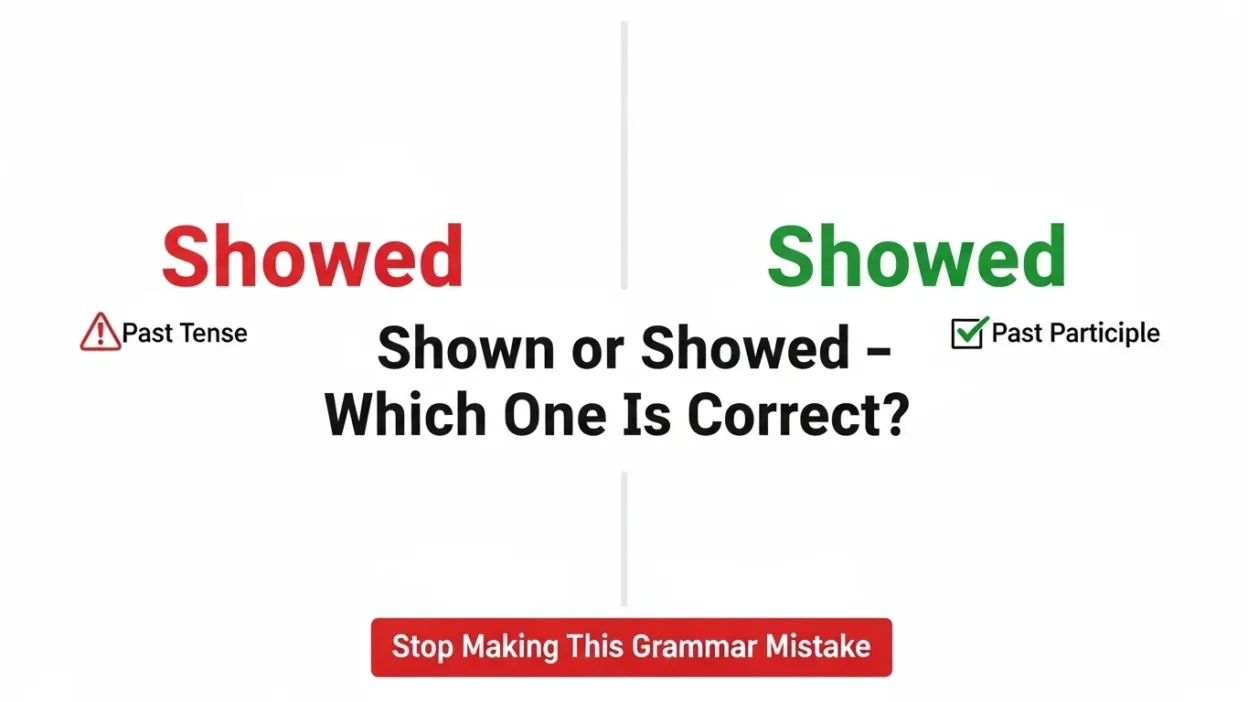
- Showed is the simple past tense of “show.”
- Shown is the past participle of “show” and is used with helping verbs like has, have, had, was, were, and been.
✅ Correct: She showed me the picture.
✅ Correct: She has shown me the picture.
❌ Incorrect: She has showed me the picture.
If there’s no helping verb, use showed. If there is a helping verb, use shown.
What Does “Showed” Mean?
Showed is the simple past form of the verb “show.” It describes something that happened and finished in the past.
Structure:
- Subject + showed + object
Examples:
- He showed me his new car.
- They showed great courage during the storm.
- The teacher showed us how to solve the problem.
In each sentence, the action happened in the past and is complete.
Think of showed as your go-to form when telling a story or describing past events without extra helping verbs.
What Does “Shown” Mean?
Shown is the past participle of “show.” It cannot stand alone. It must be used with auxiliary (helping) verbs such as:
- has
- have
- had
- was
- were
- be
- been
- being
Structure examples:
- has/have/had + shown
- was/were + shown
- has been shown
Examples:
- She has shown remarkable improvement.
- The results were shown on the screen.
- He had shown interest before the meeting.
- The movie has been shown three times.
Here, shown works as part of perfect tenses or passive voice.
Shown vs Showed: Side-by-Side Comparison
| Feature | Showed | Shown |
| Verb Type | Simple past tense | Past participle |
| Used Alone? | Yes | No |
| Needs Helping Verb? | No | Yes |
| Example | She showed me the way. | She has shown me the way. |
| Used in Passive Voice? | No | Yes (was shown) |
This table makes it easy: if there’s a helping verb, you probably need shown.
Understanding Verb Tenses: Why the Difference Exists
English verbs often have three main forms:
- Base form: show
- Past tense: showed
- Past participle: shown
This pattern is similar to other irregular verbs:
- Break → broke → broken
- Write → wrote → written
- Drive → drove → driven
Notice how the past participle usually changes form. That’s exactly what happens with shown.
Common Mistakes with Shown and Showed
Let’s look at errors people frequently make.
1. Using “showed” with a helping verb
❌ She has showed me the file.
✅ She has shown me the file.
Rule: After has, have, or had, always use the past participle (shown).
2. Using “shown” without a helping verb
❌ He shown me the report yesterday.
✅ He showed me the report yesterday.
Rule: If there’s no helping verb, use showed.
3. Confusion in passive voice
❌ The results were showed yesterday.
✅ The results were shown yesterday.
Passive voice always requires the past participle — so use shown.
Shown vs Showed in Different Tenses
Here’s how the verb works across common tenses:
Simple Past:
- I showed him the message.
Present Perfect:
- I have shown him the message.
Past Perfect:
- I had shown him the message before the meeting.
Future Perfect:
- I will have shown him the message by tomorrow.
Passive Voice:
- The evidence was shown to the jury.
Once you see the pattern, it becomes natural.
American vs British English Differences
Good news: There is no difference between American English and British English when it comes to shown vs showed.
Both follow the same grammar rules:
- Showed = past tense
- Shown = past participle
Whether you’re writing for a US or UK audience, the usage remains consistent.
When to Use “Has Shown” vs “Showed”
This is where nuance matters.
“She showed improvement.”
- Focuses on a completed action in the past.
“She has shown improvement.”
- Connects the improvement to the present moment.
Present perfect (has shown) often suggests relevance now, while simple past (showed) stays fully in the past.
Understanding this helps elevate your writing and makes it sound more natural.
Real-Life Example Sentences
Here are more natural examples to build confidence:
With Showed:
- The guide showed us around the museum.
- She showed kindness to everyone.
- The chart showed a decline in sales.
With Shown:
- The data has shown consistent growth.
- His true character was shown during the crisis.
- Research has shown that sleep improves memory.
Notice how academic and formal writing is often used has shown.
Memory Trick to Never Get It Wrong
Here’s a simple trick:
If you see:
- has
- have
- had
- was
- were
- been
Use shown.
If you don’t see a helping verb, use showed.
You can even ask yourself:
“Can I remove the helping verb?”
If yes then the sentence probably needs showed instead.
FAQ
1. Is “shown” correct grammar?
Yes. “Shown” is the correct past participle of “show.” It must be used with a helping verb.
2. Why is “has showed” wrong?
Because “showed” is simple past, not a past participle. After “has,” you must use “shown.”
3. Can I say “was showed”?
No. The correct form is “was shown.” Passive voice requires the past participle.
4. Is “shown” more formal than “showed”?
Not necessarily. It depends on the tense. However, phrases like “research has shown” are common in formal and academic writing.
5. Is “showed” ever used in passive voice?
No. Passive voice always requires the past participle, which is “shown.”
6. Which is more common: shown or showed?
Both are common but used in different grammatical structures. “Shown” appears frequently in present perfect and passive constructions.
7. Can “shown” be used without has/have/had?
No. It must be paired with a helping verb like “has,” “have,” “had,” “was,” “were,” or “been.”
Summary:
The difference between shown vs showed comes down to verb tense and grammar structure. Showed is the simple past tense used alone to describe completed actions in the past.
Shown is the past participle used with helping verbs in perfect tenses and passive voice.
If you remember one thing, let it be this: helping verb = shown. No helping verb = showed.
Once you practice this pattern, your grammar will feel more natural and confident.
Actionable Takeaway
Next time you write a sentence, pause and look for a helping verb. If you see one, choose shown. If not, use showed. Practice by rewriting 5 sentences using both forms correctly.
With just a little awareness, you’ll never mix them up again.