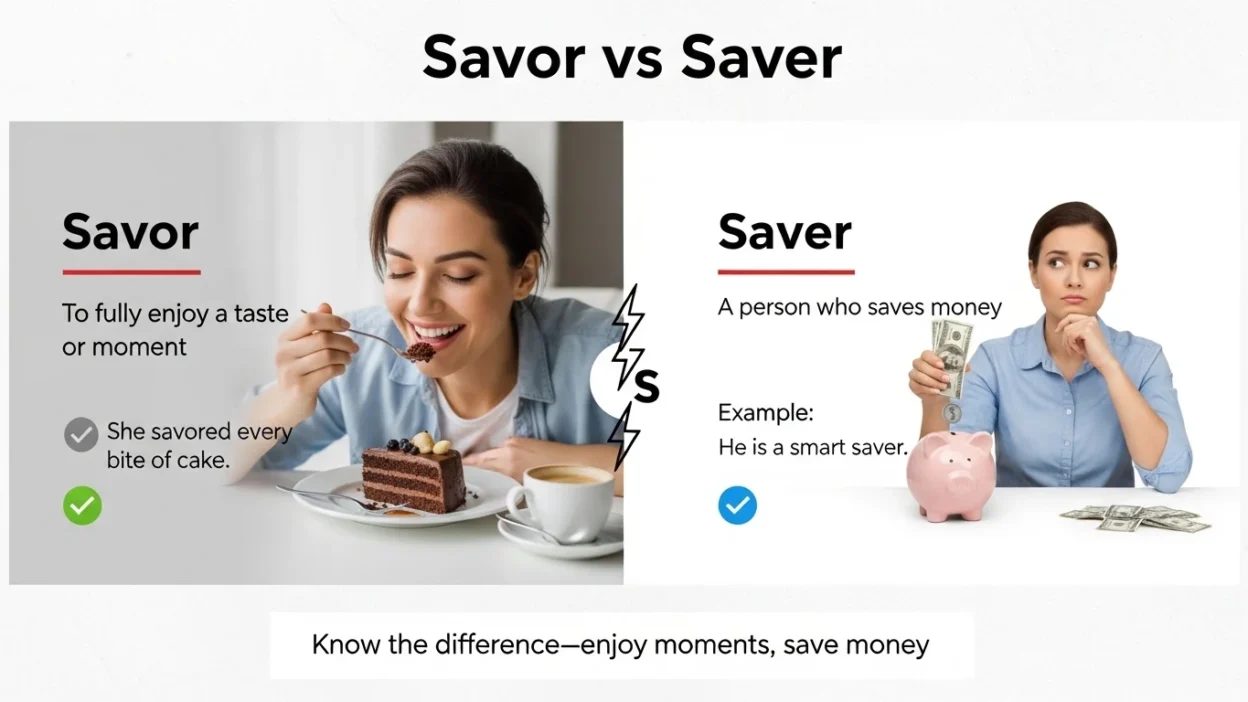
Confused about savor vs saver? You’re not alone; these two words sound almost identical but carry completely different meanings. One is about enjoying life’s little pleasures, while the other is about storing or saving something for later. Mixing them up can change the meaning of your sentence entirely.
In this simple, human-friendly guide, you’ll learn exactly what each word means, how to use them correctly, and how to avoid common mistakes. If you’re writing, speaking, or just improving your English, this article will make the difference crystal clear.
Quick Answer
- Savor = to enjoy something fully (especially taste, smell, or experience)
- Saver = a person or thing that saves (money, time, or resources)
👉 Example:
- I like to savor my coffee in the morning.
- She is a great saver and plans her finances well.
What Does “Savor” Mean?
Savor is a verb (and sometimes a noun) that means to enjoy something deeply and slowly, especially a pleasant experience.
Simple Definition
To appreciate or enjoy something fully, often using your senses.
Examples
- Take your time and savor every bite of the meal.
- He paused to savor the beautiful sunset.
- She likes to savor quiet moments after a busy day.
Related Words (LSI Keywords)
- enjoy
- relish
- appreciate
- taste
- experience deeply
👉 Think of “savor” as feeling and enjoying the moment.
What Does “Saver” Mean?
Saver is a noun that refers to someone who saves something, usually money, time, or effort.
Simple Definition
A person or thing that keeps or stores something for future use.
Examples
- He is a smart saver who invests wisely.
- This app is a real time-saver.
- She became a consistent saver by budgeting monthly.
Related Words (LSI Keywords)
- saver account
- money saver
- budgeter
- investor
- frugal person
👉 Think of “saver” as keeping something for later.
Key Differences Between Savor vs Saver
| Feature | Savor | Saver |
| Part of Speech | Verb (sometimes noun) | Noun |
| Meaning | To enjoy deeply | One who saves |
| Usage Focus | Experiences & feelings | Money, time, resources |
| Example | Savor the flavor | A money saver |
| Memory Tip | “A” = Appreciate | “E” = Economize |
Common Mistakes to Avoid
Many learners confuse these words because they sound alike. Here are some common errors:
❌ Incorrect Usage
- I like to saver my food slowly.
- She loves to savor money for the future.
✅ Correct Usage
- I like to savor my food slowly.
- She loves to save money or is a good saver.
Why These Mistakes Happen
- Similar pronunciation
- Fast typing or autocorrect
- Lack of context understanding
👉 Tip: Always check if you’re talking about enjoying (savor) or saving (saver).
Savor vs Saver in American and British English
Good news there’s no difference in meaning between American and British English for these words.
However, spelling variations may appear in related forms:
- American English: savor
- British English: savour
👉 Example:
- US: I like to savor the moment.
- UK: I like to savour the moment.
“Saver” remains the same in both forms.
Easy Tricks to Remember the Difference
Use these simple memory hacks:
- Savor = A = Appreciate
- Saver = E = Economize (save money)
Or:
- Savor → Feeling
- Saver → Finance
Real-Life Examples for Better Understanding
Daily Life
- After a long day, she sat quietly to savor her tea.
- He is a careful saver who tracks every expense.
Work & Productivity
- This shortcut helps you savor your free time.
- Automation tools are real time-savers.
Emotional Context
- Try to savor happy memories.
- A disciplined saver prepares for the future.
FAQs
1. Are savor and saver interchangeable?
No, they have completely different meanings. “Savor” is about enjoying, while “saver” is about saving.
2. Is savor always a verb?
Mostly yes, but it can also be a noun (e.g., the savor of spices).
3. Can saver be used for things?
Yes. Example: “This tool is a time-saver.”
4. What is the British spelling of savor?
“Savour” is the British spelling.
5. Which word is used for enjoying food?
“Savor” is the correct word when talking about enjoying food.
6. What does “money saver” mean?
It refers to something or someone that helps reduce expenses.
7. Why do people confuse savor and saver?
Because they sound very similar but have different meanings.
8. Is “saver” related to “save”?
Yes, “saver” comes from the verb “save.”
Summary
Understanding the difference between savor vs saver is simple once you focus on their core meanings. “Savor” is all about enjoying experiences deeply whether it’s food, moments, or emotions.
On the other hand, “saver” refers to someone or something that saves resources like money, time, or effort. Even though they sound alike, their usage is completely different.
By remembering small tricks like A for Appreciate (savor) and E for Economize (saver), you can avoid confusion and use both words confidently. With practice, choosing the correct word will become second nature.
Actionable Takeaway
Next time you write or speak:
- Ask yourself: Am I enjoying something? → Use “savor”
- Or: Am I saving something? → Use “saver”
Practice using both in sentences daily to build confidence and clarity.

Edward Axel is the administrator of SyntaxlyHub, responsible for overseeing site operations, content management, and technical performance. He ensures accuracy, consistency, and smooth functionality while supporting the team in delivering reliable, high-quality grammar resources and a user-friendly learning experience for readers worldwide.