If you’ve ever paused mid-sentence wondering whether to write “reorder” or “re-order,” you’re not alone. It’s one of those small but surprisingly tricky spelling choices that can make your writing look polished or slightly off. The good news? The answer is simple once you understand the rule.
In this guide, you’ll learn exactly when to use reorder vs re-order, why both forms exist, and how to avoid common mistakes. If you’re writing emails, blog posts, or product listings, this quick explanation will help you sound more confident and professional.
Quick Answer: Reorder or Re-Order?
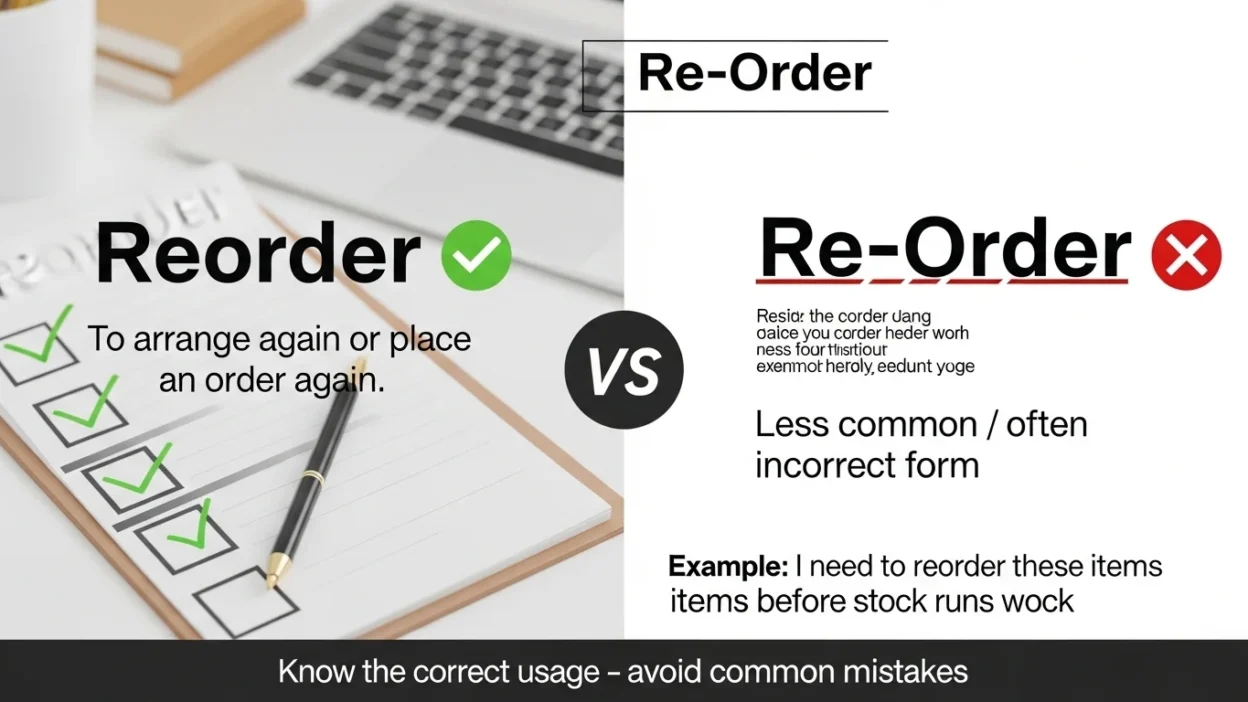
“Reorder” (one word) is the correct and most commonly used form.
“Re-order” (with a hyphen) is usually unnecessary in modern English, except in rare cases for clarity.
- ✅ Correct: I need to reorder these items.
- ⚠️ Less common: I need to re-order these items.
👉 In most situations, stick with “reorder.”
What Does “Reorder” Mean?
The word reorder is a verb that means:
- To arrange something again in a different order
- To place another order for something (especially in shopping or business)
Simple Definitions
- Rearranging meaning: Changing the sequence or position
- Ordering again meaning: Buying or requesting something again
Examples in Sentences
- Please reorder the slides before the presentation.
- I need to reorder my favorite product online.
- The teacher asked students to reorder the sentences.
Why Do Some People Write “Re-Order”?
The hyphenated form “re-order” comes from older writing styles where prefixes like “re-” were often separated with a hyphen.
When a Hyphen Might Be Used
In rare cases, a hyphen can help avoid confusion:
- When the word looks awkward or unclear without it
- When double vowels might confuse readers
Example:
- We need to re-order the system settings (used for clarity, but still uncommon)
👉 However, modern English (especially American English) prefers closed compounds, meaning no hyphen.
Reorder vs Re-Order: Key Differences
| Feature | Reorder ✅ | Re-Order ⚠️ |
| Usage frequency | Very common | Rare |
| Modern writing | Preferred | Less preferred |
| Clarity | Clear in most cases | Used only if confusion arises |
| SEO & readability | Better choice | Not recommended |
👉 Bottom line: “Reorder” wins in almost every situation.
American vs British English Differences
Good news there’s no major difference between American and British English for this word.
- 🇺🇸 American English: reorder (preferred)
- 🇬🇧 British English: reorder (also preferred)
Both versions follow the same modern rule of dropping unnecessary hyphens.
Common Mistakes to Avoid
Even simple words can trip people up. Here are the most common mistakes with “reorder”:
❌ 1. Overusing Hyphens
- Incorrect: Please re-order the list
- Correct: Please reorder the list
👉 Hyphens are not needed here.
❌ 2. Confusing Meaning
- Incorrect use: I will reorder my room tomorrow (if you mean clean)
- Better: I will rearrange my room tomorrow
👉 “Reorder” is about sequence, not general cleaning.
❌ 3. Splitting the Word
- Incorrect: re order
- Correct: reorder
👉 Never write it as two separate words.
When Should You Use “Reorder”?
Use reorder when you want to:
✔ Change Arrangement
- Reorder the steps for better understanding.
✔ Place Another Order
- Customers can reorder products easily.
✔ Improve Organization
- Reorder your priorities to reduce stress.
👉 It’s widely used in business, education, and everyday communication.
Related Words and Synonyms (LSI Keywords)
To strengthen your writing and SEO, you can also use related terms like:
- Rearrange
- Restructure
- Reorganize
- Sort again
- Re-sequence
- Order again
These synonyms can help avoid repetition while keeping your content natural and engaging.
FAQs
1. Is “reorder” one word or two?
It is one word. Writing “re order” is incorrect.
2. Is “re-order” ever correct?
Yes, but rarely. It may be used for clarity, though modern writing avoids it.
3. Which is better for SEO: reorder or re-order?
“Reorder” is better because it’s more commonly searched and widely accepted.
4. Does “reorder” have different meanings?
Yes. It can mean rearranging something or ordering something again.
5. Do British people use “re-order”?
Not commonly. Like American English, British English prefers “reorder.”
6. Why do some words still use hyphens with “re-”?
Hyphens are used when removing them could cause confusion (e.g., “re-enter”).
7. Is “reorder” formal or informal?
It works in both formal and informal writing.
8. Can I use “reorder” in professional writing?
Absolutely. It’s widely accepted in business, academic, and digital content.
Final Summary
Choosing between reorder and re-order doesn’t have to be confusing. In modern English, the clear winner is “reorder” a simple, clean, and widely accepted spelling. While “re-order” might appear occasionally, it’s mostly outdated and only used when clarity demands it.
For everyday writing, business communication, and SEO content, sticking with reorder ensures your writing feels natural, professional, and easy to read. It also aligns with current language trends, making your content more trustworthy and user-friendly.
Actionable Takeaway
Next time you write, remember this rule:
👉 Use “reorder” 99% of the time.
👉 Only consider “re-order” if removing the hyphen creates confusion.
By applying this small but powerful tip, you’ll instantly improve the clarity and professionalism of your writing.