If you’ve ever paused mid-sentence wondering whether to write reinforce or reenforce, you’re not alone. These two spellings look confusingly similar, and many writers assume they’re interchangeable.
The truth is simpler and knowing it will instantly improve your writing accuracy and credibility.
In this guide, you’ll learn the exact difference between reinforce vs reenforce, when each is correct, which one modern English prefers, and how to avoid common mistakes. Let’s clear it up once and for all.
Quick Answer
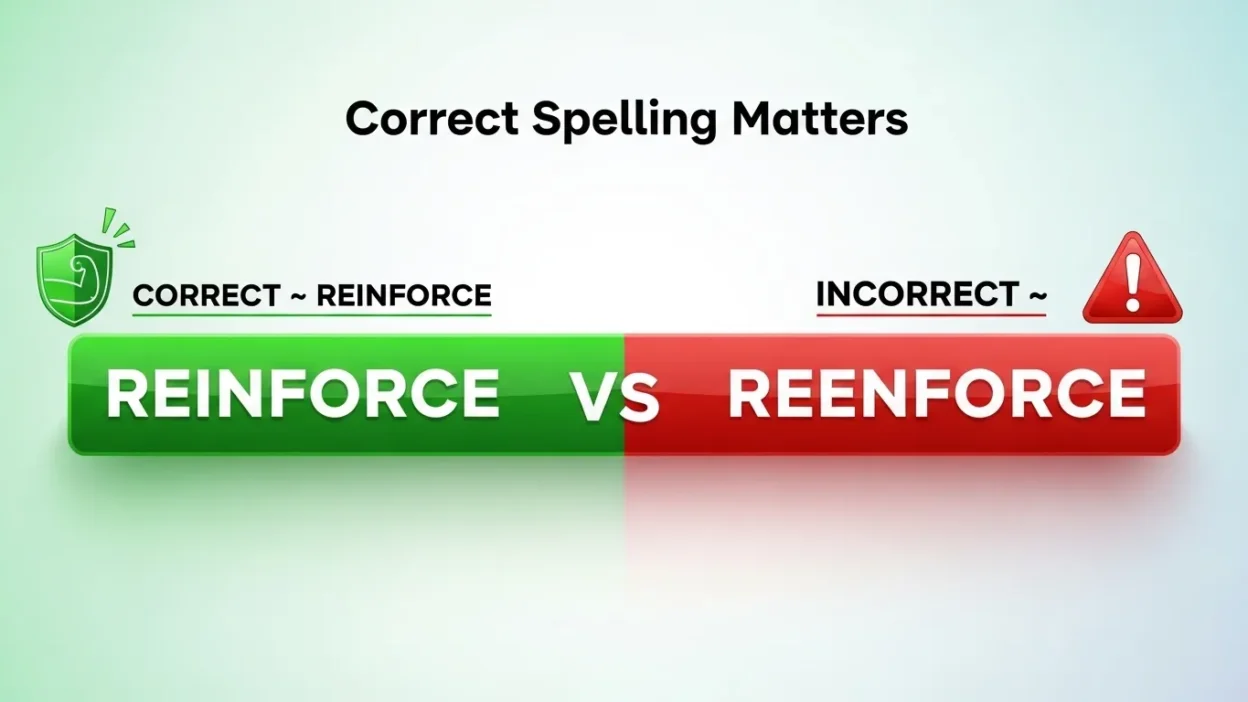
Reinforce is the correct and standard modern spelling.
Reenforce is an outdated or rare variant that is almost never used in contemporary English.
If you want your writing to look professional, polished, and current, always choose reinforce.
Meaning of Reinforce vs Reenforce
Reinforce
Reinforce means to strengthen, support, or make something stronger. It can refer to physical strength, ideas, emotions, or actions.
Examples
- The steel beams reinforce the structure.
- Teachers reinforce positive behavior.
- Evidence reinforces her argument.
Reenforce
Reenforce is an obsolete or archaic spelling of reinforce. It once appeared in older texts but is now considered outdated and unnecessary in modern writing.
Today, dictionaries list reenforce only as a historical variant. Most style guides recommend avoiding it completely.
Why Reinforce Is the Preferred Spelling
Language evolves, and spelling standards become simplified over time. The form reinforce won because it is:
- Easier to read
- More consistent with similar words (re + enforce → reinforce)
- Universally recognized
- Used in modern dictionaries, academic writing, and media
Using reenforce can make your writing look:
- Old-fashioned
- Incorrect
- Typo-like
Comparison Table: Reinforce vs Reenforce
| Feature | Reinforce | Reenforce |
| Modern usage | ✅ Standard | ❌ Rare/obsolete |
| Dictionary acceptance | Yes | Historical only |
| Recommended in writing | Yes | No |
| Seen in academic texts | Yes | Almost never |
| Professional tone | Strong | Weak |
Bottom line: Always use reinforce unless you’re quoting historical text.
Common Mistakes Writers Make
Many people accidentally use reenforce because they assume the prefix re- should always be spelled separately. But English spelling doesn’t always follow that logic.
Here are frequent errors:
- Writing reenforce instead of reinforce
- Thinking both spellings are equal
- Assuming reenforce is British spelling
- Believing reenforce means something different
None of these are correct. There is no difference in meaning only a difference in correctness and modern usage.
American vs British English Differences
Unlike words such as color/colour or organize/organise, reinforce is spelled the same in both American and British English.
There is no regional variation:
- 🇺🇸 American English → reinforce
- 🇬🇧 British English → reinforce
The spelling reenforce is not standard in either variety.
When to Use Reinforce (Real-Life Contexts)
You can use reinforce in many situations. It’s a versatile verb used across subjects.
Physical context
- Engineers reinforce bridges.
- Workers reinforce walls.
Emotional or psychological context
- Praise reinforces confidence.
- Routine reinforces discipline.
Academic or argumentative context
- Data reinforces a claim.
- Statistics reinforce conclusions.
Social or behavioral context
- Rewards reinforce habits.
- Rules reinforce structure.
Synonyms of Reinforce (LSI Keywords)
Using synonyms helps improve SEO depth and readability. Related words include:
- strengthen
- support
- fortify
- bolster
- solidify
- back up
- intensify
- enhance
- stabilize
Example:
The results reinforce the theory.
The results support the theory.
Memory Trick to Avoid Confusion
Here’s a simple trick:
Reinforce = Re + In + Force → Put force into something again
Notice there’s only one “e” after the r. If you see reenforce, it’s likely incorrect.
Example Sentences Showing Correct Usage
- The coach’s speech reinforced team morale.
- Steel rods reinforce concrete.
- Repetition reinforces learning.
- Evidence reinforces credibility.
- Positive feedback reinforces motivation.
Incorrect:
- ❌ The beams reenforce the building.
Correct:
- ✅ The beams reinforce the building.
FAQs
1. Is reenforce ever correct?
Only in historical texts or quotations. In modern writing, it’s considered outdated.
2. Is reenforce British spelling?
No. British English also uses reinforce.
3. Do they mean different things?
No. Both spellings have the same meaning, but only one is standard.
4. Which spelling should I use in essays?
Always use reinforce for academic, professional, or formal writing.
5. Why does reenforce exist?
It’s an older spelling from earlier English usage that faded over time.
6. Will spellcheck flag reenforce?
Most modern spellcheck tools mark it as incorrect or suggest reinforce.
7. Is reenforce a typo?
In most cases, yes. It’s usually an accidental misspelling.
8. What part of speech is reinforce?
It’s primarily a verb, though it can also be used as a noun in rare contexts (e.g., military reinforcement).
Expert Writing Tip
Professional editors follow one simple rule:
If a variant spelling is obsolete, don’t use it unless quoting history.
That means reinforce should be your default choice 100% of the time.
Summary
Understanding reinforce vs reenforce is straightforward once you know the rule: reinforce is the only correct modern spelling, while reenforce is outdated and rarely used today.
They share the same meaning, but only one meets current language standards. Choosing the right spelling ensures your writing looks professional, accurate, and trustworthy.
Language clarity builds reader confidence. When you consistently use correct forms like reinforce, you strengthen your message, improve readability, and establish authority.
Small spelling decisions can make a big difference in how your writing is perceived.
Actionable Takeaway
Whenever you’re about to write reenforce, pause and replace it with reinforce. Save this rule:
Modern English = Reinforce only.
Memorize it once, and you’ll never second-guess again.