Sometimes a single hyphen can make writers pause. Should you write reevaluation or re-evaluation? If you’ve ever wondered which one is correct, you’re not alone.
Many English learners, students, and professional writers face the same confusion because both forms appear in books, articles, and official documents.
The good news is that both spellings can be correct depending on style, context, and readability. Understanding when and why each form is used will help you write more clearly and confidently.
In this guide, you’ll learn the meaning, correct usage, examples, common mistakes, and the subtle differences between reevaluation and re-evaluation.
Quick Answer
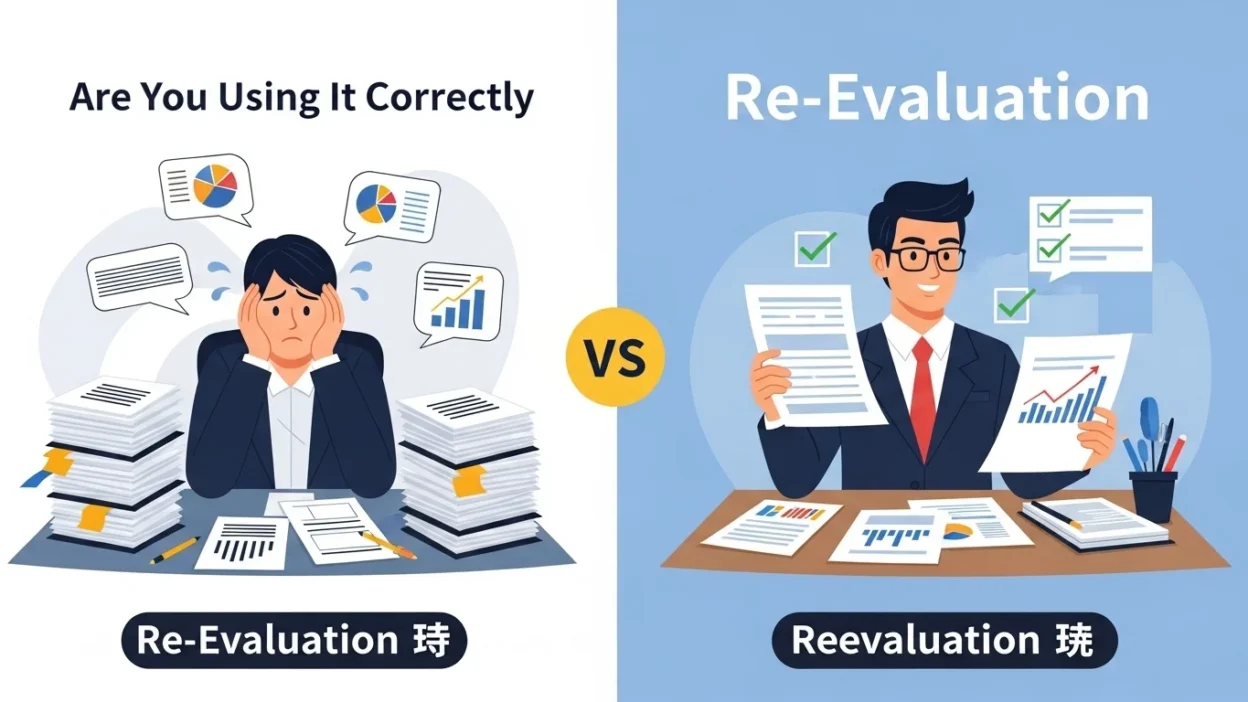
Reevaluation and re-evaluation both mean reviewing or assessing something again.
- Reevaluation (without a hyphen) is the modern and more commonly used spelling, especially in American English.
- Re-evaluation (with a hyphen) is sometimes used for clarity or stylistic preference, and it appears more often in formal or British-influenced writing.
In most modern writing, reevaluation is preferred unless the hyphen improves readability.
Meaning of Reevaluation (or Re-Evaluation)
The word reevaluation comes from the prefix re- meaning again and the word evaluation, meaning to judge, assess, or determine value.
So reevaluation simply means:
The act of assessing, reviewing, or examining something again to determine its value, importance, or accuracy.
People often perform reevaluations when circumstances change, new information appears, or decisions need reconsideration.
Common contexts where reevaluation happens
- Business strategies
- Academic grading
- Personal goals
- Medical diagnoses
- Government policies
- Financial planning
Example sentences
- The company conducted a reevaluation of its marketing strategy.
- After receiving new evidence, the court ordered a re-evaluation of the case.
- Her career goals went through a major reevaluation after graduation.
- The teacher agreed to a re-evaluation of the student’s project.
Why Two Spellings Exist
The difference between reevaluation and re-evaluation comes from how English handles prefixes.
Normally, prefixes like re- attach directly to words:
- rebuild
- reconsider
- rewrite
But sometimes writers insert a hyphen to make the word easier to read, especially when vowels meet.
For example:
- reenter → re-enter
- reeducate → re-educate
- reevaluate → re-evaluate
Because evaluation begins with a vowel, some writers prefer re-evaluation to avoid the long sequence of vowels.
However, modern style guides increasingly prefer closed forms like reevaluation.
Reevaluation vs Re-Evaluation: Key Differences
| Feature | Reevaluation | Re-evaluation |
| Spelling style | Closed compound | Hyphenated compound |
| Modern usage | More common today | Less common |
| American English | Strongly preferred | Occasionally used |
| British English | Common | Slightly more accepted |
| Readability | Standard form | Used for clarity in some writing |
Simple rule:
Use reevaluation in most cases unless a style guide or editor prefers the hyphen.
American vs British English Usage
Understanding regional writing styles can also help.
American English
American style guides such as AP Style and Chicago Manual of Style generally prefer closed compounds when possible.
Examples:
- reevaluate
- reelection
- reevaluation
So in American writing, reevaluation is the standard form.
British English
British English sometimes keeps hyphens longer, especially in formal contexts.
Examples you might see:
- re-evaluation
- re-examination
- re-education
However, even in British English, the closed form reevaluation is becoming increasingly common.
When to Use Reevaluation
Use reevaluation when writing:
- Blog articles
- Academic essays
- Business reports
- Emails
- Most modern publications
Example sentences
- The policy requires annual reevaluation.
- A financial reevaluation helped the company reduce expenses.
- The doctor recommended a reevaluation after six months.
Because it is cleaner and more modern, reevaluation fits most situations.
When to Use Re-Evaluation
The hyphenated re-evaluation may be used when:
- A style guide requires it
- You want to improve readability
- Writing in very formal contexts
- Avoiding visual confusion with repeated vowels
Example sentences
- The committee approved a re-evaluation of the project.
- A full re-evaluation of the strategy is scheduled next quarter.
Although correct, this form is simply less common today.
Common Mistakes to Avoid
Writers sometimes make small but noticeable errors when using these words.
1. Using the two spellings inconsistently
Incorrect:
- The report includes a reevaluation and a re-evaluation.
Correct:
- Choose one style and use it consistently.
2. Adding unnecessary spaces
Incorrect:
- re evaluation
Correct:
- reevaluation
- re-evaluation
3. Confusing reevaluation with evaluation
These words are related but different.
- Evaluation = assessing something once
- Reevaluation = assessing something again
Example:
- The teacher completed the evaluation.
- The student requested a reevaluation.
4. Overusing the hyphen
Modern writing usually removes unnecessary hyphens.
Prefer:
- reevaluation
Instead of:
- re-evaluation (unless needed)
Related Words and Synonyms
Using related terms can improve writing variety and SEO relevance.
Similar words
- reassessment
- reconsideration
- review
- reanalysis
- reexamination
- reconsidering
Example usage
- The team performed a reassessment of their goals.
- A strategic review improved company performance.
- Scientists began a reanalysis of the data.
These alternatives can help avoid repetition while maintaining meaning.
Real-Life Examples of Reevaluation
Understanding how the word appears in real contexts can help clarify usage.
Business
Companies often perform reevaluations when markets change.
Example:
- The organization announced a reevaluation of its investment strategy.
Education
Students sometimes request grade reviews.
Example:
- She asked for a reevaluation of her exam score.
Healthcare
Doctors may reassess diagnoses.
Example:
- A medical reevaluation confirmed the treatment plan.
Personal life
People frequently rethink goals and priorities.
Example:
- Traveling led to a reevaluation of his career path.
FAQs
1. Is reevaluation one word or two?
Reevaluation is one word. The hyphenated re-evaluation is also correct but less commonly used.
2. Which spelling is more common?
Reevaluation (without the hyphen) is the most common spelling in modern English, especially in American writing.
3. Is re-evaluation incorrect?
No. Re-evaluation is grammatically correct but appears less often today.
4. Why do some writers use the hyphen?
Some writers use the hyphen to improve readability when vowels appear together.
5. Does British English prefer re-evaluation?
British English sometimes uses hyphenated forms more often, but reevaluation is still widely accepted.
6. What part of speech is reevaluation?
It is a noun describing the act of reviewing or assessing something again.
7. What is the verb form of reevaluation?
The verb form is reevaluate (or re-evaluate).
Example:
- The manager decided to reevaluate the proposal.
8. Is reevaluation formal or informal?
It can be used in both formal and informal writing, including academic, professional, and casual contexts.
Summary
Both reevaluation and re-evaluation refer to the act of assessing or reviewing something again. While the meanings are identical, modern writing trends strongly favor reevaluation without a hyphen.
This closed form is cleaner, more widely accepted, and commonly used in American English and contemporary publications.
The hyphenated re-evaluation still appears in some formal contexts or when writers want to improve readability.
However, consistency matters more than the specific form you choose. As long as you use one style consistently, your writing will remain clear and professional.
Actionable takeaway:
When in doubt, use reevaluation. It is the modern, standard spelling that works in most writing situations.