If you’ve ever paused mid-sentence wondering whether to use proved or proven, you’re not alone. These two words look similar, sound similar, and are often used interchangeably but there’s a subtle difference that can make your writing feel either polished or slightly off.
In this guide, you’ll finally understand when to use proved vs proven with confidence. We’ll break it down in plain English, give you memorable examples, and show you how native speakers actually use these words in everyday writing.
Quick Answer
- Proved is the standard past tense and past participle of prove.
- Proven is also a past participle, commonly used in American English, especially before nouns.
- Both are correct, but “proven” is often preferred in modern usage, particularly in informal and business contexts.
👉 Simple rule:
- Use proved in formal writing or after helping verbs.
- Use proven when describing something before a noun (e.g., proven results).
What Does “Proved” Mean?
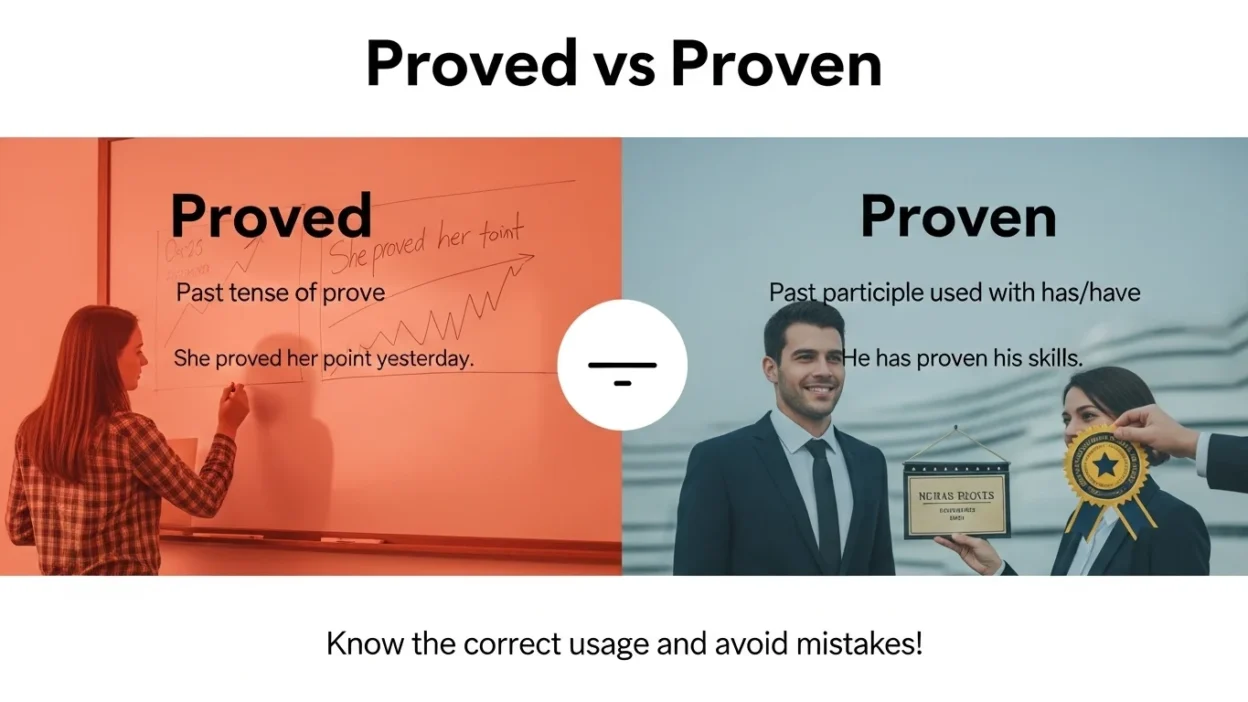
Proved is the traditional past tense and past participle of the verb prove, which means to show that something is true with evidence.
Examples:
- She proved her point with strong data.
- The lawyer has proved his case beyond doubt.
- They proved that the theory works in real life.
👉 In these sentences, proved focuses on the action of demonstrating truth.
What Does “Proven” Mean?
Proven is also a past participle of prove, but it’s more commonly used in modern English especially in American usage and before nouns.
Examples:
- This is a proven method for success.
- He has proven himself as a reliable leader.
- The strategy is proven to work.
👉 Here, proven often emphasizes reliability or established truth.
Proved vs Proven: Key Differences
Although both words come from the same verb, their usage can vary depending on context.
| Feature | Proved | Proven |
| Grammar Role | Past tense & past participle | Past participle |
| Formality | More formal/traditional | More modern/common |
| Usage Position | Often after verbs | Often before nouns |
| Example | She has proved it | A proven solution |
American vs British English
The difference between proved vs proven becomes clearer when you look at regional usage:
American English 🇺🇸
- Proven is widely accepted and preferred in many contexts.
- Example: a proven track record
British English 🇬🇧
- Proved is traditionally more common, especially in formal writing.
- However, proven is also accepted and increasingly used.
👉 Bottom line: Both forms are correct, but “proven” dominates in modern global English, especially in marketing, business, and casual writing.
When to Use “Proved”
Use proved when:
- You’re writing formally (academic, legal, or traditional contexts)
- It follows auxiliary verbs like has, have, had
Examples:
- The scientist has proved the hypothesis.
- They had proved their innocence before the trial ended.
👉 Tip: If your sentence sounds formal or technical, proved is usually a safe choice.
When to Use “Proven”
Use proven when:
- It comes before a noun
- You want a natural, modern tone
- You’re writing for marketing, blogs, or general audiences
Examples:
- This is a proven strategy for growth.
- We use proven techniques to improve results.
👉 Tip: If it sounds like something you’d see in an ad or headline, proven fits better.
Common Mistakes to Avoid
Here are some typical errors people make when using proved vs proven:
1. Using “proven” incorrectly in formal writing
❌ The theory has proven correct.
✔ The theory has proved correct. (more formal)
2. Avoiding “proven” entirely
Some learners think proven is wrong it’s not! It’s widely accepted, especially in modern English.
3. Mixing styles in the same text
Stick to one style (formal or modern) for consistency.
4. Overthinking the difference
In many cases, both are correct clarity matters more than perfection.
Real-Life Usage Examples
Let’s look at how these words appear in everyday situations:
In Business Writing:
- We deliver proven results for our clients.
- Our system has proved effective over time.
In Academic Writing:
- The experiment proved the hypothesis.
- The method has proved reliable in multiple studies.
In Marketing:
- A proven formula for success
- Proven techniques that work fast
👉 Notice how proven dominates in persuasive language.
Helpful Memory Trick
Here’s a simple way to remember:
👉 “Proven sounds like proof already done.”
- If something feels established or trusted, use proven.
- If you’re describing the act of proving, use proved.
FAQs
1. Is “proven” grammatically correct?
Yes, proven is fully correct and widely used, especially in American English and modern contexts.
2. Which is more formal: proved or proven?
Proved is generally considered more formal and traditional.
3. Can I use “proven” in academic writing?
You can, but many formal styles still prefer proved, especially in strict academic contexts.
4. Why do people prefer “proven”?
Because it sounds more natural and persuasive, especially in everyday and business language.
5. Is “proven fact” correct?
Yes, proven fact is a common and correct phrase.
6. Should I always use “proved” after “has” or “have”?
Traditionally yes, but “has proven” is also widely accepted in modern usage.
7. Is there any difference in meaning?
No major difference both mean something has been demonstrated as true.
8. Which one should I use in SEO writing?
Use proven, because it sounds more engaging and aligns with common search language.
Final Summary
Understanding proved vs proven doesn’t have to be complicated. Both words come from the verb prove and can function as past participles, but their usage depends on tone, context, and style.
Proved leans more toward formal and traditional writing, while proven feels modern, natural, and persuasive especially in everyday communication.
In today’s English, especially online, “proven” is often the better choice for clarity and engagement, while “proved” remains important in formal or academic contexts. The key is consistency and knowing your audience.
Actionable Takeaway
- Use proved for formal, traditional, or academic writing.
- Use proven for modern, conversational, and SEO-friendly content.
- When in doubt, choose the version that sounds natural in your sentence.
👉 Practice tip: Try writing 2–3 sentences using both words you’ll quickly feel the difference.

Edward Axel is the administrator of SyntaxlyHub, responsible for overseeing site operations, content management, and technical performance. He ensures accuracy, consistency, and smooth functionality while supporting the team in delivering reliable, high-quality grammar resources and a user-friendly learning experience for readers worldwide.