If you’ve ever paused mid-sentence wondering whether it’s “per say” or “per se,” you’re not alone. This tiny phrase causes a surprisingly large amount of confusion especially in writing where accuracy matters.
The good news? The difference is simple once you understand the meaning and origin. In this guide, you’ll learn the correct spelling, how to use it naturally, and how to avoid one of the most common English mistakes.
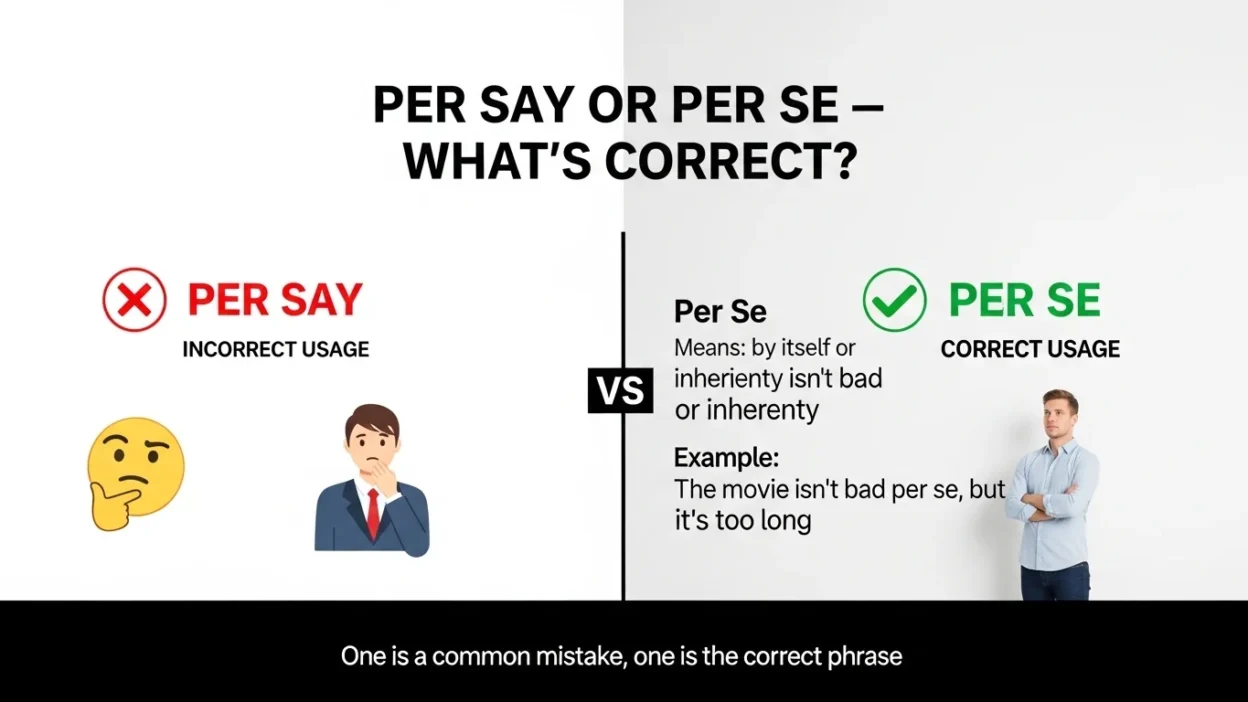
Quick Answer: Per Say or Per Se?
- ✅ Correct: Per se
- ❌ Incorrect: Per say
“Per se” is a Latin phrase meaning “by itself” or “in itself.”
“Per say” is just a misspelling and should be avoided in formal and informal writing.
What Does “Per Se” Mean?
The phrase per se comes from Latin, where it literally translates to “by itself.” In modern English, it’s used to clarify that something is being considered independently, not in combination with other factors.
Simple Meaning:
- Per se = inherently / intrinsically / in itself
Examples:
- “The movie isn’t bad per se, but it’s too long.”
- “Working from home isn’t stressful per se, but it can feel isolating.”
- “Money isn’t evil per se, but greed can be.”
In each case, per se separates the core idea from surrounding circumstances.
Why Do People Write “Per Say”?
The confusion comes from pronunciation.
Per se is pronounced like “per say”, which leads many people to spell it phonetically.
Common reasons for the mistake:
- Hearing the phrase more than seeing it written
- Assuming it’s English instead of Latin
- Overthinking spelling in formal writing
But remember: even though it sounds like “say,” the correct spelling is always se.
When and How to Use “Per Se”
Use per se when you want to clarify nuance especially when something isn’t entirely true or false on its own.
Best Use Cases:
- To soften a statement
- To add precision
- To avoid overgeneralization
Example Sentences:
- “It’s not wrong per se, just unconventional.”
- “This isn’t a problem per se, but it could become one.”
- “The design isn’t flawed per se, but it lacks creativity.”
Tip:
If you can replace the phrase with “in itself”, then per se is likely correct.
Per Say vs Per Se: Key Differences
| Feature | Per Se | Per Say |
| Correct spelling | ✅ Yes | ❌ No |
| Origin | Latin | Not a real term |
| Meaning | By itself / inherently | No meaning |
| Usage | Formal & informal writing | Should be avoided |
| Example | “Not bad per se” | Incorrect |
Common Mistakes to Avoid
Even experienced writers sometimes misuse per se. Here are the most frequent pitfalls:
1. Spelling It as “Per Say”
This is the biggest mistake. Always double-check the spelling.
2. Overusing the Phrase
Using per se too often can make your writing sound unnatural or overly formal.
❌ “This isn’t good per se, and the service isn’t great per se either.”
✅ “This isn’t particularly good, and the service isn’t great either.”
3. Using It Without Context
Per se should clarify meaning not confuse it.
❌ “It’s per se.”
✅ “It’s not dangerous per se, but caution is still needed.”
4. Misplacing It in Sentences
It usually works best after the word or idea it modifies.
✅ “The idea isn’t wrong per se.”
❌ “Per se the idea isn’t wrong.”
American vs British English Usage
Good news there’s no difference between American and British English when it comes to per se.
- Both use “per se” (never “per say”)
- Both use it in formal and semi-formal contexts
- Pronunciation is also the same
However, British English tends to use slightly more formal phrasing overall, so you may see per se used more frequently in academic or professional UK writing.
Related Words and Phrases (LSI Keywords)
To improve your vocabulary and SEO understanding, here are some similar expressions:
- In itself
- Intrinsically
- Essentially
- Fundamentally
- By definition
- Strictly speaking
- As such
- Technically
These alternatives can sometimes be replaced per se depending on context.
FAQs
1. Is “per say” ever correct?
No, per say is always incorrect. It’s a common misspelling of per se.
2. What language does “per se” come from?
It comes from Latin, where it means “by itself.”
3. Can I use “per se” in informal writing?
Yes, but use it sparingly. It can sound slightly formal in casual conversation.
4. Is “per se” outdated?
No, it’s still widely used in modern English, especially in professional and academic contexts.
5. Where should I place “per se” in a sentence?
Usually after the subject or idea you’re clarizing:
- “It’s not bad per se.”
6. Can I replace “per se” with “in itself”?
Yes, in most cases they mean the same thing.
7. Why is “per se” so commonly misunderstood?
Because it’s pronounced like “per say,” leading to spelling confusion.
8. Should I avoid using “per se”?
Not at all just use it correctly and naturally without overdoing it.
Summary
The difference between per say and per se is simple but important. Only “per se” is correct, and it means “by itself” or “inherently.” The incorrect version exists purely because of how the phrase sounds when spoken.
Using per se correctly can make your writing more precise and thoughtful. It helps you express subtle distinctions like saying something isn’t entirely wrong, but not entirely right either.
Actionable Takeaway
- Always write “per se,” never “per say.”
- Use it when you want to clarify meaning or avoid generalizations
- Replace it with “in itself” if you’re unsure
- Keep it natural don’t overuse it
Mastering small phrases like this builds credibility and sharpens your communication, especially in professional and academic writing.