Confused about paid vs payed? You’re not alone. Many English learners and even native speakers pause when writing this word. Is it “I paid the bill” or “I payed the bill”? One of them looks right… but which one actually is?
In this guide, we’ll break down the difference in a simple, clear, and friendly way.
You’ll learn the correct spelling, see real-life examples, understand common grammar mistakes, and finally feel confident using the right form every time.
Quick Answer
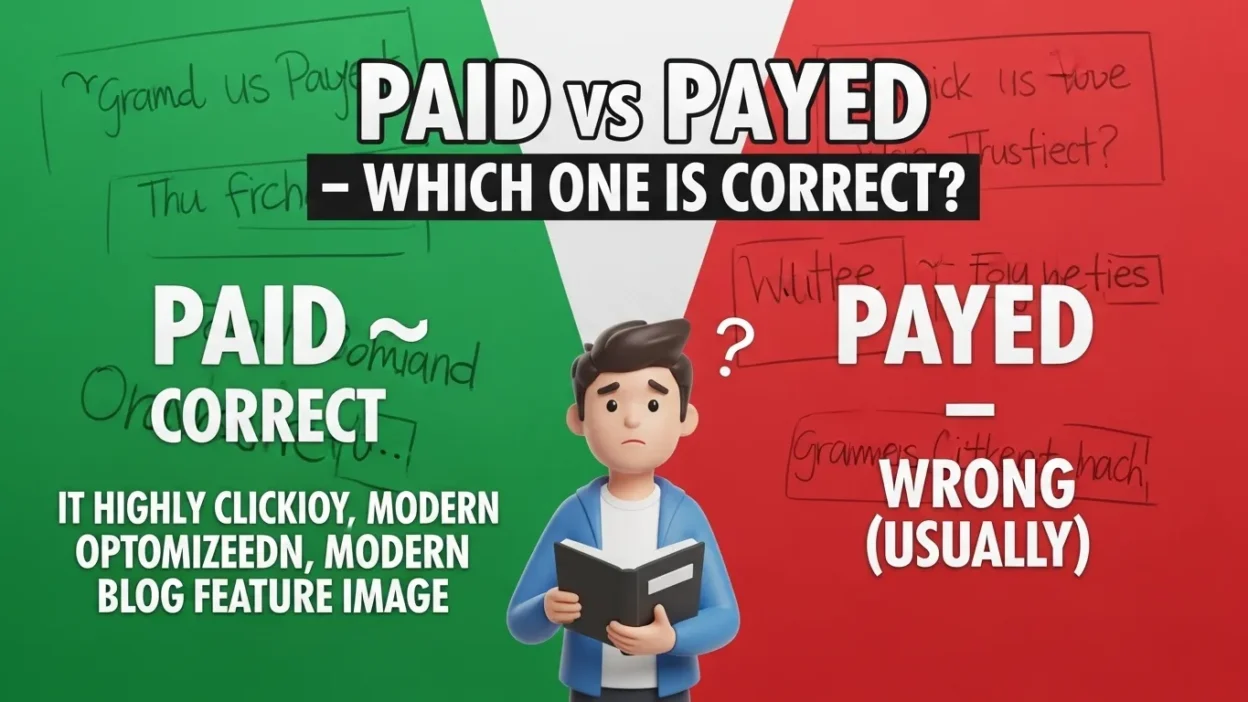
“Paid” is the correct past tense of “pay” in almost all situations.
“Payed” is rarely correct and is only used in specific nautical (sailing) contexts.
If you’re talking about money, salary, bills, costs, or payments, the correct word is always paid.
Example:
- ✅ I paid the rent yesterday.
- ❌ I payed the rent yesterday.
Now let’s explore why.
What Does “Paid” Mean?
Paid is the past tense and past participle of the verb “pay.”
It refers to:
- Giving money for something
- Settling a bill
- Receiving wages
- Suffering a consequence (“paid the price”)
Common Uses of “Paid”
Here are everyday examples:
- She paid the electricity bill.
- I paid for dinner.
- They were paid on Friday.
- He paid attention during class.
- She paid the price for her mistake.
Notice something important: even in phrases that don’t involve money (like “paid attention”), we still use paid, not payed.
Grammar Rule
“Pay” is an irregular verb.
Base form: pay
Past tense: paid
Past participle: paid
Just like:
- Say → Said
- Lay → Laid
It does NOT follow the regular “-ed” pattern.
That’s why “payed” looks logical but it’s usually wrong.
What Does “Payed” Mean?
Here’s where things get interesting.
“Payed” is a real word but it is not the past tense of “pay” in financial situations.
“Payed” is used mainly in nautical or sailing contexts. It refers to:
- Sealing a boat with tar
- Letting out rope or cable gradually
Most people will never need to use this word in daily life.
Rare Examples of “Payed”
- The sailors payed the deck with tar.
- The crew payed out the rope slowly.
Unless you are writing about ships, boats, or sailing, you almost certainly need paid, not payed.
Paid vs Payed:
| Feature | Paid | Payed |
| Part of speech | Past tense of “pay” | Rare nautical verb |
| Used for money? | ✅ Yes | ❌ No |
| Used in everyday English? | ✅ Always | ❌ Very rarely |
| Grammar status | Correct standard spelling | Correct only in sailing contexts |
| Example | I paid the bill | The sailor payed the rope |
If you’re unsure, choose paid. It’s correct 99.9% of the time.
Common Mistakes People Make
Let’s clear up some frequent grammar errors related to paid vs payed.
1. Adding “-ed” Automatically
Many learners think:
Pay + ed = Payed
This works for regular verbs like:
- Walk → Walked
- Clean → Cleaned
But “pay” is irregular, so the correct form is paid.
2. Spellchecker Confusion
Some spellcheck tools don’t flag “payed” because it is technically a real word. But that doesn’t mean it’s correct in your sentence.
Always check the meaning and context.
3. Mixing It in Formal Writing
Using “payed” instead of “paid” in:
- Job applications
- Academic essays
- Business emails
- Blog posts
can reduce credibility and professionalism.
For SEO writers, bloggers, and content creators, this mistake can also affect readability and trust.
Paid in Common Expressions
Here are some popular phrases where “paid” is always correct:
- Paid in full
- Paid off
- Paid attention
- Paid the price
- Paid a visit
- Well-paid job
- Poorly paid workers
Never use “payed” in these phrases.
American vs British English: Is There Any Difference?
Good news there is no difference between American and British English in this case.
Both American English and British English use:
- ✅ Paid (standard past tense)
- ❌ Payed (only nautical)
Whether you’re writing for a US, UK, Canadian, or Australian audience, the rule stays the same.
That makes things easier!
Why Does “Payed” Even Exist?
English spelling evolved over centuries. Some verbs changed form irregularly.
Originally, “pay” came from Old French and Latin roots. Over time, its past tense became “paid,” not “payed.”
Meanwhile, the nautical term “payed” developed separately in maritime language.
Language history can be fascinating but for practical writing, just remember:
Money = Paid
Boats = Maybe “Payed”
Memory Trick to Remember the Difference
Here’s a simple trick:
Think of the word “aid.”
Paid → has “aid” in it
You give “aid” when you give money.
Both words relate to giving.
So:
- If it involves giving money → use paid
This mental shortcut works beautifully.
More Example Sentences for Clarity
Let’s practice with real-life examples.
Correct Usage:
- She paid her credit card bill.
- I paid $50 for the shoes.
- They were paid late this month.
- He finally paid off his loan.
- The company paid compensation.
Incorrect Usage:
- ❌ She payed her credit card bill.
- ❌ I payed $50 for the shoes.
- ❌ He payed attention in class.
These are wrong unless we’re talking about ships.
FAQs
1. Is “payed” ever correct?
Yes, but only in nautical contexts, such as sealing a boat with tar or letting out rope.
2. Is “paid” the past tense of pay?
Yes. “Paid” is both the past tense and past participle of “pay.”
3. Why do people write “payed” instead of “paid”?
Because many English verbs form their past tense with “-ed,” so learners assume “pay” follows the same rule.
4. Is “payed attention” correct?
No. The correct phrase is “paid attention.”
5. Does British English use “payed”?
No, not for financial meaning. British English also uses “paid.”
6. Is “paid off” correct?
Yes. “Paid off” is a common phrasal verb meaning to settle a debt or achieve success.
7. How can I avoid this mistake?
Remember: If it involves money, salary, bills, or consequences, use paid.
Final Summary
Understanding paid vs payed is simpler than it first appears. “Paid” is the correct and standard past tense of “pay” in almost every situation involving money, salaries, bills, debts, or even figurative expressions like “paid attention.”
It’s an irregular verb, which is why it doesn’t follow the normal “-ed” pattern.
“Payed,” on the other hand, is a rare and specialized term used mainly in nautical contexts. Unless you’re writing about ships or sailing, you probably won’t need it.
For everyday writing, academic work, business communication, or SEO content, paid is almost always the right choice.
Actionable Takeaway
Before writing “payed,” pause and ask yourself:
Am I talking about money, payment, attention, or consequences?
If yes use paid confidently.
Keep this rule in mind, and you’ll never mix them up again.

Edward Axel is the administrator of SyntaxlyHub, responsible for overseeing site operations, content management, and technical performance. He ensures accuracy, consistency, and smooth functionality while supporting the team in delivering reliable, high-quality grammar resources and a user-friendly learning experience for readers worldwide.