If you’ve ever paused mid-sentence wondering whether to write openned or opened, you’re not alone.
English spelling can feel tricky, especially when similar-looking words seem plausible. The good news? This is a simple fix once you understand one key rule.
In this guide, you’ll learn which spelling is correct, why the confusion happens, and how to remember the right form every time.
By the end, you’ll feel confident using it in emails, essays, captions, and professional writing.
Quick Answer
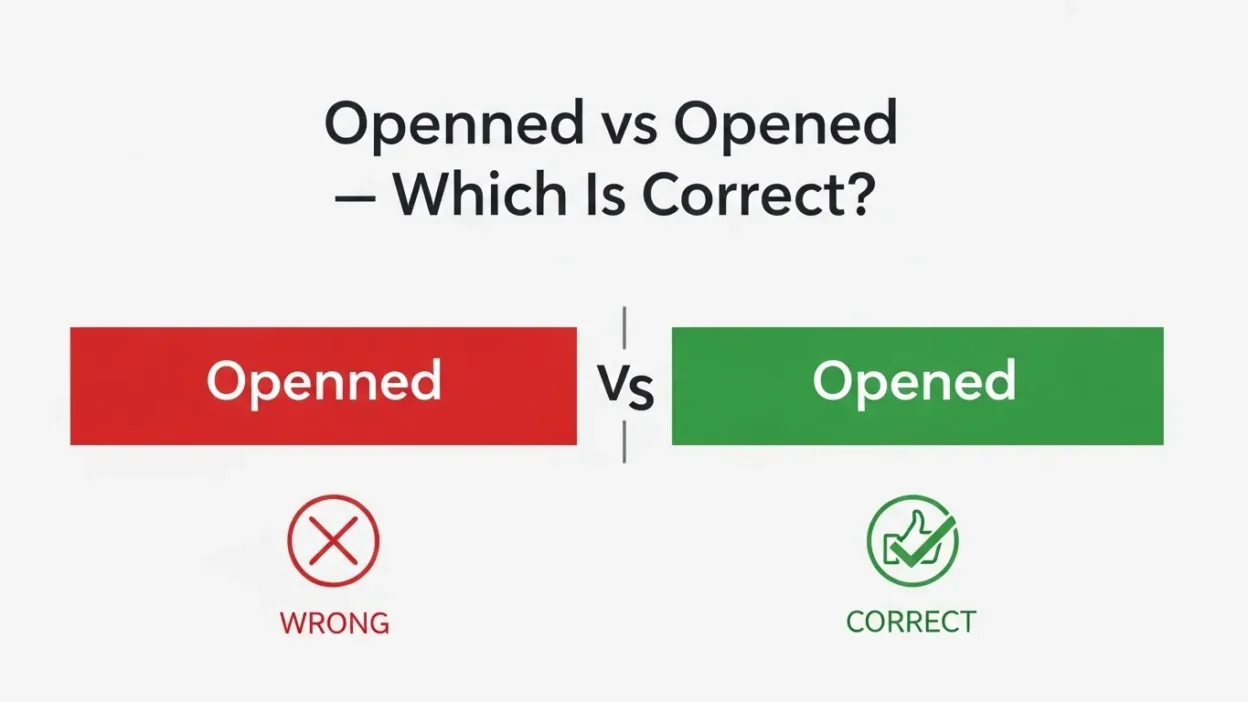
Opened is the correct spelling.
Openned is incorrect and not a real English word.
Meaning of “Opened”
Opened is the past tense and past participle of the verb open, which means:
- To make something no longer closed
- To start or begin something
- To make something accessible or available
Examples
- She opened the door quietly.
- They opened a new café last week.
- He opened the file on his laptop.
Because open is a regular verb, it follows the standard rule:
verb + –ed = past tense
So:
- open → opened ✔
- open → openned ✘
Why People Mistakenly Write “Openned”
This error usually happens because of a spelling pattern misunderstanding. Some English verbs double the final consonant before adding –ed, such as:
- stop → stopped
- plan → planned
- drop → dropped
Writers sometimes assume open follows the same pattern. But it doesn’t, because of this rule:
You only double the final consonant if the word ends in vowel + consonant AND the stress is on the last syllable.
Examples where doubling happens:
- admit → admitted (stress on “mit”)
- refer → referred (stress on “fer”)
But open is pronounced OH-pen, with stress on the first syllable, so no doubling is needed.
Correct: opened
Incorrect: openned
Simple Rule to Remember
If the stress isn’t on the last syllable, don’t double the final consonant before adding –ed.
Since open is stressed at the beginning, you write:
open + ed = opened
A helpful memory trick:
“Open stays open—no extra N needed.”
Comparison Table: Openned vs Opened
| Word | Correct? | Meaning | Example Sentence |
| Opened | ✔ Yes | Past tense of open | She opened the gift. |
| Openned | ✘ No | Not a real word | Incorrect spelling |
Examples in Sentences
Seeing real usage makes spelling stick faster. Here are examples across contexts.
Daily conversation
- I opened the window because it was hot.
- He opened the package carefully.
Professional writing
- The company opened a new branch in March.
- She opened the meeting with a welcome speech.
Academic writing
- The researcher opened the discussion with a key question.
Digital communication
- I opened your email this morning.
- They opened the link without hesitation.
Common Mistakes to Avoid
Writers often make predictable spelling mistakes with opened. Watch out for these:
- Writing openned because it “looks right”
- Typing quickly and accidentally doubling the N
- Assuming all verbs double consonants in past tense
- Copying incorrect spelling from social media posts
Pro tip: Spell-checkers usually flag openned, but it’s still good to know the rule yourself.
American vs British English Differences
Here’s the reassuring part:
There is no difference between American and British English for this word.
Both use:
- open → opened ✔
Unlike words such as colour/color or travelled/traveled, the spelling of opened stays the same worldwide.
So whether you’re writing for:
- U.S. readers
- U.K. readers
- International audiences
Opened is always correct.
Related Forms of “Open”
Understanding related word forms helps reinforce spelling accuracy.
Verb forms
- open present
- opened past
- opening present participle
Adjective uses
- open door
- open mind
- open road
Noun uses
- the open
- grand opening
All these forms keep a single N, which reinforces why openned is incorrect.
Synonyms for “Opened”
Using synonyms improves writing variety and readability. Depending on context, you can replace opened with:
- unlocked
- began
- started
- launched
- initiated
- unveiled
- activated
- revealed
Example
- She opened the event.
→ She launched the event.
Mini Spelling Test (Try Yourself)
Which sentence is correct?
- She openned the letter slowly.
- She opened the letter slowly.
Answer: Sentence 2 ✔
If you chose correctly, great! If not, don’t worry—now you know the rule.
Why Correct Spelling Matters
Using correct spelling isn’t just about grammar rules. It affects:
- Professional credibility
- Academic accuracy
- Reader trust
- SEO quality
- Clarity of communication
Even a small mistake like openned can make writing look rushed or unpolished. Correct spelling shows attention to detail and confidence.
FAQs
1. Is “openned” ever correct?
No. It’s always a misspelling. The correct form is opened.
2. Why doesn’t open double the N?
Because the stress is on the first syllable (OH-pen), so the consonant isn’t doubled before adding –ed.
3. Is it a regular verb?
Yes. It follows the standard pattern: verb + ed.
4. Do any dialects use “openned”?
No standard English dialect uses it. It’s considered incorrect everywhere.
5. How can I remember the correct spelling?
Think: Open doesn’t need extra letters to open.
6. Does spell-check catch “openned”?
Usually yes, but not always—especially in informal apps or captions.
7. Is opened used as both verb and adjective?
Yes. Example: The store is opened (verb phrase) or an opened box (adjective use).
8. What’s the difference between open and open?
Open is present tense; opened is past tense.
Summary
Choosing between openned or opened is actually simple once you know the rule: only double the final consonant when the stress falls on the last syllable.
Since open is stressed at the beginning, the correct past tense is always opened. The spelling openned is a common mistake but not a real English word.
Correct spelling strengthens your writing, boosts credibility, and ensures your message is clear.
Small details like this can make a big difference, whether you’re writing professionally, academically, or casually online.
Actionable takeaway:
Whenever you write the past tense of open, remember:
👉 One N is enough opened is always correct.