Choosing between “my father and I” and “my father and me” can feel confusing, even for fluent English speakers. You’ve probably paused mid-sentence, unsure which one sounds right. The truth is, both are correct but only in the right context.
This guide will help you finally understand the difference in a simple, memorable way. By the end, you’ll not only know which one to use, but you’ll also feel confident using them naturally in everyday conversation and writing.
Quick Answer
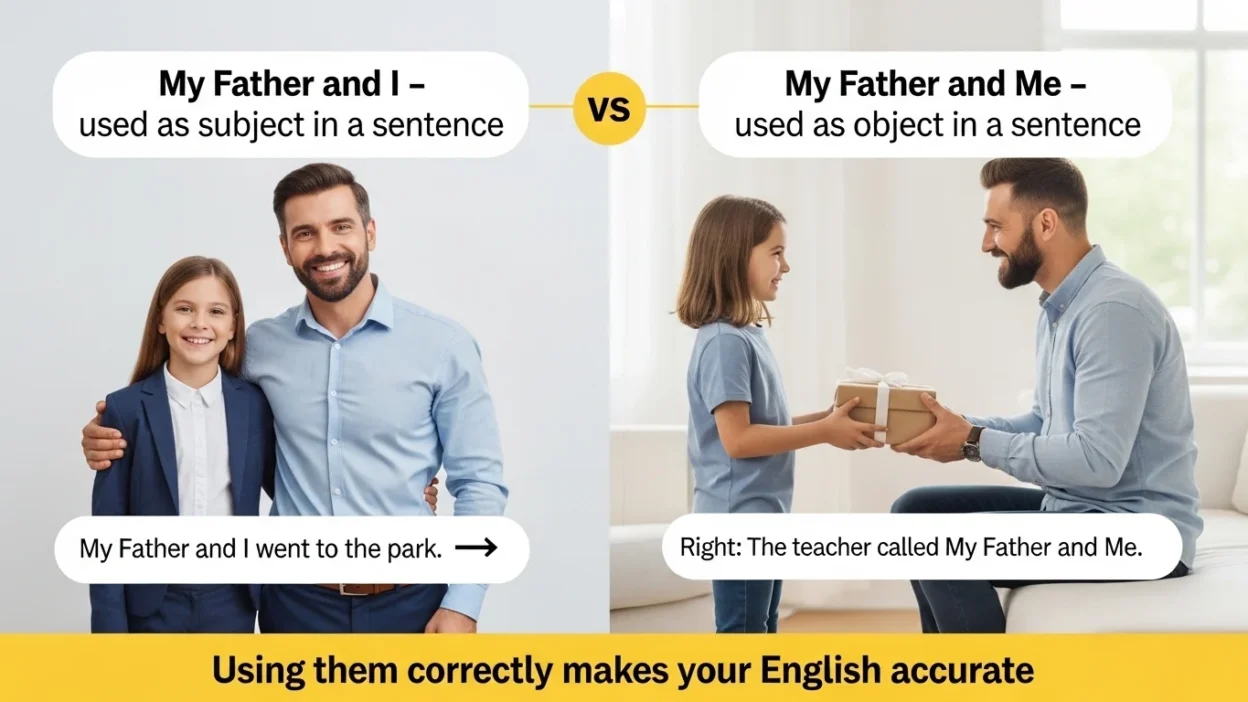
- Use “my father and I” when the phrase is the subject of a sentence.
- Use “my father and me” when the phrase is the object of a sentence.
Simple trick: Remove “my father and” and see what sounds correct:
- “I went to the store” ✅ → My father and I went to the store
- “She called me” ✅ → She called my father and me
What Do “My Father and I” and “My Father and Me” Mean?
Both phrases refer to you and your father together. The difference is not meaning it’s grammar.
- “My father and I” = subject form (doing the action)
- “My father and me” = object form (receiving the action)
Think of it like:
- I → subject
- Me → object
When to Use “My Father and I”
Use this phrase when you and your father are performing the action in a sentence.
Examples:
- My father and I are going on a trip.
- My father and I enjoy watching cricket together.
- My father and I built this house.
Quick Breakdown:
In these sentences, “my father and I” are doing something, so it acts as the subject.
When to Use “My Father and Me”
Use this phrase when you and your father are receiving the action.
Examples:
- She invited my father and me to dinner.
- The teacher gave my father and me an award.
- They told my father and me the truth.
Quick Breakdown:
Here, “my father and me” is affected by the action it’s the object.
The Easiest Trick to Always Get It Right
Remove “my father and” from the sentence.
Example 1:
- My father and I went to the park
→ Remove: “I went to the park” ✔️ correct
Example 2:
- She gave my father and me a gift
→ Remove: “She gave me a gift” ✔️ correct
Example 3 (Incorrect):
- She gave my father and I a gift
→ Remove: “She gave I a gift” ❌ wrong
This simple test works almost every time.
Common Mistakes to Avoid
Many people make mistakes because they think “my father and I” sounds more formal or correct in every situation but that’s not true.
Mistake 1: Using “I” Everywhere
❌ She called my father and I
✔️ She called my father and me
Mistake 2: Overcorrecting in Speech
Some speakers avoid “me” completely, thinking it sounds informal. But “me” is perfectly correct when used as an object.
Mistake 3: Ignoring Sentence Role
If you don’t check whether the phrase is a subject or object, errors happen easily.
Comparison Table for Clarity
| Usage Type | Correct Phrase | Example Sentence |
| Subject (doing action) | My father and I | My father and I went shopping |
| Object (receiving action) | My father and me | She invited my father and me |
| After prepositions | My father and me | This gift is for my father and me |
| Informal speech confusion | Often wrong | “Between my father and I” ❌ |
Special Case: After Prepositions
Always use “my father and me” after prepositions like:
- to
- for
- with
- between
Examples:
- This is a surprise for my father and me.
- Between my father and me, this is a secret.
- She sat with my father and me.
American vs British English Differences
Good news there is no difference between American and British English in this rule.
Both follow the same grammar structure:
- Subject → “my father and I”
- Object → “my father and me”
However, in informal British speech, you might occasionally hear incorrect usage like:
- “Me and my father went…” (informal, not grammatically standard)
In formal writing (both US and UK), correct grammar is always expected.
Related Keywords and Variations
To deepen your understanding, here are similar phrases that follow the same rule:
- My mother and I / my mother and me
- John and I / John and me
- My friends and I / my friends and me
The same rule applies every time:
- Subject → I
- Object → me
FAQs
1. Is “my father and I” always correct?
No. It is only correct when used as the subject of a sentence.
2. Why do people say “my father and I” even when it’s wrong?
Because it sounds more formal, many people overuse it even in incorrect situations.
3. Is “my father and me” informal?
No, it is grammatically correct when used as an object.
4. Can I say “me and my father”?
In informal speech, yes but in proper grammar, it should be:
- “My father and I” (subject)
5. What about “between my father and I”?
This is incorrect. It should be:
- “between my father and me”
6. Does this rule apply in writing and speaking?
Yes, especially in formal writing. In casual speech, mistakes are common but still technically incorrect.
7. How can I remember this easily?
Use the removal trick:
Take out “my father and” and test the sentence.
8. Is it okay to break the rule in casual conversation?
People often do, but it’s better to use correct grammar especially in professional or academic settings.
Summary
Understanding the difference between “my father and I” and “my father and me” comes down to one simple idea: subject vs object. If you’re doing the action, use “I.” If you’re receiving the action, use “me.”
This small distinction makes a big difference in how polished and correct your English sounds.
Once you start using the removal trick, this rule becomes second nature. You won’t need to guess anymore you’ll just know what feels right because you understand why it’s right.
Actionable Takeaway
Next time you write or speak:
- Pause for a second
- Remove “my father and”
- Choose “I” or “me” based on what sounds correct
Practice this with a few sentences daily, and soon you’ll never mix them up again.