If you’ve ever paused mid-sentence wondering whether to write minuet or minute, you’re not alone. These two words look almost identical but mean completely different things and using the wrong one can quietly confuse your readers.
In this guide, you’ll quickly understand the difference between minuet vs minute, learn how to use each word correctly, and avoid the common mistakes that even experienced writers sometimes make.
Quick Answer
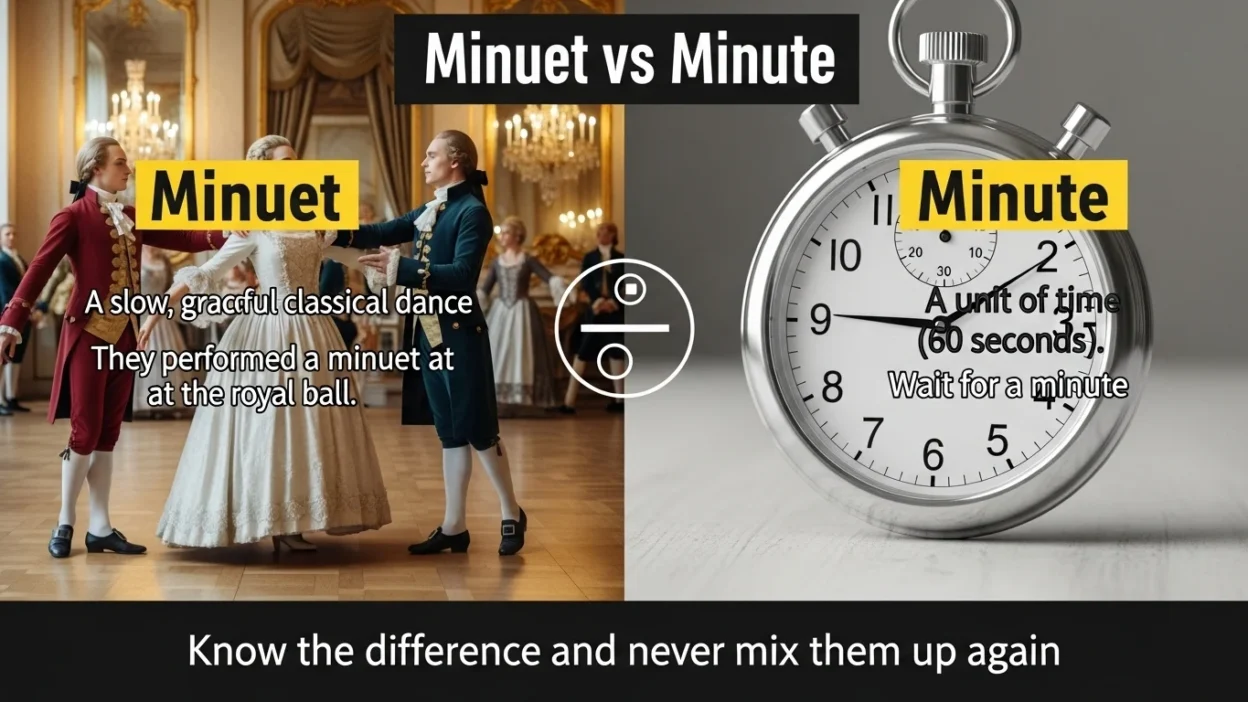
- Minuet: A type of slow, graceful dance or a piece of classical music.
- Minute: Can mean a unit of time (60 seconds) or something very small.
👉 Simple trick: Minuet = music/dance, Minute = time or tiny.
What Does “Minuet” Mean?
A minuet is a formal dance that originated in France during the 17th century. It’s also used to describe the music composed for that dance, often found in classical compositions.
Key Points:
- Pronunciation: min-yoo-et
- Related to classical music and ballroom dance
- Elegant, slow, and structured
Examples:
- The orchestra performed a beautiful minuet during the concert.
- She learned a traditional minuet for the dance recital.
What Does “Minute” Mean?
The word minute has two completely different meanings depending on pronunciation.
1. Minute (Time)
Pronunciation: min-it
Meaning: A unit of time equal to 60 seconds
Examples:
- I’ll be ready in a minute.
- The meeting lasted 30 minutes.
2. Minute (Very Small)
Pronunciation: my-newt
Meaning: Extremely small or tiny
Examples:
- The scientist examined minute details under the microscope.
- There was a minute crack in the glass.
Minuet vs Minute: Key Differences
Here’s a simple comparison to make things crystal clear:
| Feature | Minuet | Minute |
| Meaning | Dance or musical piece | Time unit or very small |
| Pronunciation | min-yoo-et | min-it / my-newt |
| Usage Context | Music, dance, art | Time, size, measurements |
| Common Confusion | Mistaken for “minute” | Confused with “minuet” in writing |
How to Remember the Difference
A quick memory trick can save you every time:
- Minuet → “u” for “music” 🎵
- Minute → “time” or “tiny”
If you see a sentence about dancing or classical music, it’s almost certainly minuet. If it’s about time or size, go with minute.
Common Mistakes to Avoid
Even fluent English speakers mix these up, especially in writing. Here are the most common errors:
❌ Mistake 1: Using “minute” instead of “minuet”
- Incorrect: The orchestra played a soft minute.
- Correct: The orchestra played a soft minuet.
❌ Mistake 2: Spelling confusion
Because both words look similar, it’s easy to type the wrong one accidentally especially with autocorrect.
❌ Mistake 3: Pronunciation mix-up
- “Minute” (tiny) = my-newt
- “Minuet” = min-yoo-et
They sound different, but in fast speech, confusion can happen.
American vs British English Differences
Good news there’s no major spelling difference between American and British English for these words.
However:
- Pronunciation may vary slightly in accent
- Usage remains the same in both regions
So whether you’re writing for a US or UK audience, the rules for minuet vs minute stay consistent.
Real-Life Usage Scenarios
Understanding context makes everything easier. Here are practical examples:
In Music:
- Mozart composed several elegant minuets.
In Daily Conversation:
- Give me a minute, I’ll call you back.
In Scientific Writing:
- The experiment revealed minute variations in temperature.
FAQs
1. Are “minuet” and “minute” pronounced the same?
No.
- Minuet = min-yoo-et
- Minute = min-it or my-newt
2. Can “minuet” ever mean time?
No. Minuet is strictly related to music and dance.
3. Why does “minute” have two meanings?
English often evolves with multiple meanings for one word. Context determines whether it refers to time or size.
4. Which one is more commonly used?
Minute is far more common in everyday language, especially for time.
5. Is “minuet” still used today?
Yes, mostly in classical music, dance studies, and historical contexts.
6. How do I quickly check which word to use?
Ask yourself:
- Is it about music/dance? → Minuet
- Is it about time or size? → Minute
7. Is “minute detail” correct?
Yes. It means very small detail.
8. Can I use “minuet” metaphorically?
Rarely. It’s mostly used literally, though sometimes metaphorically for something graceful or formal.
Final Summary
Understanding the difference between minuet vs minute comes down to context and pronunciation. While they may look similar, their meanings are completely unrelated. One belongs to the world of classical music and dance, while the other is used in everyday conversation to describe time or something tiny.
By remembering simple cues like associating minuet with music and minute with time you can confidently use both words without hesitation. These small distinctions can make a big difference in clarity and professionalism in your writing.
Actionable Takeaway
Next time you write:
- Pause for a second
- Identify the context (music or time/size)
- Choose the correct word confidently
With just a little awareness, you’ll never mix up minuet and minute again.