If you’ve ever typed “messege” and wondered whether it’s right or wrong, you’re not alone. This is one of the most common spelling mix-ups in English, especially for learners, fast typists, and even native speakers.
The confusion usually happens because the word sounds like it could be spelled several ways but only one spelling is correct.
In this friendly guide, we’ll break down messege vs message in the simplest way possible.
You’ll learn the correct spelling, meanings, examples, mistakes to avoid, and memory tricks so you never doubt yourself again. Let’s clear it up once and for all.
Quick Answer
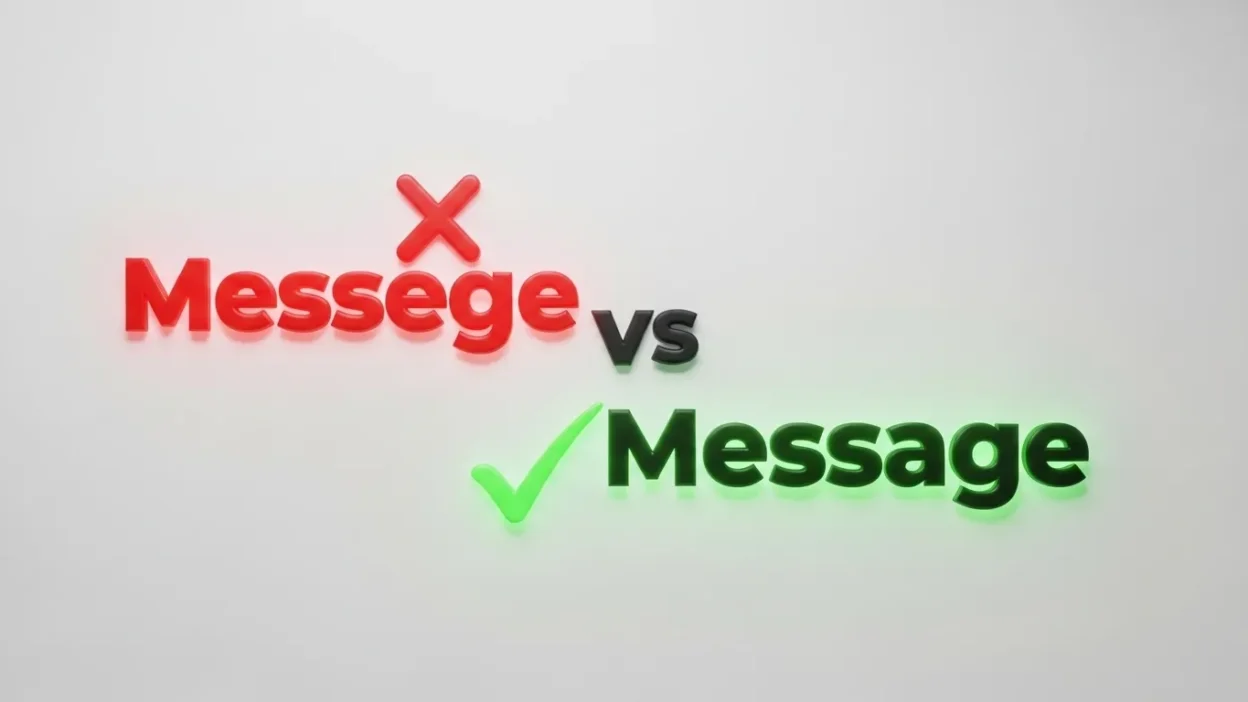
“Message” is the correct spelling.
“Messege” is incorrect and not a real English word.
Always use messages in formal writing, emails, exams, and professional communication.
Meaning of “Message”
A message is a piece of information sent from one person to another. It can be spoken, written, texted, emailed, or even implied through actions.
Common meanings:
- A written or spoken communication
- A text or chat notification
- An important idea or lesson
- A signal or warning
Examples
- I sent you a message last night.
- She left a message on my phone.
- The film carries a powerful message about kindness.
In all these cases, message is the only correct spelling.
Why People Write “Messege” Instead of “Message”
The misspelling usually happens for three reasons:
- Pronunciation confusion: The word sounds like mes-ij, which can trick the brain into guessing the spelling.
- Typing speed: When typing quickly, fingers may swap letters.
- Phonetic spelling habit: Some people spell words exactly as they sound.
However, English spelling isn’t always phonetic, and messege doesn’t follow standard spelling rules.
Messege vs Message Comparison Table
| Word | Correct? | Meaning | Should You Use It? |
| Messege | ❌ Incorrect | None | Never |
| Message | ✅ Correct | Communication or information | Always |
This simple rule helps:
👉 If you see messege, correct it immediately to message.
Correct Usage of “Message” in Sentences
Seeing examples helps your brain remember spelling patterns.
Everyday conversation
- Did you read my message?
- He sent a voice message.
Formal writing
- Please leave a message after the tone.
- The manager delivered an important message.
Digital communication
- I received your WhatsApp message.
- Your message has been delivered.
Notice how the spelling never changes. It’s always message — never messege.
Common Mistakes Related to “Message”
Here are errors people frequently make and how to fix them:
Incorrect → Correct
- messege → message
- mesage → message
- messsage → message
- messegeing → messaging
Tip: The correct spelling always has:
- ss in the middle
- age at the end
A quick memory trick:
“A message has two S’s because it’s serious communication.”
Spelling Rule Behind “Message”
The word comes from Old French message and Latin missus (meaning “sent”). Because of its origin, it keeps its traditional spelling rather than following modern phonetic rules.
That’s why:
- It uses ss instead of s
- It ends with -age, not -ege
Words with similar endings:
- package
- village
- damage
- courage
Notice they all end in -age, not -ege.
American vs British English Differences
Good news — there is no difference between American and British English spelling for this word.
Both use:
- message ✅
Neither uses:
- messege ❌
So whether you’re writing for the US, UK, Canada, Australia, or anywhere else, message is universally correct.
Related Words and Variations
Understanding related forms helps reinforce the correct spelling.
- Messages — plural
- Messaging — the act of sending messages
- Messaged — past tense
- Messenger — a person or app that delivers messages
All of these keep the same root spelling: message.
Easy Memory Tricks
If you struggle to remember spelling, these tricks help:
1. Visual pattern trick
Picture the word divided:
mes + sage → message
Both parts look like real English letter patterns.
2. Rhyme trick
“A message has age.”
This reminds you it ends in -age, not -ege.
3. Keyboard trick
Type slowly: M-E-S-S-A-G-E
Double S always comes before A.
When “Messege” Might Appear
You might still see messege online in:
- Social media comments
- Casual chats
- Typing errors
- Non-native writing
But remember: seeing a mistake often doesn’t make it correct. Dictionaries, grammar tools, and professional writing standards all confirm that messege is wrong.
Why Correct Spelling Matters
Using correct spelling like message instead of messege is important because:
- It improves credibility
- It makes writing easier to read
- It shows professionalism
- It avoids misunderstanding
In professional emails, job applications, or academic work, spelling errors can leave a negative impression even if your ideas are excellent.
FAQs
1. Is messege ever correct?
No. It’s always a misspelling. The correct form is message.
2. Why do people confuse messege and message?
Because the pronunciation doesn’t clearly reveal the spelling, and English spelling isn’t purely phonetic.
3. Is the message spelled differently in British English?
No. Both British and American English spell it the same way: message.
4. How can I remember the correct spelling?
Use the rule: Double S + age ending = message.
5. What part of speech is “message”?
It’s mainly a noun but can also be used as a verb (e.g., “I’ll message you later.”).
6. Is “messaging” spelled with one or two s’s?
Two. It comes from a message, so the double S stays.
7. Can autocorrect fix “messege”?
Most devices will automatically change it to “message,” but it’s best to learn the correct spelling yourself.
8. What are synonyms for messages?
Note, communication, text, memo, notification, announcement, signal.
Summary
The difference between messege vs message is simple: one is wrong, and one is right. Message is the only correct spelling recognized in English dictionaries and writing standards.
The incorrect form, messege, usually appears due to typing mistakes or pronunciation confusion, but it should never be used in formal or correct writing.
Remembering the correct spelling is easier than it seems. Focus on the pattern double S + age ending, and you’ll always get it right.
If you’re writing emails, essays, texts, or professional documents, using a message ensures clarity, credibility, and confidence.
Actionable takeaway:
Save this rule: If it doesn’t end in “-age,” it’s not a message. Keep this in mind, and you’ll never spell it wrong again.

Edward Axel is the administrator of SyntaxlyHub, responsible for overseeing site operations, content management, and technical performance. He ensures accuracy, consistency, and smooth functionality while supporting the team in delivering reliable, high-quality grammar resources and a user-friendly learning experience for readers worldwide.