
Accessing your online account should always be a quick, seamless process that saves you time and keeps your personal dashboard completely secure. Whether you are checking your daily stats, managing user profile settings, or exploring new features, getting past the main sign-in screen is your gateway to everything. With updated authentication protocols and user-friendly web design, navigating your member portal has never been easier or more reliable.
Ever wondered why so many people get stuck right at the account access page? Entering your user credentials like your registered email address or strong password seems simple, but small mistakes often trigger access errors or annoying account locks.
If you need to Login or Log In, knowing the right steps prevents unnecessary headaches. Master these simple security tips to ensure trouble-free access every time you open your digital workspace.
What Does Login Mean?
The single-word term “login” functions strictly as a noun or an adjective within English grammar. As a noun, it identifies the specific credentials, username, passcode, or digital key required to enter a secure computer system, online portal, or mobile application. For instance, when a platform prompts a visitor to enter their user credentials, it refers directly to their unique identity data stored within the authentication database. As an adjective, “login” modifies another noun, describing components related to the sign-in procedure. Examples include “login page,” “login screen,” “login attempt,” or “login credentials.”
In modern digital ecosystems, the term carries heavy weight regarding user interface design and cybersecurity infrastructure. When software engineers design user authentication workflows, they build a dedicated login area where encrypted sessions originate. Understanding this distinction prevents usability friction. If a user interface designer labels a button with the noun form when expecting an action, it creates subtle technical inaccuracies. Modern content strategies demand strict adherence to these grammatical definitions to ensure content clarity across enterprise software platforms, documentation portals, and consumer web services.
What Does Log In Mean?
The two-word phrase “log in” operates as a phrasal verb. It describes the physical or digital act of authenticating one’s identity to gain authorized access to a restricted system, application, or network. The word “log” acts as the primary action verb, while “in” functions as a prepositional adverb indicating movement or entry into a secured environment. Whenever an individual performs the action—such as typing credentials and clicking an action button—they log in to their personal account.
Historically, the phrase originates from maritime practices where sailors recorded entry data into a physical logbook. As computing expanded during the late twentieth century, computer scientists adopted this terminology to describe recording a user’s presence into a system’s connection registry. Today, tech-literate users perform this action daily across cloud services, personal computers, and streaming media apps. Because it denotes an ongoing action, it changes form based on tense, allowing users to write “logging in,” “logged in,” or “logs in.”
Login or Log In: What Is the Difference?
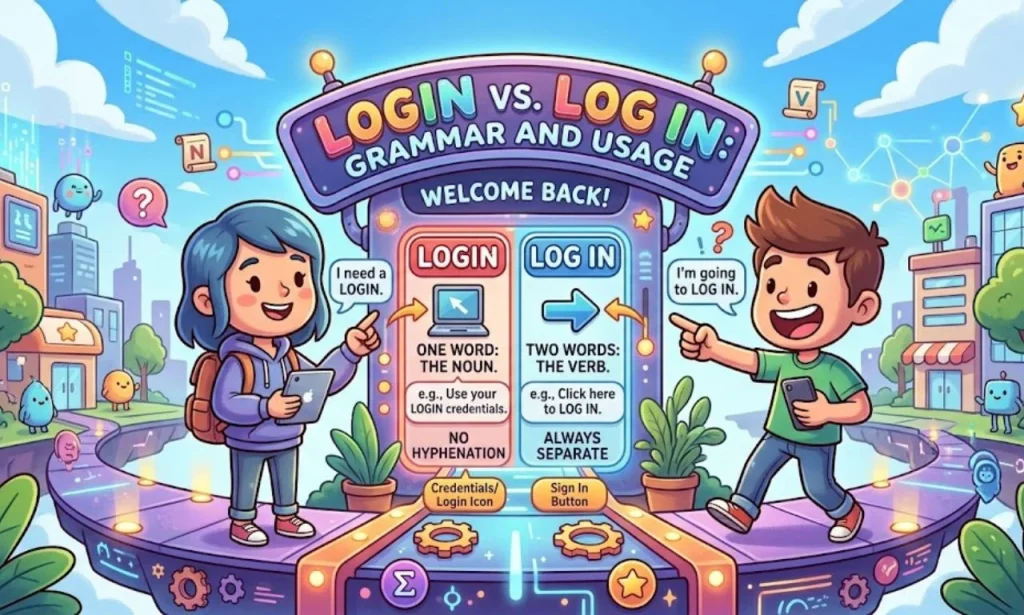
The fundamental distinction between Login or Log In centers on grammatical function: one describes a thing or attribute, while the other describes an action. Mixing up these terms is one of the most frequent errors found across modern web copy and user interfaces.
| Feature / Aspect | Login (Single Word) | Log In (Two Words) |
| Part of Speech | Noun or Adjective | Phrasal Verb |
| Primary Function | Names the portal, screen, or credentials | Describes the action of signing in |
| Verb Tense Flexibility | Fixed (Cannot be conjugated) | Flexible (logs in, logged in, logging in) |
| Common UI Placement | Page headings, field labels, button adjectives | Call-to-action (CTA) buttons, instructional text |
| Example Usage | “Please check your login details.” | “You must log in to view your balance.” |
Using the table above highlights how sentence role dictates spelling. If you can replace the term with “sign-in credentials” or “entry portal,” the single-word noun is required. If you can substitute the phrase with “sign in” or “access the system,” the two-word phrasal verb is the grammatically correct choice.
Login vs Log In: Grammar and Usage
Mastering grammar rules for computing terminology requires recognizing how closed compounds evolve. In English, phrasal verbs frequently transform into compound nouns over time. However, their action-oriented counterparts remain split into two distinct words to preserve proper verb structure.
The Role of Phrasal Verbs
Phrasal verbs combine a base verb with a preposition or adverb to create a complete idiomatic action. In “log in,” the verb “log” carries the grammatical tense. Therefore, when writing about past events, one writes “the user logged in yesterday,” rather than modifying the compound form.
The Role of Compound Nouns and Adjectives
When the action consolidates into a single entity, it forms a closed compound. “Login” acts as a standalone noun identifying the system entry mechanism or as a modifier attached to another noun.
- Correct Noun Usage: “I forgot my login.”
- Correct Adjective Usage: “Please update the login screen.”
- Correct Verb Usage: “Please log in using your account password.”
Login or Log In: Which One Is Correct?
Both variations are entirely correct, but their correctness depends exclusively on context. Neither spelling is inherently superior or outdated; rather, each fulfills a specific structural responsibility within a sentence.
When drafting technical documentation, digital marketing copy, or software user interfaces, applying the wrong variation introduces subtle errors that lower writing quality. If you write “Click here to login,” the sentence contains a grammatical error because an adjective or noun is serving as an action verb. The proper construction is “Click here to log in.” Conversely, writing “Enter your log in details” incorrectly uses a phrasal verb to modify a noun, where the compound adjective “login” belongs.
Login or Log In in a Sentence
To illustrate how these terms function in real-world scenarios, consider how shifting sentence intent requires changing the word choice. Sentences focused on user actions demand the two-word phrasal verb, whereas sentences describing portal elements or credentials require the single-word compound.
- Scenario A (Action): “Users must log in before accessing confidential financial records.”
- Scenario B (Attribute): “The developer updated the login page security features.”
- Scenario C (Identity Data): “Keep your login safe to prevent unauthorized access.”
By examining the target of the sentence, writers can instantly identify whether they are describing an activity or an object.
Examples of Login in Sentences

Below are practical examples demonstrating how “login” functions correctly as a noun and as an adjective in technical and everyday contexts.
As a Noun
- “Your login consists of your email address and a personal identification number.”
- “The database rejected my login because the account was temporarily locked.”
- “She saved her website login in an encrypted password manager.”
As an Adjective
- “The system administrator monitored every login attempt across the corporate network.”
- “We noticed a layout glitch on the mobile login form.”
- “The app launched a new login prompt following the security update.”
Examples of Log In in Sentences
These examples showcase how “log in” functions as a phrasal verb across various tenses and sentence structures.
- “You can log in to your dashboard using single sign-on technology.”
- “After three failed attempts to log in, the security portal locked my user account.”
- “He logged in early this morning to review the overnight build reports.”
- “System administrators recommend logging in only from trusted personal devices.”
- “She logs in every Monday to verify weekly project milestones.”
When to Use Login
Use the single-word compound “login” whenever your sentence requires a noun that represents system entry information or an adjective modifying a related interface element.
Key Contexts for Single-Word Usage
- Field Labels: Use “Login ID” or “Login Name” when prompting users for input.
- Page Titles: Name landing portals “Login Page” or “User Login.”
- Security Events: Refer to historical system connections as “Login History” or “Failed Logins.”
- Credential References: Describe stored passwords and usernames collectively as “Login Information.”
If you can insert the word “portal,” “screen,” or “credentials” directly after the term, you should almost always use the single-word form “login.”
When to Use Log In
Use the two-word phrase “log in” whenever the sentence describes an individual or automated system actively performing an authentication step.
Key Contexts for Two-Word Usage
- Direct Instructions: “Please log in to continue your purchase.”
- Call-to-Action (CTA) Buttons: Buttons that trigger an instant authentication action should technically read “Log In” rather than “Login.”
- Troubleshooting Guides: “If you cannot log in, reset your password using the link below.”
- System Descriptions: “The software allows multiple users to log in simultaneously.”
Whenever the term answers the question “What is the user doing?”, the two-word phrasal verb “log in” is the appropriate choice.
Login or Log In for Websites and Apps
Digital product design and UX copy demand consistency. Millions of web users interact with authentication interfaces every day, making clear labels essential for smooth navigation.
Standard user interface practices dictate the following guidelines:
- Headers and Titles: Use Login for headings like “Customer Login” or “Member Login,” as these label the destination page or module.
- Buttons: Use Log In on submission buttons that execute the authentication command, signaling an active verb step to the visitor.
- Help Text: Use log in when giving instructions, such as “Click here to log in to your account.”
Adhering to these UX conventions prevents user confusion and ensures interface text aligns with high-level accessibility and design standards.
Login or Log In in Professional Writing
In professional corporate communication, software documentation, and journalism, maintaining strict grammatical precision reflects directly on brand credibility. Style guides such as The Associated Press Stylebook, The Chicago Manual of Style, and The Microsoft Manual of Style maintain firm rules regarding these terms.
- AP Stylebook: Recommends “login” as a noun and adjective, while reserving “log in” exclusively for verb forms.
- Microsoft Manual of Style: Advises technical writers to use “log in to” (three words) rather than “login to” or “log into” when instructing users on system operations.
- Chicago Manual of Style: Supports closed compounds for noun uses while keeping phrasal verbs split into two distinct words.
Adopting these style rules across technical documentation, internal wikis, and customer support databases ensures consistency across all brand touchpoints.
Common Mistakes With Login and Log In
Despite clear rules, writers and software developers frequently make predictable mistakes when handling authentication terminology.
1. Using “Login” as a Verb
- Incorrect: “Please login to your bank account.”
- Correct: “Please log in to your bank account.”
- Why: “Login” cannot perform an action; it requires the phrasal verb form.
2. Combining “Log In” into “Log Into”
- Incorrect: “Log into the network server.”
- Correct: “Log in to the network server.”
- Why: “In” is part of the phrasal verb “log in,” while “to” functions as the preposition governing the target object (“the network server”).
3. Splitting Nouns into Two Words
- Incorrect: “I forgot my log in credentials.”
- Correct: “I forgot my login credentials.”
- Why: Here, the word modifies “credentials,” requiring the adjectival single-word form.
Tips to Remember Login vs Log In
Remembering the difference between these two forms becomes effortless when applying quick mental substitution tests during drafting and editing.
- The “Sign In” Swap: Replace the word in question with “sign in” or “sign-in.”
- If “sign in” (two words) works naturally, use log in. (“I need to sign in” → “I need to log in“)
- If “sign-in” (hyphenated/compound) fits best, use login. (“Go to the sign-in page” → “Go to the login page”)
- The Action Check: Ask yourself if an action is occurring. If a person or automated script is actively doing something, choose the two-word option (log in).
- The Space Rule: Remember that actions take up space! Since performing an action requires energy and physical effort, leave a space between log and in.
Applying these simple rules ensures your technical content, interface design, and daily written communications remain clear, professional, and grammatically accurate.
FAQ’s
- What is the primary difference between Login or Log In in daily grammar?
“Login or Log In” differs by usage: single-word “login” acts as a noun or adjective, while two-word “log in” functions exclusively as an active verb.
- When should you select Login or Log In for a website submission button?
Choose two-word “log in” over single-word “login” on action buttons because clicking triggers the active verb process of authenticating your account.
- How do style guides differentiate between Login or Log In in technical writing?
Standard style manuals recommend “login” for page headings or credentials, reserving two-word “log in” when instructing users to perform an entry action.
- Why is using Login or Log In incorrectly so common in software development?
Developers often confuse “Login or Log In” because closed compounds frequently replace phrasal verbs in casual conversational text and digital copy.
- Is it grammatically correct to use Login or Log In interchangeably in casual messaging?
No, mixing up “Login or Log In” creates grammatical errors; always separate the words when describing the physical action of signing in online.

Edward Axel is the administrator of SyntaxlyHub, responsible for overseeing site operations, content management, and technical performance. He ensures accuracy, consistency, and smooth functionality while supporting the team in delivering reliable, high-quality grammar resources and a user-friendly learning experience for readers worldwide.