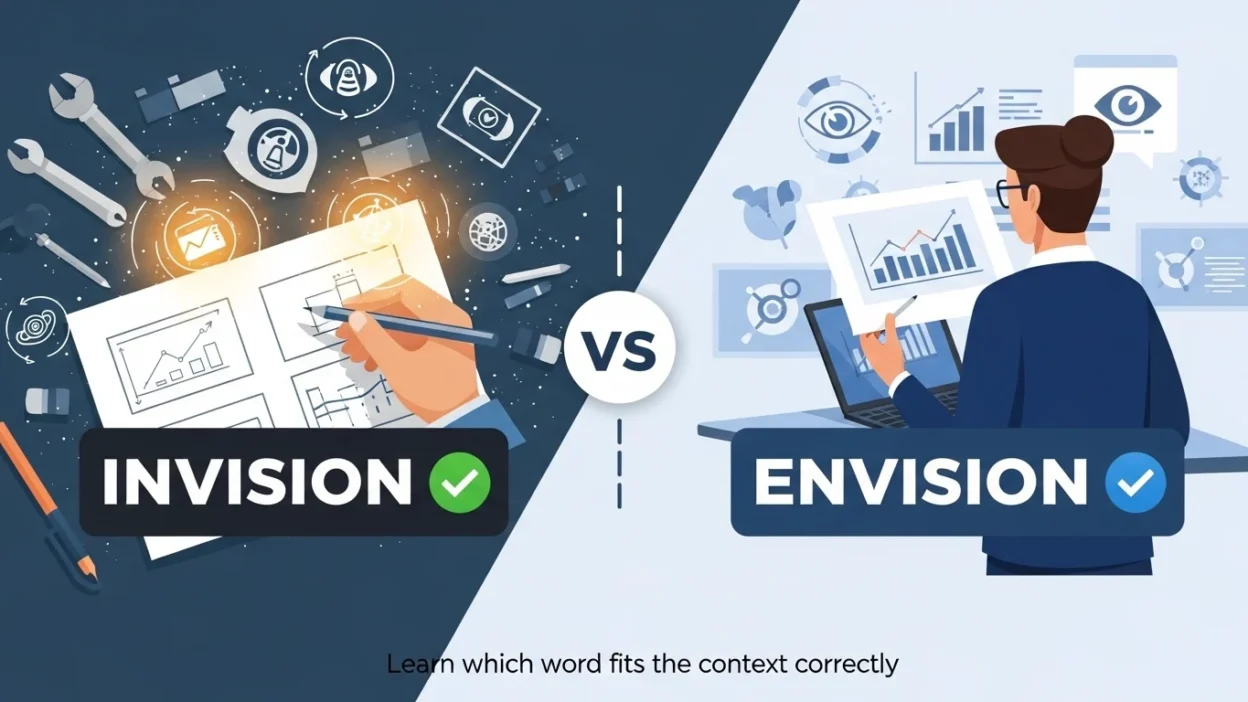
Words that sound similar can easily confuse even experienced writers. One common question people ask is whether “invision” or “envision” is the correct spelling and which one should be used in writing. If you’ve ever paused while typing and wondered which version is right, you’re not alone.
In this guide, you’ll learn the correct spelling, the meaning of the word, real examples, and the most common mistakes people make. By the end, you’ll clearly understand when to use envision and why invision is usually incorrect.
Quick Answer
The correct word is envision.
Invision is typically a misspelling of envision and is not considered standard English.
- Envision means to imagine or picture something in the future.
- Invision is rarely used and is generally incorrect unless it appears as a brand name or typo.
Example:
- ✔ I envision a future where technology makes education accessible to everyone.
- ✘ I invision a future where technology helps everyone learn.
What Does “Envision” Mean?
The verb envision means to imagine, visualize, or mentally picture something that may happen in the future. It is commonly used when talking about goals, plans, innovations, or possibilities.
People often use envision in professional writing, speeches, planning discussions, and creative contexts.
Simple Definition
Envision (verb):
To imagine or visualize something clearly in your mind, especially something that could happen in the future.
Example Sentences
- She envisions opening her own business within the next five years.
- The architect envisioned a modern building with eco-friendly features.
- Teachers often envision a classroom where every student succeeds.
- The company envisions becoming a global leader in sustainable energy.
Is “Invision” a Real Word?
In standard English, “invision” is not recognized as a correct spelling of the word envision. Most dictionaries and grammar guides treat it as a common spelling mistake.
However, you might see the word InVision used in a completely different context.
When “InVision” Appears
“InVision” can appear as:
- A brand name
- A software platform
- A company name
For example:
- InVision is a popular design collaboration tool used by product designers.
But when you want to express imagining or visualizing something, the correct word is envision.
Envision vs Invision: Key Differences
| Feature | Envision | Invision |
| Correct English Word | Yes | No (usually a misspelling) |
| Meaning | To imagine or visualize the future | No standard meaning |
| Dictionary Recognition | Yes | No |
| Common Usage | Writing, planning, storytelling | Mostly typos or brand names |
Quick Tip
If you’re talking about imagining something, always use envision.
Why Do People Confuse “Invision” and “Envision”?
There are several reasons this confusion happens.
1. Pronunciation Similarity
When spoken quickly, envision may sound like “invision,” which leads to spelling mistakes.
2. Typing Habits
Some writers automatically type “in” instead of “en” because “in” appears more frequently in English words.
3. Brand Recognition
Because of the design platform InVision, many people assume the spelling is correct in general writing.
4. Lack of Familiarity
Writers who rarely use the word may not realize that envision is the standard spelling.
Common Mistakes Writers Make
Here are some frequent errors and how to fix them.
Mistake 1: Using “Invision” in Formal Writing
Incorrect:
- I invision a better future for our community.
Correct:
- I envision a better future for our community.
Mistake 2: Mixing Both Spellings
Incorrect:
- She envisioned a project that many people invision today.
Correct:
- She envisioned a project that many people envision today.
Mistake 3: Assuming Both Words Are Acceptable
Some writers believe both versions are interchangeable. In reality, only “envision” is correct in standard English.
Synonyms for “Envision”
Using synonyms can improve writing and prevent repetition. Here are some useful alternatives.
- Imagine
- Visualize
- Picture
- Foresee
- Anticipate
- Conceptualize
- Dream of
- Plan for
Example:
- I envision a world without poverty.
- I imagine a world without poverty.
When Should You Use “Envision”?
You can use envision whenever you’re talking about imagining something that is not yet real.
Future Planning
- The government envisions new transportation systems.
Personal Goals
- She envisions becoming a successful writer.
Business Strategy
- The startup envisions expanding into international markets.
Creativity and Innovation
- Designers envision new user experiences.
American vs British English
In this case, there is no spelling difference between American and British English.
Both forms use:
- Envision ✔
- Invision ✘ (incorrect)
So whether you are writing for an American audience or a British audience, “envision” remains the correct spelling.
Tips to Remember the Correct Spelling
Here are a few easy tricks to avoid confusion.
Remember the “Vision” Inside the Word
The word envision contains vision, which relates to seeing or imagining.
En + vision = seeing something in your mind
Think of Future Vision
Whenever you imagine a future idea, you’re using your vision, so the spelling envision makes sense.
Use Spellcheck
Most grammar tools will automatically flag “invision” as a mistake.
Example Sentences in Different Contexts
Professional Writing
- The CEO envisions a company culture focused on innovation.
Education
- Teachers envision classrooms that inspire curiosity.
Technology
- Engineers envision smarter cities powered by AI.
Personal Development
- Many people envision their dream life before setting goals.
FAQs
1. Is “invision” ever correct?
In standard English writing, no. It is typically a misspelling of “envision.”
2. What does “envision” mean?
Envision means to imagine or visualize something clearly in your mind, often related to future possibilities.
3. Why do people spell it “invision”?
The mistake usually happens because of pronunciation confusion or typing habits.
4. Is “InVision” a real word?
Yes, but only as a brand name used by a digital product design platform.
5. Can “envision” be used in formal writing?
Yes. It is commonly used in academic, professional, and business writing.
6. What part of speech is “envision”?
Envision is a verb.
7. What are common synonyms for envision?
Some common synonyms include imagine, visualize, picture, foresee, and conceptualize.
8. Is “envision” used differently in British English?
No. The spelling and meaning remain the same in both American and British English.
Summary
The confusion between invision or envision is very common, but the answer is simple. Envision is the correct spelling and means to imagine or visualize something in the future. On the other hand, invision is generally just a misspelling and should be avoided in formal writing.
Understanding this distinction can improve your writing clarity and professionalism. Whenever you’re describing an idea, goal, or future possibility, remember to use envision, not invision.
Actionable Takeaway
Next time you’re writing about ideas, goals, or future possibilities, pause and remember this quick rule: If you’re imagining something, you should use “envision.” Keeping this simple tip in mind will help you avoid a common spelling mistake and write with greater confidence.