Are you confused about whether to say interested in or interested on? You’re not alone. Many English learners and even native speakers pause when choosing the correct preposition after “interested.”
It’s a small detail, but using the wrong one can make your sentence sound unnatural or grammatically incorrect.
In this complete guide, you’ll learn the correct usage of interested in or on, see clear examples, understand common mistakes, and discover how American and British English treat this phrase.
By the end, you’ll feel confident using it naturally in conversation and writing.
Quick Answer:
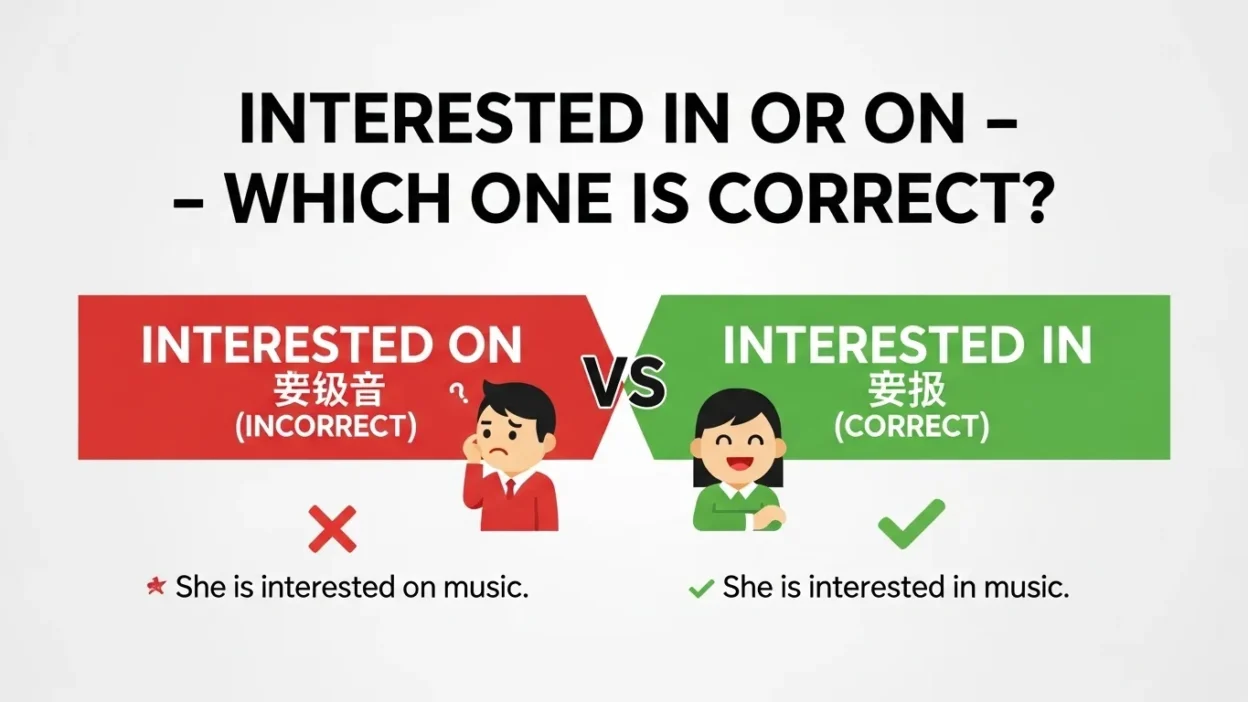
The correct phrase is interested in.
❌ Incorrect: I am interested on this topic.
✅ Correct: I am interested in this topic.
“Interested on” is grammatically incorrect in standard English.
What Does “Interested In” Mean?
“Interested in” means:
- Feeling curiosity about something
- Wanting to learn more about something
- Having attraction or enthusiasm for something
- Considering involvement in something
It is commonly followed by:
- A noun
- A pronoun
- A gerund (-ing form)
Examples
- I am interested in psychology.
- She’s interested in learning Spanish.
- Are you interested in this project?
- They’re interested in joining the club.
In all these cases, “in” is the correct preposition because it shows involvement, focus, or engagement.
Why “Interested On” Is Incorrect
In English grammar, the adjective “interested” collocates (naturally pairs) with the preposition in, not on.
The preposition “on” is typically used for:
- Surfaces (on the table)
- Specific days (on Monday)
- Devices (on TV)
- Topics in certain contexts (a book on history)
But when expressing curiosity or attraction, English requires “interested in.”
❌ I am interested on sports.
❌ She is interested on your idea.
❌ We are interested on applying.
These are incorrect because “interested” does not grammatically connect with “on.”
Grammar Rule Behind “Interested In”
“Interested” is an adjective that describes a feeling. In English collocations:
- Interested + in = correct structure
- Interested + on = incorrect structure
This pattern is fixed in standard English grammar. It’s similar to:
- Good at
- Afraid of
- Excited about
- Responsible for
Prepositions often don’t follow strict logic—they follow usage conventions.
Comparison Table:
| Phrase | Correct? | Why? | Example |
| Interested in | ✅ Yes | Standard collocation | I’m interested in art. |
| Interested on | ❌ No | Not grammatically accepted | I’m interested on art. |
There is no situation in standard English where “interested on” is correct.
Common Contexts Where “Interested In” Is Used
1. Academic Interest
- She is interested in biology.
- He’s interested in studying abroad.
2. Career & Job Applications
- I am interested in the marketing position.
- We are interested in working with your company.
3. Romantic Interest
- He seems interested in her.
- Are you interested in someone?
4. Hobbies & Activities
- I’m interested in photography.
- They’re interested in playing football.
5. Business & Professional Communication
- We are interested in your proposal.
- The client is interested in expanding the partnership.
As you can see, “interested in” works across formal, informal, academic, and professional settings.
Common Mistakes to Avoid
Mistake 1: Translating Directly From Another Language
Many languages use prepositions similar to “on” when talking about interest. Direct translation causes errors like:
❌ I am interested on this matter.
Always remember English requires “in.”
Mistake 2: Confusing With “Information On”
People sometimes confuse:
- Information on climate change
- A book on economics
These are correct because “on” describes the subject of something.
But when expressing personal curiosity:
✅ I am interested in climate change.
❌ I am interested on climate change.
Mistake 3: Using “Interest On”
Another related mistake:
❌ I have interest on science.
✅ I have an interest in science.
Notice the structure change:
“Have an interest in” is correct.
Similar Expressions (LSI Keywords & Synonyms)
To improve your vocabulary and writing naturally, here are related phrases:
- Keen on
- Curious about
- Passionate about
- Fascinated by
- Drawn to
- Engaged in
- Focused on (different meaning)
- Concerned with
Example:
- She is keen on music.
- He is fascinated by space exploration.
These expressions help diversify your writing while keeping meaning clear.
American vs British English: Any Difference?
Good news: There is no difference between American English and British English in this case.
Both:
- American English uses “interested in”
- British English uses “interested in”
“Interested on” is incorrect in both varieties.
Whether you’re writing for the US, UK, Canada, Australia, or international audiences, stick with interested in.
Advanced Usage: Interested In + Gerund
When followed by a verb, use the -ing form:
✅ I’m interested in learning French.
❌ I’m interested in learn French.
Structure:
Interested in + verb + ing
More examples:
- She’s interested in starting a business.
- They’re interested in moving abroad.
- Are you interested in investing?
This pattern is extremely common in professional emails and formal writing.
FAQs
1. Is “interested on” ever correct?
No. In standard English grammar, “interested on” is incorrect in all contexts.
2. Why do people say “interested on”?
Usually due to direct translation from another language or misunderstanding of prepositions.
3. Can I say “interested about”?
No. The correct phrase is “interested in,” not “interested about.”
4. What’s the difference between “interested in” and “focused on”?
“Interested in” expresses curiosity or attraction.
“Focused on” expresses concentration.
Example:
- I’m interested in math. (I like it.)
- I’m focused on math. (I’m concentrating on it.)
5. Is “very interested on” correct?
No. Even with modifiers, it remains incorrect.
❌ Very interested on
✅ Very interested in
6. Can I say “interest in” without “interested”?
Yes.
- There is strong interest in the project.
- She has an interest in art.
7. Is “keen on” the same as “interested in”?
They are similar, but “keen on” is slightly more common in British English and can sound more enthusiastic.
8. How do I remember the correct form?
Think of it as a fixed pair:
Interested = Involved = In
Both start with “In,” which makes it easier to remember.
Real-Life Example Sentences
Here are natural sentences you might actually use:
- I’m interested in improving my English skills.
- Are you interested in collaborating?
- She’s interested in applying for the scholarship.
- They are interested in expanding their business.
- He isn’t interested in politics.
Practice reading these aloud to build fluency.
Summary:
To wrap it up clearly:
The correct and only standard form is interested in. The phrase “interested on” is grammatically incorrect in both American and British English.
Whenever you want to express curiosity, attraction, enthusiasm, or involvement, always use in after “interested.”
English prepositions can feel tricky, especially when they don’t follow strict logic. But this is one of those fixed expressions you can confidently memorize.
Once you use it correctly a few times, it will start feeling completely natural.
Actionable Takeaway
From today onward:
- Always use “interested in.”
- Never use “interested on.”
- Practice by writing five sentences about your own interests.
- Pay attention to this phrase in movies, books, and conversations.
Small grammar improvements like this make a big difference in clarity, professionalism, and confidence.