Have you ever paused mid-sentence and wondered whether to write infront or in front? You’re not alone. This is one of the most common English spelling mistakes especially in emails, exams, captions, and professional writing.
If you want a clear, simple answer with examples you can actually remember, you’re in the right place.
Let’s break it down in a friendly, no-confusion way so you never second-guess yourself again.
Quick Answer
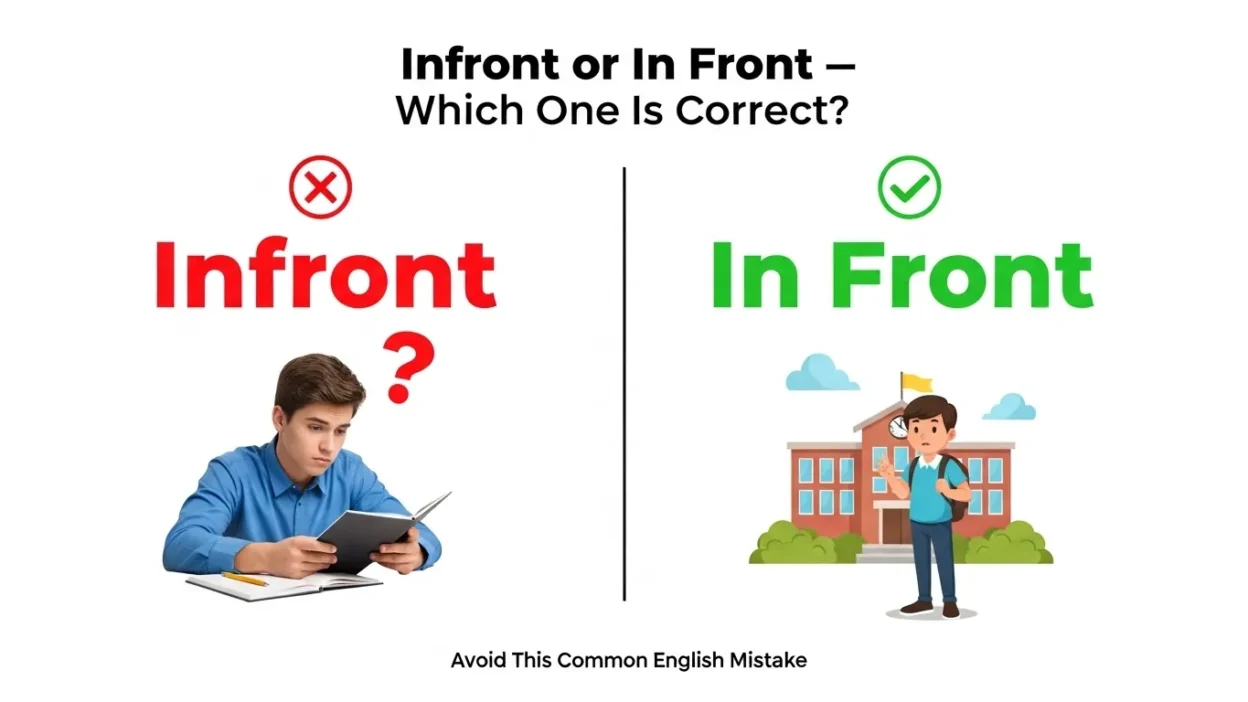
✅ “In front” (two words) is correct.
❌ “Infront” (one word) is incorrect and not recognized in standard English.
Always use in front when referring to something positioned ahead of another thing.
What Does “In Front” Mean?
The phrase in front is a prepositional phrase. It means:
- Ahead of something or someone
- Facing something
- In a position before something else
It describes physical position or sometimes figurative position.
Simple Meaning:
If something is in front, it is located before or ahead of something else.
Examples of “In Front” in Sentences
Here are clear examples to make it stick:
- The car is parked in front of the house.
- She stood in front of the mirror.
- There’s a long line in front of the store.
- He spoke in front of a large audience.
- Don’t stand in front of the TV.
Notice how it is always written as two separate words.
Why “Infront” Is Incorrect
Many people write infront because:
- It sounds like one word when spoken quickly.
- English has many compound words (like “inside,” “into,” “without”).
- Autocorrect sometimes doesn’t catch it immediately.
However, “infront” is not a real English word in dictionaries or grammar guides.
If you write infront in formal writing, it may:
- Lower your credibility
- Affect exam scores
- Reduce SEO quality in blog writing
- Make professional emails look careless
So it’s important to remember the correct version.
In Front vs Infront Comparison Table
| Feature | In Front | Infront |
| Correct spelling | ✅ Yes | ❌ No |
| Dictionary recognized | ✅ Yes | ❌ No |
| Used in formal writing | ✅ Yes | ❌ Never |
| SEO-friendly | ✅ Yes | ❌ No |
| Grammatical | ✅ Correct | ❌ Incorrect |
There is no situation in modern standard English where infront is correct.
Common Mistakes People Make
Here are the most common grammar mistakes related to this phrase:
1. Writing It as One Word
❌ The car is parked infront of the building.
✅ The car is parked in front of the building.
2. Confusing “In Front Of” With “Opposite”
“In front of” means ahead of not across from.
3. Mixing It With “At the Front”
These are similar but slightly different:
- In front of the building → outside, ahead of it
- At the front of the building → near its front section
In Front vs At The Front – What’s the Difference?
Many learners confuse these two phrases.
In Front Of
Means: outside and ahead of something.
Example:
- The car is in front of the hotel. (Outside it)
At The Front Of
Means: positioned in the front area of something (inside or part of it).
Example:
- She sits at the front of the classroom. (Inside the room)
Understanding this difference improves your grammar accuracy significantly.
American vs British English Any Difference?
Good news:
There is no difference between American English and British English in this case.
Both:
- 🇺🇸 American English uses in front
- 🇬🇧 British English uses in front
“Infront” is incorrect in both forms of English.
So whether you’re writing for the US, UK, Canada, Australia, or anywhere else always use in front.
Grammar Rule Behind “In Front”
The reason we write it as two words is that:
- “In” = preposition
- “Front” = noun
Together, they form a prepositional phrase, not a compound word.
Compare it with similar phrases:
- In back
- In place
- In line
- In charge
Notice these are also written separately.
Memory Trick to Never Forget
Here’s an easy trick:
Think of the front as a physical place.
You can say:
- The front of the house
- The front door
- The front seat
Since front is a separate noun, it needs space when used in the phrase.
So remember:
👉 If you’re talking about position, leave a space: in front
Is “Infront” Ever Correct?
No.
It is:
- Not in the Oxford Dictionary
- Not in Merriam-Webster
- Not used in academic writing
- Not accepted in professional grammar
Even in informal texting, it’s technically wrong.
FAQs
1. Is infront one word or two?
It is two words: in front.
2. Why do people write infront incorrectly?
Because it sounds like one word when spoken quickly.
3. Is infront accepted in informal writing?
No. Even informally, it’s considered incorrect.
4. Is there a grammar rule for in front?
Yes. It’s a prepositional phrase made of “in” + “front” (noun).
5. Is it correct in front of me?
Yes. “In front of” is completely correct and commonly used.
6. What is the opposite of in front?
The opposite is behind.
Example:
- The car is behind the building.
7. Is there any situation where infront is correct?
No. It is always incorrect.
Quick Practice Sentences
Test yourself:
- She stood ____ the door.
- The dog ran ____ the car.
- He spoke ____ his classmates.
Answers:
- in front of
- in front of
- in front of
If you wrote “infront,” now you know better!
Final Summary
The confusion between infront or in front is common, but the solution is simple.
The correct spelling is always in front, written as two separate words. It describes the position something located ahead of something else.
“Infront” is not a recognized English word in American or British English.
If you’re writing an email, blog post, academic paper, or social media caption, using the correct version strengthens your credibility and clarity.
Actionable Takeaway
From today onward:
✔ Always write in front (two words)
✔ Never use infront
✔ Remember it’s a prepositional phrase
✔ Double-check your spelling before publishing
Small grammar fixes like this make a big difference in professional and academic writing.