
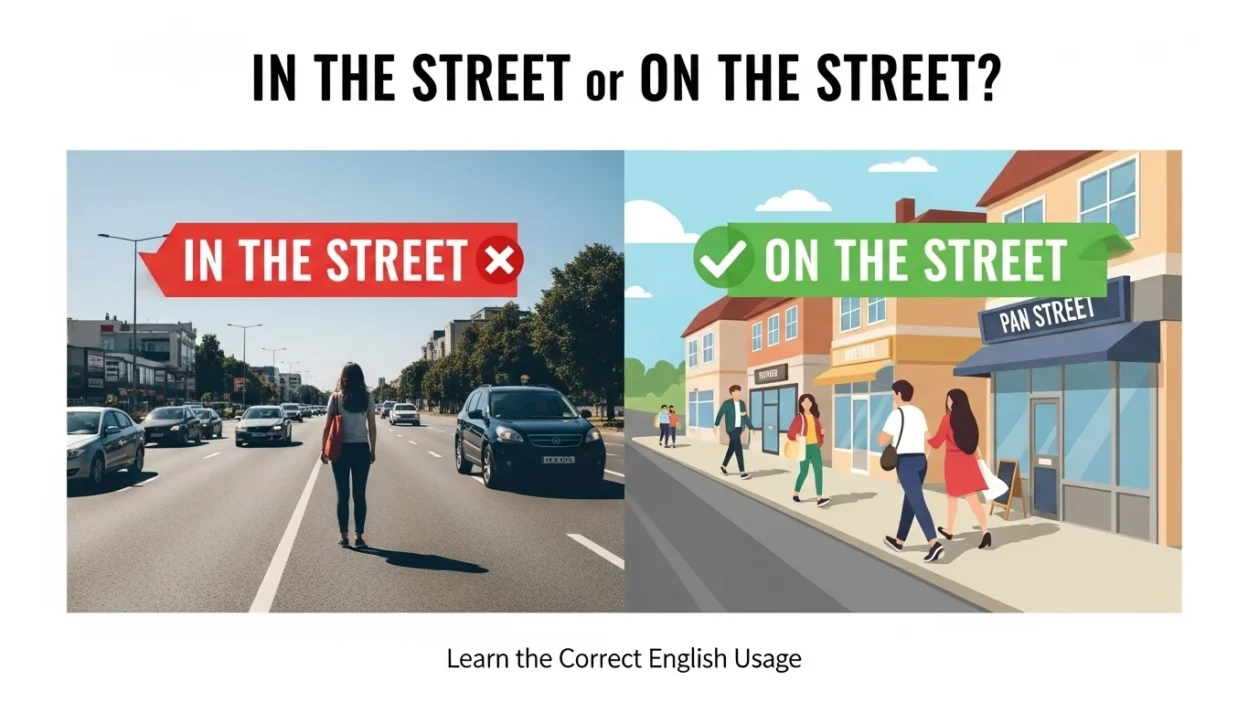
English prepositions can be confusing, especially when two phrases seem almost identical. One common question many learners ask is whether they should say “in the street” or “on the street.” Both phrases exist in English, but they are used in slightly different situations.
Understanding the difference can help you sound more natural and confident when speaking or writing English. In this guide, you’ll learn the meaning of each phrase, when to use them, common mistakes to avoid, and simple examples to remember the correct usage.
Quick Answer
The correct phrase depends on the context:
- “On the street” is the most common expression in everyday English when talking about location or something happening along a street.
- “In the street” is used when someone or something is physically inside the roadway, where cars normally drive.
Example:
- People were walking on the street during the festival.
- The ball rolled in the street, and the child ran after it.
In short:
- On the street = general location along the street
- In the street = inside the road itself
Meaning of “On the Street”
The phrase “on the street” refers to something happening along, beside, or associated with a street. It is the most widely used expression in modern English.
You will often hear this phrase when talking about daily life, businesses, neighborhoods, or public activities.
Examples
- There are many restaurants on the street.
- I met an old friend on the street yesterday.
- Children were playing on the street during the celebration.
- That café on the street is very popular.
Why “On” Is Used
In English, the preposition “on” is often used for surfaces or locations connected to something. Streets are considered surfaces where activities take place, so we usually say on the street.
Meaning of “In the Street”
The phrase “in the street” refers specifically to something inside the road area, usually where vehicles travel.
It often suggests that something is physically positioned within the roadway, which can sometimes imply danger or obstruction.
Examples
- A dog was sleeping in the street.
- The kids accidentally left their bikes in the street.
- A broken car was stuck in the street all night.
- She dropped her phone in the street.
Why “In” Is Used
The preposition “in” typically refers to being inside a space or area. When something is directly within the roadway itself, English speakers may use in the street.
Key Differences Between “In the Street” and “On the Street”
The difference is subtle but important. The table below makes it easier to understand.
| Phrase | Meaning | Typical Usage | Example |
| On the street | Along or connected to a street | General location or activity | There are shops on the street. |
| In the street | Inside the roadway | Physical placement in the road | The ball rolled in the street. |
Simple Rule to Remember
- Use “on the street” for most situations.
- Use “in the street” when something is literally inside the road.
Common Situations Where “On the Street” Is Used
This phrase appears in many everyday contexts.
1. Describing Location
- Our house is on the street near the park.
- The bakery on the street sells fresh bread.
2. Talking About Public Life
- Musicians were performing on the street.
- Vendors were selling food on the street.
3. Informal Expressions
“On the street” can also mean among ordinary people or in public opinion.
Example:
- The rumor on the street is that the store will close soon.
Situations Where “In the Street” Sounds More Natural
Although less common, “in the street” is still correct in certain contexts.
1. Something Blocking the Road
- A fallen tree was lying in the street.
- A truck broke down in the street.
2. Something Dropped or Placed in the Road
- He accidentally dropped his wallet in the street.
- The trash was scattered in the street after the storm.
3. Safety Warnings
- Don’t play in the street.
- Always look both ways before stepping in the street.
Common Mistakes Learners Make
Many English learners confuse these two phrases. Here are some mistakes to avoid.
Mistake 1: Using “In the Street” for General Location
❌ There are many shops in the street.
✔ There are many shops on the street.
Shops are beside or along the street, not inside the road.
Mistake 2: Mixing Prepositions Randomly
❌ I saw him in the street corner.
✔ I saw him on the street corner.
Mistake 3: Overthinking the Rule
Remember that “on the street” is the default phrase in most conversations.
American vs British English Differences
Both American English and British English use “on the street” and “in the street.” However, there is a small preference difference.
American English
American speakers strongly prefer “on the street” for most situations.
Example:
- The restaurant on the street is famous.
British English
British English sometimes uses “in the street” slightly more often, especially when describing activity in the road.
Example:
- Children were playing in the street.
However, even in the UK, “on the street” remains very common.
Related Expressions You Might Hear
Learning related phrases can help you sound more fluent.
On the Streets
This phrase refers to living without a home.
Example:
- Many people were left on the streets after the disaster.
Word on the Street
This idiom means rumors or popular opinion.
Example:
- The word on the street is that a new mall will open soon.
Street-Level
Used to describe something happening directly among the public.
Example:
- The issue affects people at the street level.
Practical Tips to Remember the Difference
If you still feel unsure, these tips will help.
- Imagine the street as a surface → use on the street.
- Imagine something inside the roadway → use in the street.
- When talking about shops, buildings, or general activity, choose on the street.
Frequently Asked Questions
1. Is it correct to say “in the street”?
Yes, it is correct. It usually refers to something physically located inside the roadway.
2. Which phrase is more common: in the street or on the street?
“On the street” is much more common in everyday English.
3. Can both phrases be used in the same sentence?
Sometimes, yes.
Example:
There are many cafés on the street, but a car is parked in the street.
4. Do native speakers use “in the street”?
Yes, but mainly when referring to objects or people inside the road.
5. Is “on the street” used in idioms?
Yes. Common examples include “word on the street” and “living on the streets.”
6. Is one phrase grammatically wrong?
No. Both are grammatically correct. The key difference is context and meaning.
7. Is this difference important for exams?
Yes. Many English grammar tests check correct preposition usage.
8. What is the easiest rule to remember?
Use “on the street” most of the time, and use “in the street” when something is literally inside the road.
Summary
The difference between “in the street” and “on the street” is mainly about location and perspective.
The phrase “on the street” is the most common and is used when talking about things happening along a street, such as shops, people, or daily activities. It treats the street as a general place or surface where events occur.
On the other hand, “in the street” is used when something is physically inside the roadway, such as an object blocking traffic or someone standing where cars usually drive.
While both phrases are correct, choosing the right one helps your English sound more natural and precise.
Actionable Takeaway
Whenever you feel unsure, remember this simple rule:
Use “on the street” for general location, and use “in the street” when something is actually inside the road. Practicing with real examples will make the difference easy to remember.

Edward Axel is the administrator of SyntaxlyHub, responsible for overseeing site operations, content management, and technical performance. He ensures accuracy, consistency, and smooth functionality while supporting the team in delivering reliable, high-quality grammar resources and a user-friendly learning experience for readers worldwide.