English has many words that look similar but carry completely different meanings. Imitated vs intimated is a perfect example. Because these two words share similar spelling and pronunciation, they often confuse writers, students, and even fluent English speakers.
If you’ve ever wondered whether someone imitated an action or intimated a message, you’re not alone. Understanding the difference between these words can instantly improve your writing clarity and prevent embarrassing mistakes.
In this guide, you’ll learn the exact meanings, real-life examples, common errors, and a simple way to remember when to use each word correctly.
Quick Answer
The difference between imitated vs intimated is simple:
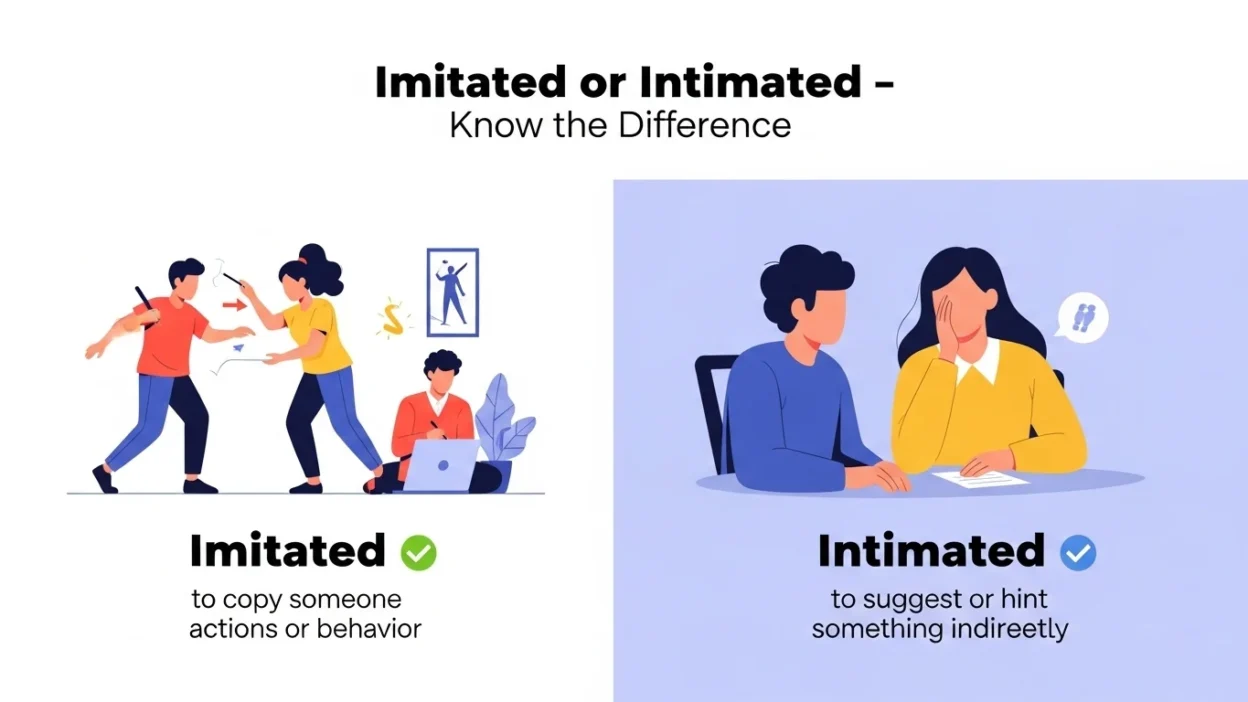
- Imitated means copied or mimicked someone’s actions, behavior, or style.
- Intimated means suggested or hinted at something indirectly.
Example:
- She imitated her teacher’s accent during the play.
- The manager intimated that changes might happen next month.
Even though they look similar, the meanings are completely different—one refers to copying, while the other refers to hinting.
What Does “Imitated” Mean?
The word imitated comes from the verb imitate, which means to copy someone’s behavior, style, speech, or actions.
People often imitate others for different reasons, such as learning, entertainment, admiration, or humor.
Simple Definition
Imitated = copied or mimicked something.
Common Situations Where “Imitated” Is Used
- Acting or comedy
- Learning new skills
- Copying a person’s behavior
- Artistic inspiration
Examples of “Imitated” in Sentences
- The child imitated his father’s walk.
- She imitated the famous singer perfectly.
- Students often imitate their teachers’ speaking style.
- The young artist imitated classic painting techniques.
In each example, someone is copying or reproducing something they observed.
Related Words and Synonyms
Some related words include:
- mimic
- copy
- replicate
- reproduce
- mirror
- emulate
These synonyms help expand your vocabulary while keeping your writing natural and engaging.
What Does “Intimated” Mean?
The word intimated comes from the verb intimate, meaning to suggest or hint at something indirectly rather than stating it clearly.
It is commonly used in formal communication, literature, or professional writing.
Simple Definition
Intimated = hinted or suggested indirectly.
Common Situations Where “Intimated” Appears
- Professional communication
- Formal announcements
- Literature and storytelling
- Subtle warnings or suggestions
Examples of “Intimated” in Sentences
- The director intimated that the project might be delayed.
- She intimated her dissatisfaction without directly complaining.
- The report intimated possible financial problems.
- He intimated that he might leave the company soon.
Here, the speaker does not say something directly, but suggests it indirectly.
Related Words and Synonyms
Words similar to intimated include:
- hinted
- suggested
- implied
- indicated
- alluded to
- subtly expressed
These words are often used in formal or academic writing.
Key Differences Between Imitated and Intimated
Although these words look similar, their meanings are completely unrelated.
| Feature | Imitated | Intimated |
| Meaning | Copied or mimicked something | Hinted or suggested indirectly |
| Type of Action | Physical or behavioral copying | Subtle communication |
| Context | Acting, learning, entertainment | Formal speech or writing |
| Synonyms | mimic, copy, emulate | hint, imply, suggest |
| Example | He imitated the actor. | She intimated a secret. |
Easy Memory Trick
A simple way to remember:
- Imitated → Imitation → Copy
- Intimated → Indirect message → Hint
Think:
Imitation = Copy
Intimation = Suggestion
Common Mistakes People Make
Because imitated and intimated are only one letter apart, they are frequently mixed up in writing.
Mistake 1: Using “Imitated” Instead of “Intimated”
Incorrect:
- The manager imitated that layoffs may happen.
Correct:
- The manager intimated that layoffs may happen.
Explanation: The manager is hinting, not copying.
Mistake 2: Using “Intimated” Instead of “Imitated”
Incorrect:
- The comedian intimated the president’s voice.
Correct:
- The comedian imitated the president’s voice.
Explanation: The comedian is copying the voice.
Mistake 3: Confusing Meaning Because of Similar Sound
Since the words sound somewhat similar, many learners assume they are related in meaning—but they are not.
Understanding their context and purpose helps avoid confusion.
Real-Life Examples for Better Understanding
Seeing both words in context makes the difference clearer.
Example 1
- The actor imitated the famous politician during the comedy show.
Example 2
- During the meeting, the CEO intimated that expansion plans were underway.
Example 3
- The student imitated the teacher’s handwriting for fun.
Example 4
- The email intimated that policy changes were coming soon.
Notice how imitated involves copying, while intimated involves suggesting.
American vs British English Usage
Good news: there is no difference between American and British English when it comes to the words imitated and intimated.
Both spellings and meanings remain the same in:
- American English
- British English
- Canadian English
- Australian English
However, “intimated” is slightly more common in formal British writing, such as academic articles and legal language.
In everyday American conversation, people often use simpler alternatives like:
- hinted
- suggested
- implied
Instead of saying “He intimated…”, many speakers say “He hinted…”.
When Should You Use Each Word?
Here is a quick guide to help you decide.
Use Imitated when:
- Someone copies behavior or style
- A person mimics a voice or action
- Learning through observation
Use Intimated when:
- Someone hints at something
- A message is implied but not directly stated
- Communication is subtle or formal
Quick Comparison Example
- The child imitated the superhero’s pose.
- The teacher intimated that exams would be difficult.
FAQs
1. What is the main difference between imitated vs intimated?
Imitated means to copy or mimic someone, while intimated means to hint or suggest something indirectly.
2. Are imitated and intimated interchangeable?
No. These words have completely different meanings and cannot replace each other in sentences.
3. Is “intimated” commonly used in everyday conversation?
Not very often. People usually say hinted, suggested, or implied instead.
4. Can “imitated” be used in professional writing?
Yes. It is commonly used in academic, artistic, and descriptive contexts when referring to copying behavior or style.
5. Why do people confuse imitated and intimated?
The confusion happens because the words look and sound very similar, even though their meanings are unrelated.
6. Is “intimated” a formal word?
Yes. It is often considered formal or literary, especially in professional communication.
7. What is a synonym for “imitated”?
Common synonyms include mimicked, copied, replicated, and emulated.
8. What is a synonym for “intimated”?
Some good alternatives include hinted, implied, suggested, and indicated.
Summary
Understanding the difference between imitated vs intimated is easier once you focus on their core meanings. Imitated refers to copying someone’s behavior, voice, or actions, often for learning, entertainment, or admiration. On the other hand, intimated refers to suggesting something indirectly without stating it openly.
Although these words look very similar, they function in completely different contexts. One deals with imitation, while the other deals with subtle communication. By remembering that imitation means copying and intimation means hinting, you can avoid confusion and write with more confidence.
Actionable Takeaway
Whenever you write or speak, ask yourself one simple question:
- Is someone copying something? → Use imitated
- Is someone hinting at something indirectly? → Use intimated
This quick check will help you use the right word every time and improve both your writing clarity and credibility.

Edward Axel is the administrator of SyntaxlyHub, responsible for overseeing site operations, content management, and technical performance. He ensures accuracy, consistency, and smooth functionality while supporting the team in delivering reliable, high-quality grammar resources and a user-friendly learning experience for readers worldwide.