
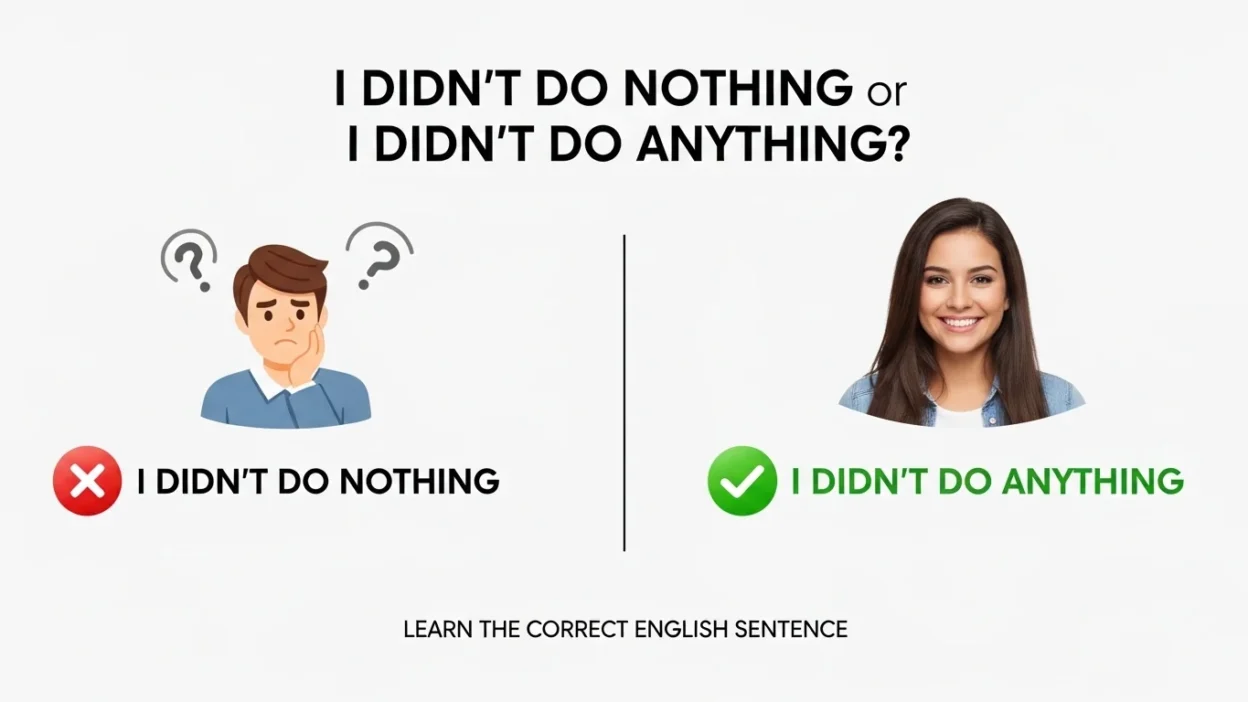
Many English learners and even native speakers sometimes get confused between “I didn’t do nothing” and “I didn’t do anything.” At first glance, both may seem to mean the same thing, but grammatically they are very different.
One is considered incorrect in standard English, while the other is the proper form used in formal communication. If you’ve ever wondered which phrase is correct, why one sounds wrong, and when people still use it in conversation, this guide will clear up the confusion.
By the end, you’ll understand the grammar rule, see practical examples, and know exactly which phrase to use in writing and speaking.
Quick Answer
The correct phrase in standard English is “I didn’t do anything.”
“I didn’t do nothing” is usually considered incorrect because it creates a double negative, which technically changes the meaning of the sentence. However, it is sometimes used in informal speech or certain dialects for emphasis.
Correct:
- I didn’t do anything wrong.
Incorrect (in standard grammar):
- I didn’t do nothing.
Understanding the Meaning
To understand the difference, we need to look at how negative words work in English.
Words like these are negatives:
- not
- never
- nothing
- nobody
- none
- nowhere
In standard English grammar, two negatives in the same clause cancel each other or create confusion.
“I didn’t do nothing” contains two negatives:
- didn’t
- nothing
This creates a double negative, which technically means the opposite of what the speaker intends.
Logical Meaning
“I didn’t do nothing” literally means:
- I did something
But most speakers who say this actually mean they did not do anything.
That is why the correct form is:
- I didn’t do anything
Correct Usage: I Didn’t Do Anything
The phrase “I didn’t do anything” follows proper grammar rules because it combines:
- one negative verb (didn’t)
- one neutral word (anything)
Examples:
- I didn’t do anything wrong.
- I didn’t do anything to upset her.
- I didn’t do anything yesterday.
- I didn’t do anything suspicious.
- I didn’t do anything you asked me to avoid.
This structure is widely accepted in:
- academic writing
- professional communication
- exams and formal English
Why People Say “I Didn’t Do Nothing”
Even though it’s grammatically incorrect in standard English, you may still hear people say “I didn’t do nothing.”
This happens for several reasons.
1. Informal Speech
In casual conversations, people sometimes use double negatives for emphasis.
Example:
- I didn’t do nothing, I swear!
2. Regional Dialects
Some dialects of English accept double negatives as normal speech patterns.
Examples include:
- certain American regional dialects
- African American Vernacular English (AAVE)
- some British regional dialects
In these dialects, the phrase does not confuse listeners, because the grammar rules are different.
3. Influence of Other Languages
Many languages use double negatives as a normal rule, such as:
- Spanish
- Italian
- Russian
When speakers translate directly into English, they may produce sentences like:
- I didn’t see nobody.
- I didn’t do nothing.
Comparison Table
| Phrase | Grammar Status | Meaning | Recommended Usage |
| I didn’t do anything | Correct | I did nothing | Formal and informal English |
| I didn’t do nothing | Incorrect (standard English) | Technically means I did something | Informal or dialect speech |
| I did nothing | Correct | I did absolutely nothing | Formal and neutral |
Example Sentences
Here are examples showing the difference in context.
Correct Examples
- I didn’t do anything wrong during the meeting.
- She didn’t say anything about the problem.
- They didn’t bring anything to the party.
- We didn’t hear anything unusual.
Incorrect Examples (Standard Grammar)
- I didn’t do nothing wrong.
- She didn’t say nothing to me.
- They didn’t bring nothing.
Corrected Versions
- I didn’t do anything wrong.
- She didn’t say anything to me.
- They didn’t bring anything.
Common Mistakes to Avoid
Many learners accidentally use double negatives. Here are some common mistakes and their corrections.
Mistake:
- I didn’t see nobody.
Correct:
- I didn’t see anybody.
Mistake:
- He didn’t tell me nothing.
Correct:
- He didn’t tell me anything.
Mistake:
- We didn’t go nowhere.
Correct:
- We didn’t go anywhere.
Simple Rule to Remember
If your sentence already has “not” or “didn’t,” use:
- anything
- anyone
- anywhere
Not:
- nothing
- nobody
- nowhere
American vs British English Differences
Interestingly, both American English and British English follow the same rule regarding double negatives in standard grammar.
American English
American English strongly avoids double negatives in formal communication.
Correct:
- I didn’t do anything.
Incorrect:
- I didn’t do nothing.
However, double negatives may appear in:
- casual speech
- music lyrics
- movies
British English
British English follows the same rule in formal writing.
But historically, double negatives appeared more frequently in older English literature.
For example, Shakespeare and other writers sometimes used them for emphasis.
Today, both American and British English consider them nonstandard in formal contexts.
When “I Did Nothing” Is Better
Sometimes the best sentence is simply:
- I did nothing.
Examples:
- I did nothing wrong.
- I did nothing to deserve that.
- I did nothing during the weekend.
This version is:
- clear
- concise
- grammatically correct
Related Phrases and Alternatives
Here are other ways to express the same idea.
- I didn’t do anything at all.
- I didn’t do a single thing.
- I did absolutely nothing.
- I didn’t do anything wrong.
- I didn’t do anything bad.
These variations improve clarity and natural flow in conversation.
FAQs
Is “I didn’t do nothing” ever correct?
In standard grammar, no. It is considered a double negative. However, it may appear in informal speech or dialects.
Why is “I didn’t do nothing” wrong?
Because it contains two negatives: didn’t and nothing, which creates a grammatical double negative.
What is the correct sentence?
The correct sentence is:
- I didn’t do anything.
Is it okay to use double negatives in conversation?
In informal speech or regional dialects, people sometimes use them. However, they should be avoided in formal English.
Do native speakers say “I didn’t do nothing”?
Yes, some native speakers do say it in casual conversations, especially in certain dialects or for emphasis.
Is “I did nothing” better than “I didn’t do anything”?
Both are correct.
“I did nothing” is slightly more direct and concise.
Why do learners confuse these phrases?
Many languages use double negatives as normal grammar, so learners may apply the same pattern to English.
Summary
The difference between “I didn’t do nothing” and “I didn’t do anything” comes down to a simple grammar rule: avoid double negatives in standard English.
When you say “I didn’t do nothing,” you are technically using two negatives in the same sentence, which creates confusion and is considered incorrect in formal English.
The correct and widely accepted phrase is “I didn’t do anything.” It uses only one negative and follows proper English structure.
While double negatives may appear in informal speech or certain dialects, they should generally be avoided in professional writing, academic work, and standard communication.
Actionable Takeaway
Remember this easy rule:
If your sentence contains not or didn’t, use:
- anything
- anyone
- anywhere
Not:
- nothing
- nobody
- nowhere
Following this rule will help you avoid one of the most common grammar mistakes in English.

Edward Axel is the administrator of SyntaxlyHub, responsible for overseeing site operations, content management, and technical performance. He ensures accuracy, consistency, and smooth functionality while supporting the team in delivering reliable, high-quality grammar resources and a user-friendly learning experience for readers worldwide.