If you’ve ever paused mid-sentence wondering whether a word is a homophone, homograph, or homonym, you’re not alone. These three terms are often confused because they all describe words that look or sound alike in some way.
But their meanings are not identical and understanding the difference can instantly improve your grammar, writing clarity, and vocabulary skills.
In this complete guide, we’ll break down homophone vs homograph vs homonym in the simplest way possible.
You’ll get clear definitions, practical examples, common mistakes to avoid, a comparison table, and answers to frequently asked questions all explained in a friendly, easy-to-understand tone.
Quick Answer
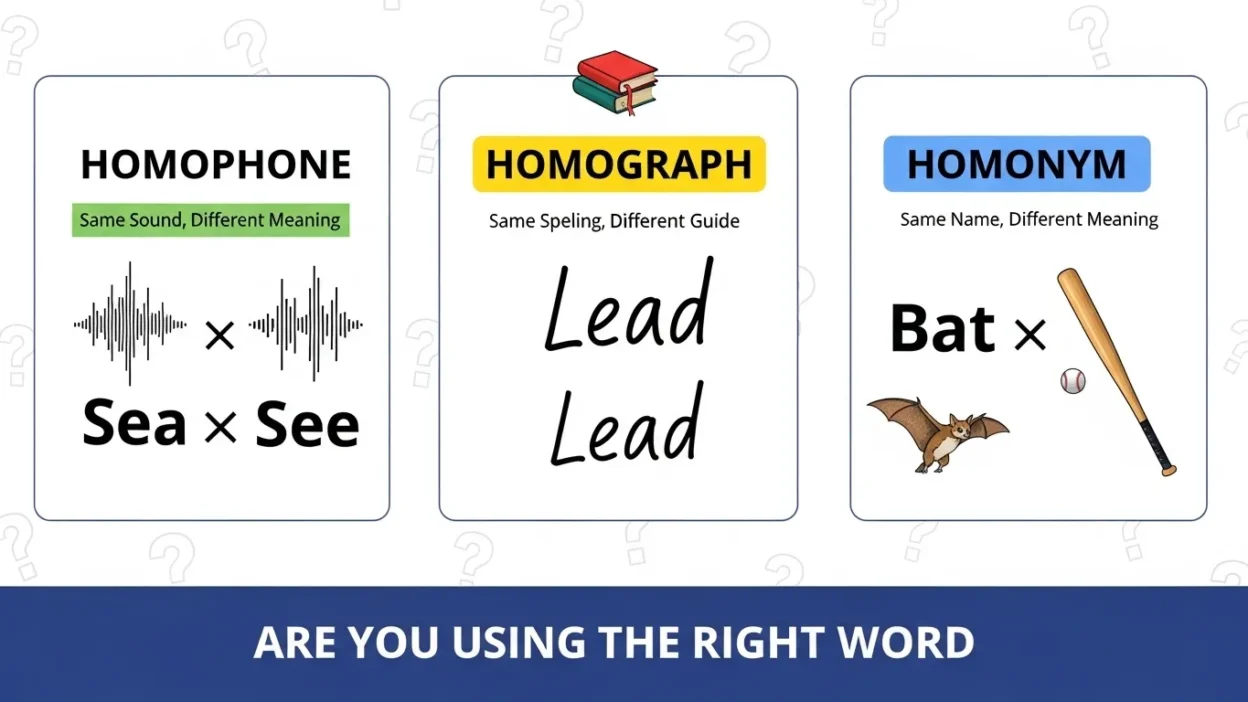
- Homophones: Words that sound the same but have different meanings and spellings.
Example: their and there - Homographs: Words that are spelled the same but have different meanings (sometimes different pronunciations).
Example: lead (to guide) and lead (a metal) - Homonyms: Words that share the same spelling or pronunciation and have different meanings.
Homonyms often include both homophones and homographs.
In short:
Homophones = same sound
Homographs = same spelling
Homonyms = same name (sound, spelling, or both)
What Is a Homophone?
A homophone is a word that sounds the same as another word but has a different meaning and usually a different spelling.
The word comes from Greek:
- homo = same
- phone = sound
Common Homophone Examples
- their / there / they’re
- to / too / two
- right / write
- flower / flour
- buy / by / bye
Example in Sentences
- Their house is beautiful.
- The book is over there.
- They’re coming tonight.
All three sound identical, but they serve completely different grammatical roles.
Why Homophones Matter
Homophones are a major source of spelling mistakes in English writing. They can:
- Change the meaning of a sentence
- Reduce writing credibility
- Affect SEO content quality
Many grammar errors in blogs, emails, and even professional documents happen because of homophones.
What Is a Homograph?
A homograph is a word that is spelled the same as another word but has a different meaning. Sometimes the pronunciation changes, and sometimes it doesn’t.
From Greek:
- homo = same
- graph = writing
Types of Homographs
There are two main kinds:
- Same spelling, different meaning, same pronunciation
- Same spelling, different meaning, different pronunciation
Homograph Examples
- Lead
- Lead (to guide) – pronounced “leed”
- Lead (metal) – pronounced “led”
- Tear
- Tear (rip) – pronounced “tair”
- Tear (drop from eye) – pronounced “teer”
- Bass
- Bass (fish)
- Bass (low musical sound)
Notice how the spelling remains the same, but the meaning changes based on context.
Why Context Is Important
Homographs rely heavily on context clues. Without context, the meaning can be confusing. That’s why reading comprehension skills are essential when identifying them.
What Is a Homonym?
A homonym is a broader term. It refers to words that have the same spelling or the same pronunciation but different meanings.
In simple terms, homonyms can include:
- Homophones
- Homographs
- Words that share both spelling and pronunciation
Examples of Homonyms
- Bat
- A flying animal
- A piece of sports equipment
- Bank
- Financial institution
- Side of a river
Both examples are spelled and pronounced the same but have completely different meanings.
Homophone vs Homograph vs Homonym: Key Differences
Here’s a simple comparison table to make things crystal clear:
| Feature | Homophone | Homograph | Homonym |
| Same Sound | Yes | Sometimes | Sometimes |
| Same Spelling | Usually No | Yes | Yes or No |
| Different Meaning | Yes | Yes | Yes |
| Example | to / two | lead / lead | bat |
Easy Memory Trick
- Phone = Sound → Homophone
- Graph = Writing → Homograph
- Nym = Name → Homonym
This quick trick can help you remember the difference during exams or writing.
Common Mistakes People Make
Even fluent English speakers mix these up. Here are frequent errors:
1. Thinking All Three Mean the Same Thing
They are related, but not identical.
Homonyms are the umbrella category.
2. Confusing Homophones With Homographs
If pronunciation changes, it’s likely a homograph not a homophone.
3. Ignoring Context
Context determines meaning, especially with homographs and homonyms.
4. Mixing Up American and British English
Pronunciation differences between American English and British English can affect whether words qualify as homophones.
For example:
- In American English, “cot” and “caught” often sound the same.
- In British English, they are pronounced differently.
This means some words may be homophones in one accent but not in another.
Why Understanding These Terms Improves Your Writing
Knowing the difference between homophones, homographs, and homonyms helps you:
- Avoid spelling errors
- Improve grammar accuracy
- Write clearer blog posts
- Perform better in academic exams
- Boost content quality for SEO
Search engines reward well-written, grammatically correct content. Misusing commonly confused words can lower trust and readability.
Related Grammar Terms (LSI Keywords)
When learning about homophones and homographs, you may also come across:
- Frequently confused words
- English vocabulary building
- Word pairs in English
- Parts of speech
- Pronunciation differences
- Context clues in reading
- Lexical ambiguity
- English grammar rules
These terms are closely related and often appear in educational resources.
FAQs
1. Is every homophone a homonym?
Yes. Homophones are considered a type of homonym because they share the same sound but different meanings.
2. Are all homographs pronounced differently?
No. Some homographs have the same pronunciation, while others change pronunciation depending on meaning.
3. Can a word be both a homophone and a homograph?
Yes. If two words share both spelling and pronunciation but have different meanings (like “bat”), they fit into both categories under homonyms.
4. Why are homophones common in English?
English has borrowed vocabulary from many languages, leading to multiple words that sound alike but evolved differently in spelling and meaning.
5. Do homophones cause spelling mistakes?
Absolutely. Words like your/you’re and its/it’s are among the most common grammar mistakes online.
6. Are homonyms important for competitive exams?
Yes. Many English proficiency tests include questions about homophones, homographs, and homonyms.
7. How can I avoid confusing these words?
- Read more regularly
- Practice vocabulary exercises
- Pay attention to context
- Use grammar-checking tools
8. Is pronunciation the main difference between them?
Pronunciation plays a key role in distinguishing homophones and homographs, but spelling and meaning are equally important factors.
Final Summary
Understanding homophone vs homograph vs homonym doesn’t have to feel overwhelming. Think of homophones as words that sound alike, homographs as words spelled the same, and homonyms as the broader category that includes both.
Once you focus on spelling, sound, and meaning separately, the confusion disappears quickly.The key takeaway is simple: always rely on context.
If you’re writing an academic essay, a blog post, or social media content, recognizing these word relationships will sharpen your grammar skills and boost your confidence.
The more you practice spotting them in everyday reading, the more natural it becomes.
Actionable Tip
Next time you write, pause and double-check commonly confused words like there, their, and they’re. Small corrections can dramatically improve clarity and credibility.

Edward Axel is the administrator of SyntaxlyHub, responsible for overseeing site operations, content management, and technical performance. He ensures accuracy, consistency, and smooth functionality while supporting the team in delivering reliable, high-quality grammar resources and a user-friendly learning experience for readers worldwide.