English has many words that sound the same but have completely different meanings. One common example is heard vs herd vs hurd. These words are often confused because they are pronounced almost identically in everyday speech. However, they belong to different parts of speech and are used in very different contexts.
If you’ve ever wondered when to use “heard,” “herd,” or “hurd,” you’re not alone. This guide will explain each word in simple terms, show clear examples, highlight common mistakes, and provide an easy comparison so you can confidently use the correct word every time.
Quick Answer
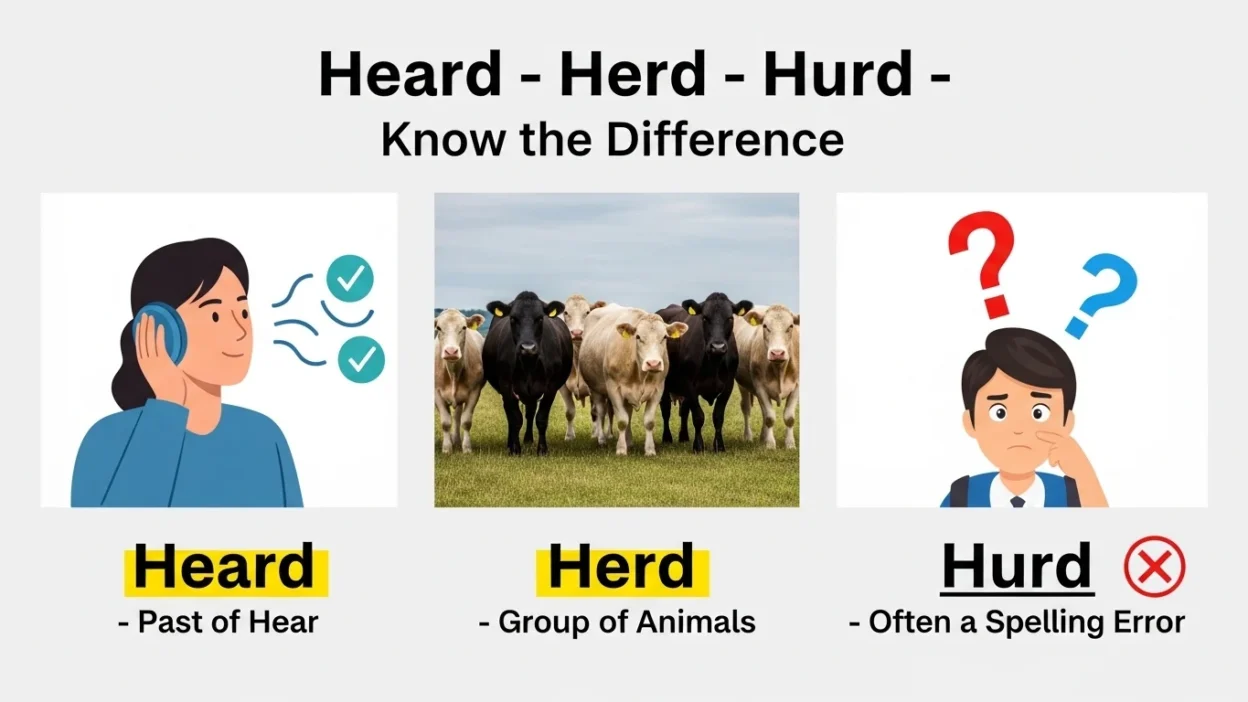
- Heard → Past tense of hear (to perceive sound).
- Herd → A group of animals or people moving together.
- Hurd → Rare word; usually refers to hemp or flax fiber residue used in materials like insulation or hemp products.
Although heard and herd are common in daily English, hurd is uncommon and mostly used in technical or agricultural contexts.
What Does “Heard” Mean?
Heard is the past tense and past participle of the verb “hear.” It refers to the act of perceiving sound through your ears.
Examples of “Heard”
- I heard a loud noise outside last night.
- She heard the announcement at the train station.
- We heard about the news this morning.
- Have you heard this song before?
Key Points
- Part of speech: Verb (past tense of hear)
- Meaning: To notice or receive sound
- Common contexts: conversations, sounds, music, news
LSI Keywords and Related Terms
- listened
- detected sound
- overheard
- listening
- audio perception
What Does “Herd” Mean?
Herd is typically used as a noun referring to a group of animals that live or move together. It can also be used as a verb, meaning to gather or guide animals or people into a group.
Examples of “Herd” as a Noun
- A herd of elephants crossed the river.
- The farmer owns a herd of cattle.
- We saw a herd of deer in the forest.
Examples of “Herd” as a Verb
- The shepherd herded the sheep into the barn.
- Security herded the crowd toward the exit.
Key Points
- Part of speech: Noun and verb
- Meaning: A group of animals or guiding animals together
- Common contexts: farming, wildlife, agriculture
LSI Keywords
- flock
- group of animals
- livestock
- cattle group
- animal gathering
What Does “Hurd” Mean?
Hurd is a rare and specialized word. It refers to the woody inner fiber of hemp or flax plants after the outer fibers are removed.
This material is commonly used in:
- hemp building materials
- animal bedding
- eco-friendly insulation
- hempcrete
Examples of “Hurd”
- Hemp hurd is used in sustainable construction materials.
- The manufacturer processes hemp hurd for insulation panels.
Key Points
- Part of speech: Noun
- Meaning: Inner woody fiber of hemp or flax
- Common contexts: agriculture, sustainability, materials science
Heard vs Herd vs Hurd: Comparison Table
| Word | Part of Speech | Meaning | Example Sentence |
| Heard | Verb (past of hear) | Perceived sound | I heard the door slam. |
| Herd | Noun / Verb | Group of animals or guiding animals | A herd of cows crossed the field. |
| Hurd | Noun | Fiber residue from hemp or flax | Hemp hurd is used in eco-construction. |
This table makes it easier to quickly identify which word fits your sentence.
Why These Words Are Often Confused
The confusion between heard, herd, and hurd mainly comes from pronunciation. They are homophones, meaning they sound the same but have different meanings and spellings.
Reasons people mix them up:
- identical pronunciation in most accents
- similar spelling
- fast typing or autocorrect errors
- lack of familiarity with “hurd”
Example of Confusion
Incorrect:
- I herd the noise outside.
Correct:
- I heard the noise outside.
Another example:
Incorrect:
- The farmer owns a heard of cows.
Correct:
- The farmer owns a herd of cows.
Common Mistakes and How to Avoid Them
Here are a few typical errors learners make and simple tricks to remember the correct usage.
Mistake 1: Using “herd” instead of “heard”
❌ I herd someone calling my name.
✔ I heard someone calling my name.
Tip: If the sentence involves sound or listening, the correct word is heard.
Mistake 2: Using “heard” for animals
❌ A heard of sheep was grazing nearby.
✔ A herd of sheep was grazing nearby.
Tip: If the sentence describes animals together, use herd.
Mistake 3: Confusing “hurd” with “herd”
Because hurd is rarely used in everyday English, writers sometimes assume it means “group.” It does not.
✔ Hemp hurd is used in eco-friendly construction.
❌ A hurd of cows crossed the field.
Simple Memory Tricks
These small memory tricks make it easier to remember the differences.
- Heard → Ear → Sound
Both words contain “ear.” - Herd → Animals together
Think of herds of cows, sheep, or elephants. - Hurd → Hemp material
Remember it is related to hemp products or plant fibers.
American vs British English Differences
Interestingly, there is no significant spelling difference between heard, herd, and hurd in American English and British English.
However, pronunciation may vary slightly depending on accent:
- In American English, the words often sound almost identical.
- In British English, subtle vowel differences may appear in careful speech.
Despite accent differences, the spelling and meanings remain the same worldwide.
Example Sentences Using All Three Words
To see the differences clearly, look at these sentences:
- I heard a strange sound in the forest.
- A herd of deer suddenly ran across the path.
- The eco-builder used hemp hurd to create natural insulation.
Each word has a completely different meaning, even though they sound alike.
FAQs
1. What is the main difference between heard and herd?
Heard relates to hearing sounds, while herd refers to a group of animals or the act of gathering animals.
2. Is “hurd” a common English word?
No, hurd is quite rare and mainly used in agriculture, hemp production, and eco-building industries.
3. Are heard and herd homophones?
Yes. Heard and herd are homophones, meaning they sound the same but have different meanings and spellings.
4. Can herd be used as a verb?
Yes. Herd can be a verb meaning to gather or move animals or people together.
Example:
- The rancher herded the cattle across the field.
5. Is there any spelling difference in British English?
No. Both American and British English use the same spelling for heard, herd, and hurd.
6. What is an easy way to remember “heard”?
Think of “ear.” If a sentence involves sound or listening, the correct word is heard.
7. Can herd refer to people?
Yes. Informally, herd can describe a crowd being guided or controlled, such as:
- Police herded fans out of the stadium.
8. Why do learners confuse these words?
They are confused because they sound identical in pronunciation and are spelled similarly.
Summary
The difference between heard vs herd vs hurd becomes clear once you understand their meanings and contexts. Heard relates to sound and listening, since it is the past tense of hear.
Herd refers to groups of animals or the act of gathering animals together. Meanwhile, hurd is a rare word connected to hemp or flax plant fibers used in sustainable materials.
Although these words sound the same, their meanings are completely different. Recognizing the context whether it involves sound, animals, or plant material will help you quickly choose the correct word.
Actionable Takeaway
When writing or speaking, pause for a second and ask yourself:
- Is the sentence about sound? → Use heard
- Is it about animals together? → Use herd
- Is it about hemp fiber material? → Use hurd
With these simple checks, you’ll avoid confusion and use heard, herd, and hurd correctly every time.

Edward Axel is the administrator of SyntaxlyHub, responsible for overseeing site operations, content management, and technical performance. He ensures accuracy, consistency, and smooth functionality while supporting the team in delivering reliable, high-quality grammar resources and a user-friendly learning experience for readers worldwide.