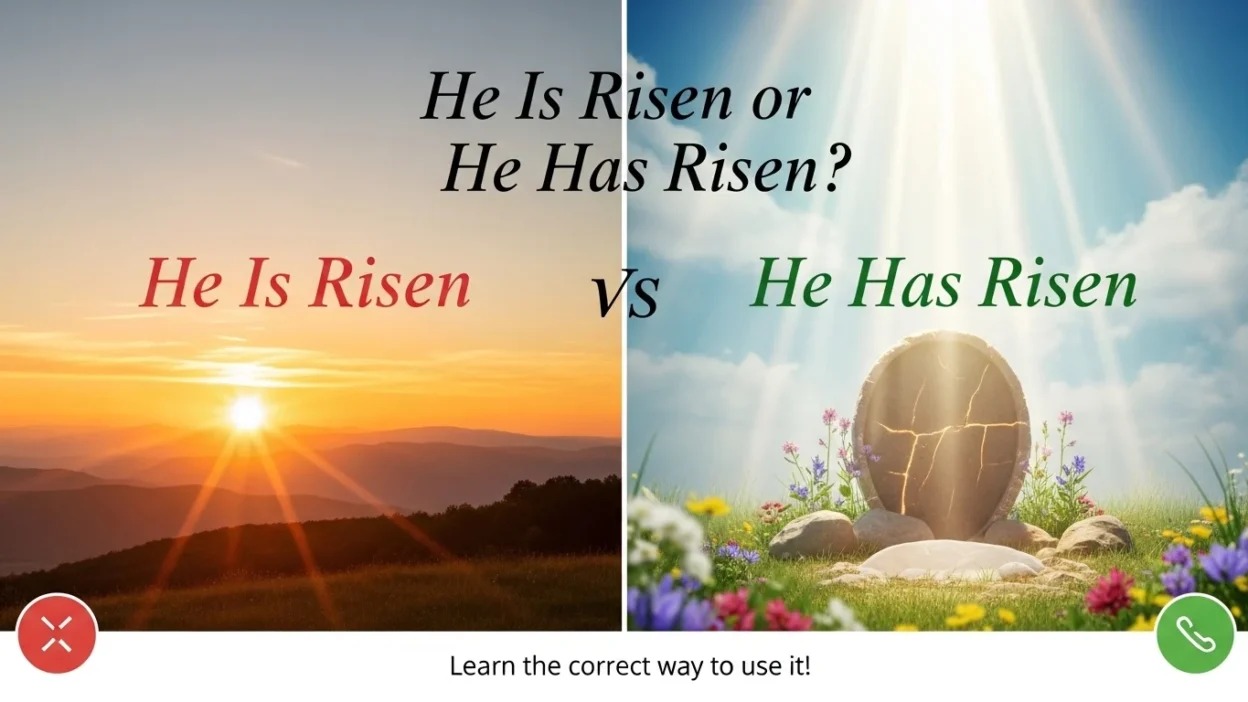
Many people hear the phrases “he is risen” and “he has risen” during Easter celebrations, church sermons, or in religious writing. Because both expressions seem similar, it can be confusing to know which one is grammatically correct and when each phrase should be used.
Understanding the difference is important not only for correct English usage but also for appreciating the historical and religious context behind the phrases.
In this guide, we’ll explain the meaning of he is risen or he has risen, show correct examples, highlight common mistakes, and help you confidently use the right phrase in conversation and writing.
Quick Answer
If you’re wondering whether to use “he is risen” or “he has risen,” here’s the simple answer:
- He has risen → Grammatically correct in modern English.
- He is risen → Archaic (old-style) expression used mainly in religious or biblical contexts, especially during Easter.
In everyday modern English, “he has risen” is the correct grammatical form. However, “he is risen” remains widely used in Christian tradition to refer to the resurrection of Jesus.
Meaning of “He Is Risen” and “He Has Risen”
Both phrases refer to the resurrection, especially in Christianity where they describe Jesus rising from the dead after crucifixion.
He Has Risen
“He has risen” uses the present perfect tense.
Meaning:
- Someone rose from a position or state in the past
- The result of that action is still relevant now
Example meanings:
- A person stood up
- Someone recovered from a fall
- Someone rose from death (religious context)
Examples:
- The sun has risen over the mountains.
- The leader has risen to power quickly.
- Christians believe Jesus has risen from the dead.
He Is Risen
“He is risen” uses an older grammatical structure where “be” was sometimes used as a helping verb instead of “have.”
Meaning:
- Essentially the same as “he has risen”
- Mostly used in traditional or liturgical language
Examples:
- Christ is risen, Hallelujah.
- The church bell rings to celebrate that He is risen.
This phrasing appears frequently in historic Bible translations and church liturgy.
Why “He Is Risen” Still Exists
Even though modern grammar prefers “he has risen,” the phrase “he is risen” continues to be used because of tradition.
Reasons include:
- Biblical translations
- Church liturgy
- Easter greetings
- Historical language preservation
For example, a traditional Easter greeting says:
- “He is risen!”
- Response: “He is risen indeed!”
This expression has been used for centuries and remains part of Christian culture worldwide.
Key Differences Between “He Is Risen” and “He Has Risen”
| Phrase | Grammar Type | Usage | Example |
| He has risen | Present perfect tense | Modern English and everyday writing | The sun has risen above the hills. |
| He is risen | Archaic construction | Religious or biblical language | Christ is risen from the dead. |
Main takeaway
- Use he has risen in normal modern English.
- Use he is risen mainly in religious tradition or Easter messages.
Examples in Sentences
Here are some examples to make the difference clearer.
Examples Using “He Has Risen”
- The champion has risen again after defeat.
- The sun has risen, bringing warmth to the valley.
- According to Christian belief, Jesus has risen from the dead.
Examples Using “He Is Risen”
- The church banner reads: He is risen.
- Christians celebrate Easter declaring He is risen indeed.
- The choir sang joyfully that He is risen.
In modern writing, you’ll usually see “has risen”, except in religious expressions.
Common Mistakes People Make
Many learners and writers confuse these two phrases. Here are the most common mistakes to avoid.
1. Using “He Is Risen” in Normal Conversation
Incorrect:
- The sun is risen.
Correct:
- The sun has risen.
“He is risen” should generally be reserved for religious expression.
2. Mixing Grammar Styles
Incorrect:
- He is risen from his chair.
Correct:
- He has risen from his chair.
Modern English grammar uses “have/has + past participle.”
3. Assuming Both Are Always Interchangeable
Although they mean the same thing historically, they are not interchangeable in everyday English.
American vs British English Differences
Interestingly, there is no major difference between American English and British English for these phrases.
Both varieties follow the same pattern:
- He has risen → correct modern grammar
- He is risen → archaic but preserved in religious contexts
However, British literature and church traditions may occasionally preserve older language forms more frequently than everyday American usage.
When You Should Use Each Phrase
Here’s a quick guide to help you decide.
Use “He Has Risen” when:
- Writing modern English
- Speaking in everyday conversation
- Writing essays or articles
- Describing someone standing up or rising
Use “He Is Risen” when:
- Writing Easter greetings
- Quoting church traditions
- Referring to biblical phrases
- Creating religious or historical content
Related Words and Similar Expressions
To understand this phrase better, it helps to know related words and expressions.
Common related terms include:
- resurrection
- risen from the dead
- Easter proclamation
- Christ is risen
- risen indeed
- resurrection of Jesus
- biblical language
These expressions are frequently used in Christian teachings and Easter celebrations.
FAQs
1. Which phrase is grammatically correct?
“He has risen” is grammatically correct in modern English.
2. Why do churches say “He is risen”?
Churches use “He is risen” because it comes from older biblical language and long-standing Christian tradition.
3. Is “He is risen” wrong?
No. It is not wrong, but it is archaic and mostly used in religious contexts.
4. What is the response to “He is risen”?
The traditional response is:
“He is risen indeed.”
5. Is the phrase used only during Easter?
It is most commonly used during Easter celebrations, but it can appear in sermons, religious writing, and Christian literature.
6. Can “He has risen” refer to things other than religion?
Yes. It can describe many situations:
- Someone standing up
- A person gaining power
- The sun rising
7. Why does older English use “is” instead of “has”?
In Old and Middle English, verbs of movement sometimes used “be” as an auxiliary verb instead of “have.”
8. Which phrase should students use in writing?
Students should generally use “he has risen” because it follows modern grammar rules.
Summary
The difference between “he is risen” and “he has risen” mainly comes down to grammar and historical usage. In modern English, “he has risen” is the correct grammatical form because it uses the present perfect tense with “has.” This structure is standard for describing actions that happened in the past but still matter now.
However, “he is risen” continues to exist because of religious tradition and biblical language, especially during Easter celebrations. While it may sound unusual in everyday conversation, it remains an important phrase within Christian culture and liturgy.
Actionable Takeaway
If you’re writing or speaking in modern English, use “he has risen.” If you are quoting scripture, writing an Easter message, or referencing Christian tradition, then “he is risen” is perfectly appropriate.
Understanding this distinction will help you write more clearly, avoid grammar mistakes, and respect the historical meaning behind these powerful expressions.