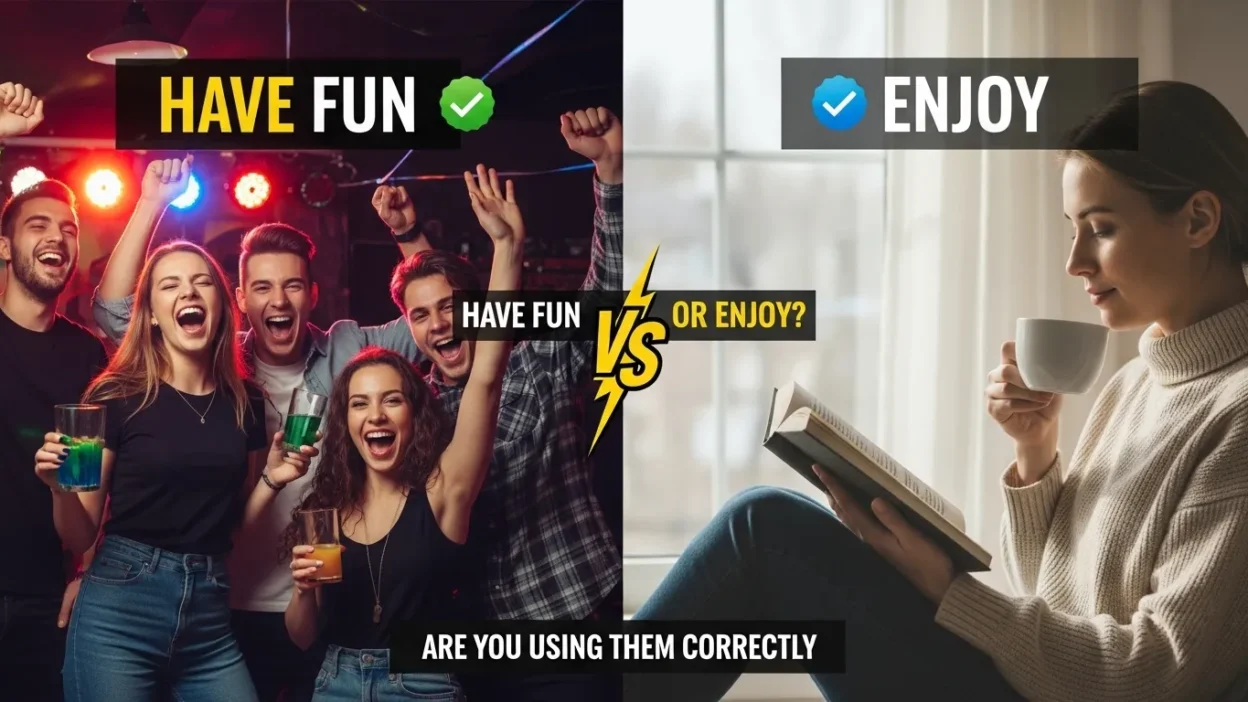
Are you confused about whether to say have fun or enjoy? You’re not alone. These two expressions seem similar, but they’re used differently in English.
Choosing the right one can make your sentence sound natural, confident, and fluent.
In this guide, you’ll learn the exact difference between have fun and enjoy, when to use each, common mistakes to avoid, and helpful examples.
By the end, you’ll clearly understand how to use both expressions correctly in everyday conversation and writing.
Quick Answer
- Having fun is usually used as a wish or encouragement before someone does something.
- Enjoy is a verb that needs an object (something specific you enjoy).
- You don’t say “enjoy!” alone in formal English (except in very casual speech).
- “Have fun” works naturally on its own.
Example:
✔ Have fun at the party!
✔ Enjoy the party!
✘ Enjoy at the party.
What Does “Have Fun” Mean?
Have fun means to experience enjoyment, pleasure, or amusement while doing something.
It is often used:
- Before an event
- As encouragement
- In casual conversation
- When wishing someone a good time
Examples of “Have Fun”
- Have fun at the concert!
- I hope you have fun on your trip.
- The kids had fun at the park.
- We always have fun together.
Key Point
“Have fun” does not need an object immediately after “fun.” You can add details with at, on, or with:
- Have fun at the party.
- Have fun on your vacation.
- Have fun with your friends.
It’s friendly, natural, and very common in American and British English.
What Does “Enjoy” Mean?
Enjoy is a verb that means to take pleasure in something.
Unlike have fun, enjoy must be followed by a noun or gerund (-ing form).
Structure of “Enjoy”
- Enjoy + noun
- Enjoy + verb (-ing)
Examples of “Enjoy”
- Enjoy your meal.
- I enjoy reading books.
- She enjoys traveling.
- Enjoy the show!
Important Rule
You cannot say:
✘ I enjoy at the beach.
✔ I enjoy the beach.
✔ I enjoy going to the beach.
“Enjoy” always needs something specific.
Have Fun vs Enjoy: What’s the Difference?
Although both expressions relate to happiness and pleasure, they are not interchangeable in every situation.
Here’s a simple comparison:
| Feature | Have Fun | Enjoy |
| Part of Speech | Phrase (verb expression) | Verb |
| Need an Object? | No (optional detail) | Yes (required) |
| Used as a Wish? | Yes | Yes (with object) |
| Formal or Casual? | Casual | Neutral (works in formal & casual) |
| Example | Have fun! | Enjoy your trip! |
When to Use “Have Fun”
Use have fun when:
- You are encouraging someone.
- The situation is social or playful.
- You want to sound friendly and warm.
- You don’t need to mention something specific.
Situations
- Before parties
- Before vacations
- Before events
- When kids are playing
Example sentences:
- Have fun at school today!
- Go and have fun!
- They had fun at the wedding.
When to Use “Enjoy”
Use enjoy when:
- You are talking about personal preferences.
- You mention something specific.
- You’re speaking more formally.
- You’re writing professionally.
Example sentences:
- I enjoy classical music.
- She enjoys cooking.
- Enjoy your stay at the hotel.
- Did you enjoy the movie?
Common Mistakes to Avoid
Let’s fix the most frequent errors learners make.
1. Using “Enjoy” Without an Object
✘ Enjoy! (formal writing)
✔ Enjoy your meal!
✔ Enjoy the event!
In casual speech, waiters sometimes say “Enjoy!” but in grammar terms, it’s incomplete.
2. Adding “To” After Enjoy
✘ I enjoy to swim.
✔ I enjoy swimming.
After enjoying it, always use the -ing form.
3. Mixing Structures
✘ Have fun your trip.
✔ Have fun on your trip.
✔ Enjoy your trip.
4. Using “Enjoy” With Prepositions Incorrectly
✘ I enjoy in music.
✔ I enjoy music.
✔ I enjoy listening to music.
American vs British English Differences
Good news there is no major difference between American and British English when using have fun or enjoy.
However, tone and frequency may vary slightly:
- American English often uses “Have fun!” more casually and frequently.
- British English also uses it commonly but may use “Enjoy yourself” more in formal situations.
Examples:
- American: Have fun at prom!
- British: Enjoy yourself at the party.
Both forms are correct in both regions.
Related Phrases and Synonyms
To expand your vocabulary, here are similar expressions:
Alternatives to “Have Fun”
- Have a great time
- Have a blast
- Have a good time
- Enjoy yourself
- Make the most of it
Alternatives to “Enjoy”
- Appreciate
- Like
- Love
- Take pleasure in
- Be fond of
Using synonyms helps your writing sound more natural and SEO-friendly while improving readability.
Real-Life Conversation Examples
Let’s see how native speakers use these naturally.
Friend 1: I’m going to Dubai next week.
Friend 2: That’s amazing! Have fun!
Teacher: Did you enjoy the book?
Student: Yes, I really enjoyed it.
Mother: Enjoy your dinner!
Child: Thank you!
Notice how:
- “Have fun” comes before the experience.
- “Enjoy” often comes after or during the experience.
Grammar Deep Dive (For Better Accuracy)
Understanding structure improves fluency.
Sentence Patterns
Have fun:
- Subject + have/has/had + fun + (optional detail)
Enjoy:
- Subject + enjoy(s/ed) + noun
- Subject + enjoy(s/ed) + verb (-ing)
Examples:
- They had fun at the fair.
- He enjoys playing football.
FAQs
1. Can I say “Enjoy!” Alone?
In a very casual speech, yes. But grammatically, it’s better to say “Enjoy your meal” or “Enjoy the show.”
2. Is “Have fun” informal?
Yes, it is slightly informal but perfectly acceptable in everyday conversation.
3. Which is more polite: have fun or enjoy?
Both are polite. “Enjoy” sounds slightly more formal.
4. Can I use “enjoy” for hobbies?
Yes.
Example: I enjoy painting.
5. Can I use “have fun” for serious events?
Not usually. It works best for relaxed or happy occasions.
6. What is the difference between “enjoy yourself” and “have fun”?
They mean almost the same thing. “Enjoy yourself” sounds slightly more formal.
7. Is “I am enjoying” correct?
Yes, in the present continuous tense.
Example: I am enjoying this conversation.
8. Can I say “Have fun your day”?
No.
Correct form: Have a fun day or Have a great day.
Summary:
To sum it up, have fun and enjoy both relate to happiness and pleasure, but they are used differently. “Have fun” is usually an encouragement before an activity and does not require a direct object.
“Enjoy,” however, is a verb that must always be followed by something specific.
If you remember one simple rule, let it be this:
Use fun for friendly wishes. Use enjoy when mentioning exactly what someone takes pleasure in.
Actionable Takeaway
Starting today:
- Use “Have fun!” before someone goes to an event.
- Use “Enjoy + noun/verb-ing” when describing pleasure.
- Avoid using “enjoy” without an object in formal writing.
- Practice by creating 5 example sentences using both phrases.
The more you practice, the more natural your English will sound.