
Have you ever paused mid-sentence and wondered: Is it “has ran” or “has run”? You’re not alone. This small grammar doubt confuses thousands of English learners and even native speakers every day.
If you want a clear, simple, and confidence-boosting explanation, you’re in the right place.
In this guide, we’ll break down the correct usage, explain why one form is wrong, give plenty of examples, show common mistakes, and help you remember the rule easily.
Quick Answer:
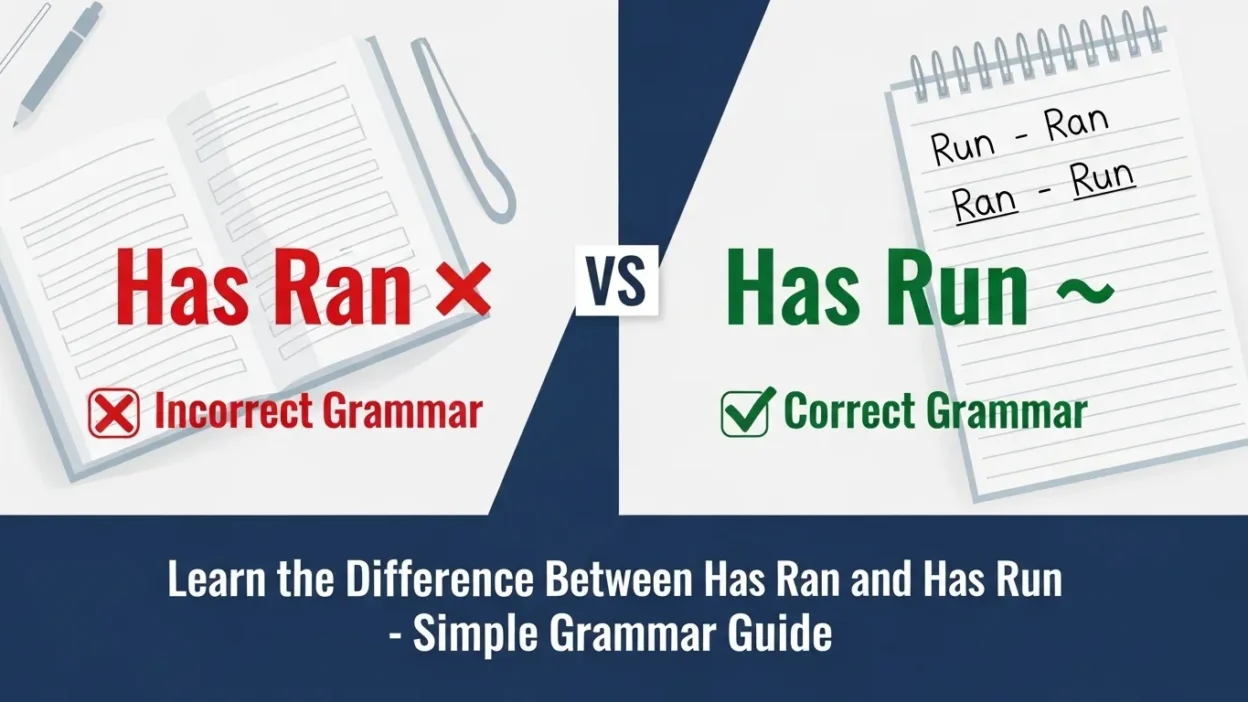
The correct phrase is “has run.”
❌ Has ran is grammatically incorrect.
✅ Has run is correct because “run” is the past participle form, and present perfect tense requires a past participle.
Example:
- She has run five miles today. ✔
- She has ran five miles today. ✘
Now let’s understand why.
Understanding the Verb “Run”
The confusion happens because “run” is an irregular verb.
Here are its three main forms:
- Base form: run
- Past tense: ran
- Past participle: run
That’s right the past participle is not “ran.” It goes back to “run.”
This is why:
- Yesterday, I ran to the store. (simple past)
- I have run three times this week. (present perfect)
When using helping verbs like has, have, or had, you must use the past participle form.
Why “Has Ran” Is Incorrect
The phrase “has ran” mixes two different tense structures:
- “Has” → signals present perfect tense
- “Ran” → is simple past tense
These two do not work together grammatically.
Present perfect structure:
- has/have + past participle
Correct structure:
- has + run ✔
- has + ran ✘
Think of it this way:
If you see has, your brain should automatically look for a past participle, not a simple past verb.
Examples of “Has Run” in Sentences
Here are practical examples to make things crystal clear:
- He has run a successful business for ten years.
- She has run every marathon in the city.
- The machine has run smoothly since installation.
- My dog has run away twice this week.
- The software has run without errors so far.
Notice how all of these use “has” followed by “run,” not “ran.”
Examples of “Ran” (Without “Has”)
Now let’s look at how “ran” is correctly used:
- She ran five miles yesterday.
- He ran out of time.
- The kids ran across the playground.
- I ran into an old friend last week.
In these examples, there is no helping verb like “has” or “have.” That’s why “ran” works perfectly.
Comparison Table: Has Ran vs Has Run
| Phrase | Correct? | Grammar Type | Example Sentence |
| Has ran | ❌ No | Incorrect structure | She has ran fast. |
| Has run | ✅ Yes | Present perfect | She has run fast. |
| Ran | ✅ Yes | Simple past tense | She ran fast. |
This table makes it easy:
If you use has, always choose run, never ran.
Present Perfect Tense Explained Simply
The present perfect tense connects the past to the present. It describes:
- Actions that happened at an unspecified time
- Actions that continue until now
- Experiences in life
- Recent completed actions
Structure:
Subject + has/have + past participle
Examples:
- She has finished her work.
- He has eaten already.
- They have gone home.
- She has run five miles today.
Just like:
- go → went → gone
- eat → ate → eaten
- run → ran → run
Irregular verbs often return to their base form in the past participle.
Common Mistakes People Make
Here are the most common grammar errors related to this confusion:
1. Mixing Tenses
❌ She has ran yesterday.
This sentence is doubly incorrect because:
- “Has ran” is wrong.
- “Yesterday” requires simple past.
✔ She ran yesterday.
✔ She has run before.
2. Assuming “Ran” Is Always the Past Form
Many learners think:
“Ran” = past, so it must always work after “has.”
But English grammar doesn’t work that way. Present perfect requires a past participle, not simple past.
3. Speaking Informally and Forgetting the Rule
In casual speech, some people say “has ran,” but it is grammatically incorrect in standard English writing and formal communication.
If you’re writing professionally, academically, or for SEO content always use “has run.”
American vs British English Differences
Good news: There is no difference between American English and British English when it comes to “has run.”
Both:
- 🇺🇸 American English → “has run”
- 🇬🇧 British English → “has run”
Unlike some verbs (like “gotten” in American English), “run” follows the same structure in both varieties.
So you don’t need to worry about regional grammar differences here.
Easy Trick to Remember
Here’s a simple memory hack:
If you can replace the verb with “gone,” then you need the past participle.
Example:
- She has gone.
- She has run.
Both use the past participle.
But:
- She has went. ❌
- She has ran. ❌
If it sounds wrong with “went,” it’s wrong with “ran.”
More Practice Examples
Let’s test your understanding:
- He has ___ a marathon before.
✔ run - She ___ five miles yesterday.
✔ ran - The program has ___ successfully.
✔ run - They ___ to the park last night.
✔ ran
If you’re getting these right, you’ve mastered the rule.
FAQs
1. Is “has ran” ever correct?
No. “Has ran” is grammatically incorrect in standard English.
2. Why do people say “has ran”?
It’s usually due to confusion between past tense and past participle forms, especially with irregular verbs.
3. Is “ran” a past participle?
No. “Ran” is the simple past tense. The past participle is “run.”
4. Can I use “has run” for recent actions?
Yes. Example: She has run five miles today.
5. What tense is “has run”?
It is present perfect tense.
6. Is this rule the same in American and British English?
Yes. Both use “has run” as the correct form.
7. What about “had run”?
“Had run” is past perfect tense and is also correct.
Example: She had run before the rain started.
8. Is “have ran” correct?
No. Just like “has ran,” it is incorrect. The correct form is “have run.”
Summary:
To put it simply, “has run” is correct, and “has ran” is incorrect. The confusion happens because “run” is an irregular verb, and its past tense (ran) looks different from its past participle (run).
When using present perfect tense, you must always use the past participle.
Remember this structure:
has/have + past participle = correct grammar
Actionable Takeaway
Next time you write or speak, pause when using “has.” Ask yourself:
“Am I using the past participle?”
If yes → Use run.
If no → Fix it before you finalize your sentence.
Mastering small grammar details like this improves your writing clarity, boosts your confidence, and strengthens your English fluency. Keep practicing, and soon this rule will feel completely natural.