
If you’ve ever paused mid-sentence wondering whether to write gluing or glueing, you’re not alone. English spelling rules can feel inconsistent, especially when verbs end in “-e” and take “-ing.” The confusion is real but the answer is simpler than you might think.
In this guide, we’ll clear up the difference between gluing and glueing, explain the rule behind it, and show you how to use the correct spelling confidently in everyday writing. If you’re a student, writer, or just polishing your grammar skills, this article will help you get it right every time.
Quick Answer
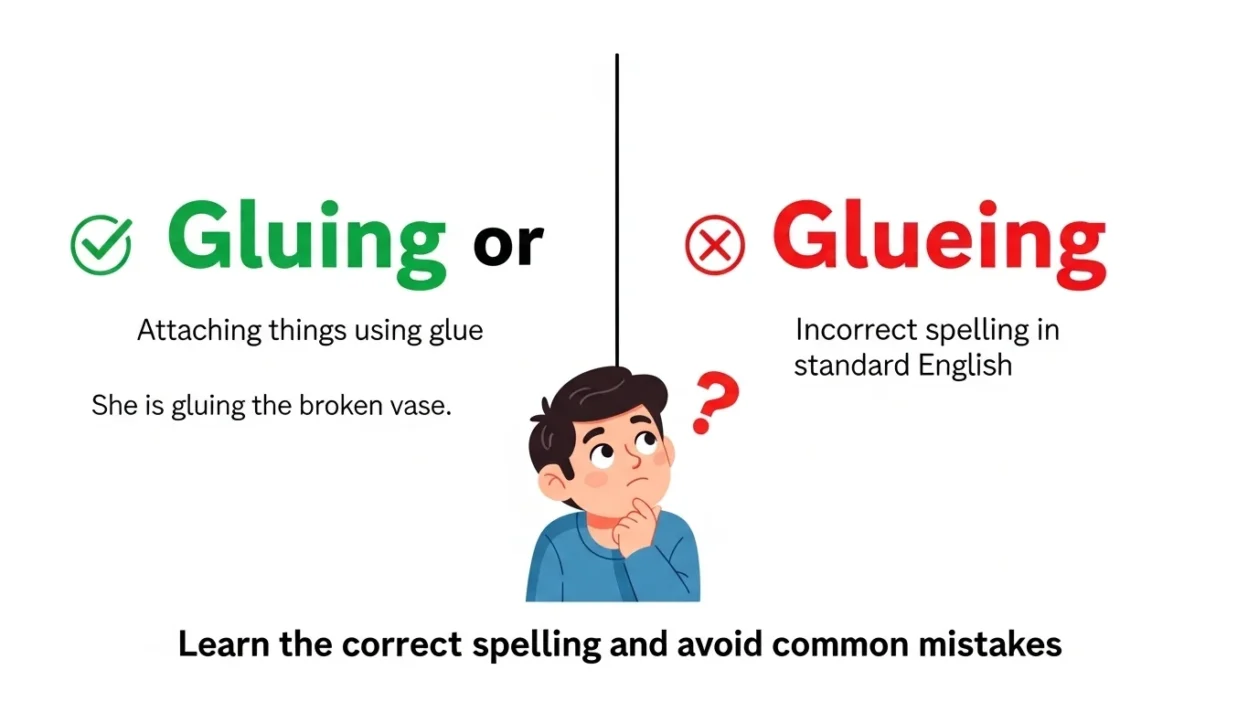
The correct spelling is gluing.
❌ Glueing is incorrect and should be avoided in standard English.
What Does “Gluing” Mean?
Gluing is the present participle of the verb glue, which means to stick or bond things together using adhesive.
Simple examples:
- I am gluing the pieces of paper together.
- She spent the afternoon gluing decorations onto the poster.
- They are gluing wood panels to build a cabinet.
In all these cases, gluing describes an ongoing action.
Why Is “Gluing” Correct and Not “Glueing”?
The answer lies in a common English spelling rule for verbs ending in silent “-e.”
The Rule:
When a verb ends in a silent “e” (like glue), you usually drop the “e” before adding “-ing.”
Examples:
- glue → gluing
- make → making
- write → writing
- drive → driving
So, following this rule:
✔ glue → gluing
❌ glue → glueing (incorrect)
This rule helps maintain smoother pronunciation and avoids awkward letter combinations.
Pronunciation Tip
Another reason gluing is correct is pronunciation clarity.
- Gluing is pronounced: /ˈɡluː.ɪŋ/
- Glueing would create an awkward double vowel sound, making it harder to read and say.
English tends to simplify spellings for ease of pronunciation, and gluing follows that pattern.
Common Mistakes to Avoid
Even though the rule is straightforward, people still make a few common errors:
1. Adding unnecessary “e”
❌ glueing
✔ gluing
2. Overgeneralizing spelling rules
Some learners think all verbs keep the “e” before “-ing,” which isn’t true.
3. Confusing with similar-looking words
Words like seeing and agreeing keep the “e” because they don’t follow the same silent “e” rule.
Compare:
- see → seeing (not silent “e”)
- glue → gluing (silent “e” dropped)
Comparison Table: Gluing vs Glueing
| Aspect | Gluing ✅ | Glueing ❌ |
| Correct spelling | Yes | No |
| Grammar rule | Follows standard | Breaks rule |
| Usage | Widely accepted | Considered wrong |
| Pronunciation | Smooth | Awkward |
| Found in dictionaries | Yes | No |
Are There Exceptions to the Rule?
Yes, English always has exceptions but glue is not one of them.
Some verbs keep the “e” when dropping it would change meaning or pronunciation:
Examples:
- dye → dyeing (to avoid confusion with “dying”)
- singe → singeing (to preserve the soft “g” sound)
But for glue, there’s no such confusion, so the “e” is dropped.
American vs British English Differences
Good news: there is no difference between American and British English in this case.
- 🇺🇸 American English: gluing
- 🇬🇧 British English: gluing
Both follow the same spelling rule, so you can use gluing confidently regardless of your audience.
Related Words and Forms
Understanding related forms helps reinforce the correct spelling:
- Glue (base verb)
- Glued (past tense)
- Gluing (present participle)
- Gluey / Gluey (adjective, sometimes spelled gluey or gluey)
Example sentences:
- He glued the broken vase carefully.
- The surface feels sticky and gluey.
LSI Keywords and Synonyms
To better understand and use gluing, here are some related terms:
- sticking
- bonding
- attaching
- fastening
- adhering
- pasting
- joining
These words can often be used interchangeably depending on context.
Real-Life Usage Examples
Here are some natural, everyday sentences:
- I’m gluing photos into my scrapbook.
- She is gluing labels onto the boxes.
- We spent hours gluing craft materials for the project.
- The carpenter is gluing the joints before securing them.
These examples show how common and practical the word is.
FAQs
1. Is “glueing” ever correct?
No, glueing is not considered correct in standard English. Always use gluing.
2. Why do some people write “glueing”?
It’s usually due to misunderstanding the rule about dropping the silent “e” before adding “-ing.”
3. What is the past tense of glue?
The past tense is glued, not glueed.
4. Are there similar words that follow this rule?
Yes:
- make → making
- take → taking
- bake → baking
5. How can I remember the correct spelling?
Just remember: drop the silent “e” before adding “-ing.”
6. Does pronunciation change with “gluing”?
No major change just a smooth transition between sounds: gloo-ing.
7. Is “gluing” used in formal writing?
Yes, it’s fully accepted in both formal and informal contexts.
8. What’s the difference between gluing and sticking?
Gluing specifically refers to using adhesive, while sticking is more general.
Final Summary
To wrap it up, gluing is the correct and standard spelling, while glueing is incorrect and should be avoided. The reason is simple: English grammar rules require dropping the silent “e” before adding “-ing.” This makes the word easier to read, pronounce, and align with other similar verbs.
If you’re writing casually or professionally, using the correct spelling helps improve clarity and credibility. Small details like this can make a big difference in how polished your writing appears.
Actionable Takeaway
- Always write gluing, never glueing
- Remember the rule: drop the silent “e” + add “-ing”
- Practice with similar verbs to reinforce the pattern
- Double-check spelling when writing to avoid common mistakes
Mastering small grammar points like this builds confidence and sharpens your writing skills over time.

Edward Axel is the administrator of SyntaxlyHub, responsible for overseeing site operations, content management, and technical performance. He ensures accuracy, consistency, and smooth functionality while supporting the team in delivering reliable, high-quality grammar resources and a user-friendly learning experience for readers worldwide.