
If you’ve ever paused while writing and wondered whether to use gases or gasses, you’re not alone. This small spelling difference causes a lot of confusion, even for confident English writers. The good news? The rule is actually simple once you understand how plural forms work in English.
In this guide, you’ll learn exactly when to use gases and when gasses is appropriate (yes, it does have a place!). We’ll break it down in a friendly, practical way so you can write with confidence every time.
Quick Answer
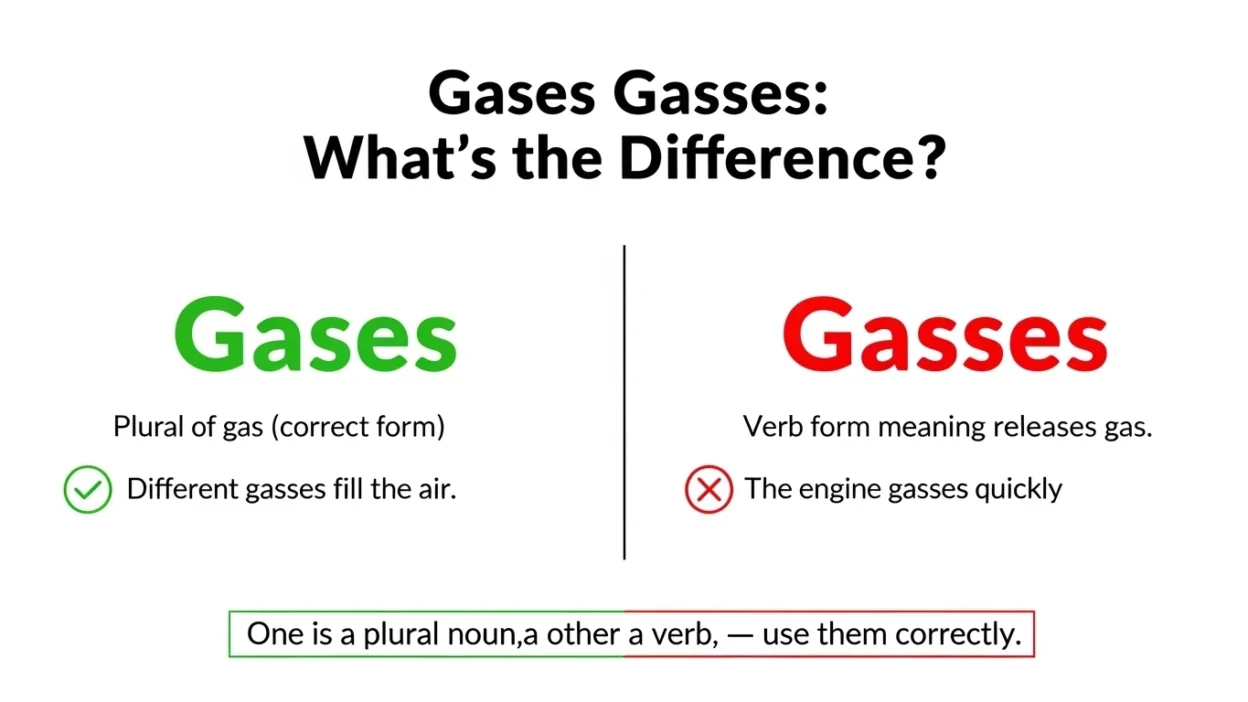
- Gases = Correct plural of gas (used in science and general writing)
- Gasses = A verb form (means releasing gas or “passing gas”)
👉 In most cases, you should use gases.
Meaning and Usage Explained
What Does “Gases” Mean?
Gases is the standard plural of the noun gas. It refers to multiple types or amounts of gas.
Examples:
- The air contains several gases, including oxygen and nitrogen.
- Greenhouse gases contribute to climate change.
- Scientists study how different gases react under pressure.
This is the form you’ll see in textbooks, articles, and everyday writing.
What Does “Gasses” Mean?
Gasses is actually a verb, not a plural noun. It comes from the verb to gas.
It can mean:
- To release gas
- To expose someone to gas
- Informally, to talk excessively or boast
- Slang: passing gas
Examples:
- The factory gasses the chamber during testing.
- He gasses on about his achievements all the time.
👉 Notice: This form is rarely used compared to gases.
Key Difference at a Glance
| Word | Part of Speech | Meaning | Example |
| Gases | Noun (plural) | More than one gas | The lab studies toxic gases. |
| Gasses | Verb | Releases or emits gas | The machine gasses the tank. |
American vs British English
Here’s something helpful: there is no major difference between American and British English for this word.
- Both use gases as the plural noun
- Both use gasses as the verb form
So no matter where you’re writing for, the rule stays consistent.
Common Mistakes to Avoid
Understanding the difference is one thing avoiding mistakes is another. Here are the most common errors:
1. Using “Gasses” as a Plural
❌ Incorrect: The room filled with harmful gasses.
✅ Correct: The room filled with harmful gases.
👉 Tip: If you’re talking about more than one gas, always use gases.
2. Overthinking the Spelling Rule
Many people assume adding “-es” automatically means doubling the “s.” That’s not always true.
- Gas → Gases (correct)
- Not: Gass + es
3. Confusing Noun and Verb Forms
❌ Incorrect: The scientist measured different gasses.
✅ Correct: The scientist measured different gases.
Why “Gases” Is the Correct Plural
English plural rules can feel tricky, but this follows a standard pattern:
- Words ending in -s often add -es for plural
- No need to double the letter unless pronunciation demands it
Examples:
- Bus → Buses
- Class → Classes
- Gas → Gases
👉 The pronunciation stays smooth without doubling the “s.”
Real-Life Examples for Better Understanding
Here are some everyday sentences to help lock it in:
Using “Gases” (Correct Plural)
- Industrial gases are used in manufacturing.
- The planet’s atmosphere contains different gases.
- Some gases are invisible but dangerous.
Using “Gasses” (Verb Form)
- The engine gasses out harmful emissions.
- He gasses his friends up with exaggerated stories.
👉 Notice how the role of the word changes completely.
Memory Trick (So You Never Forget)
Here’s a simple way to remember:
👉 “If it’s a thing, use gases. If it’s an action, use gasses.”
- Thing (noun) → gases
- Action (verb) → gasses
Related Words and Synonyms (LSI Keywords)
To strengthen your understanding (and SEO knowledge), here are related terms:
- Air components
- Atmospheric gases
- Chemical gases
- Emissions
- Vapors
- Fumes
- Gas compounds
Using these naturally in writing can improve clarity and search relevance.
FAQs
1. Is “gasses” ever correct?
Yes, but only as a verb. It’s not correct as a plural noun.
2. What is the plural of gas?
The correct plural is gases.
3. Why do people write “gasses” by mistake?
Because they assume doubling the “s” is required, which isn’t true for this word.
4. Is “gases” used in scientific writing?
Absolutely. Gases is the standard form in science, chemistry, and education.
5. Does British English use “gasses” as a plural?
No. British English also uses gases as the plural.
6. Can “gasses” mean something informal?
Yes, it can mean talking excessively or even slang for passing gas.
7. How can I quickly check which one to use?
Ask yourself:
- Is it a thing? → gases
- Is it an action? → gasses
8. Are there similar confusing words?
Yes, like:
- Practice vs practise
- License vs licence
- Advice vs advise
Final Summary
The difference between gases and gasses comes down to grammar, not preference. Gases is the correct plural form of gas and is used in almost every situation where you’re referring to multiple gases.
On the other hand, gasses is a verb and appears far less frequently in everyday writing.
If you remember just one thing, let it be this: 99% of the time, you’ll need “gases.” Keeping this simple rule in mind will instantly improve your writing accuracy and confidence.
Actionable Takeaway
Next time you write:
- Use gases for plural nouns
- Reserve gasses only for verb usage
👉 Quick check before publishing: Replace your word with “many types of gas.” If it fits, gases is correct.