If you’ve ever paused mid-sentence wondering whether to write fairing or faring, you’re not alone. These two words sound identical, look similar, and often confuse even confident writers.
The good news? Once you understand their meanings and contexts, choosing the right one becomes easy and automatic.
In this friendly, practical guide, you’ll learn the difference between fairing vs faring, how to use each correctly, real-life examples, common mistakes to avoid, and memory tricks that actually stick. Let’s clear it up together.
Quick Answer: Fairing or Faring?
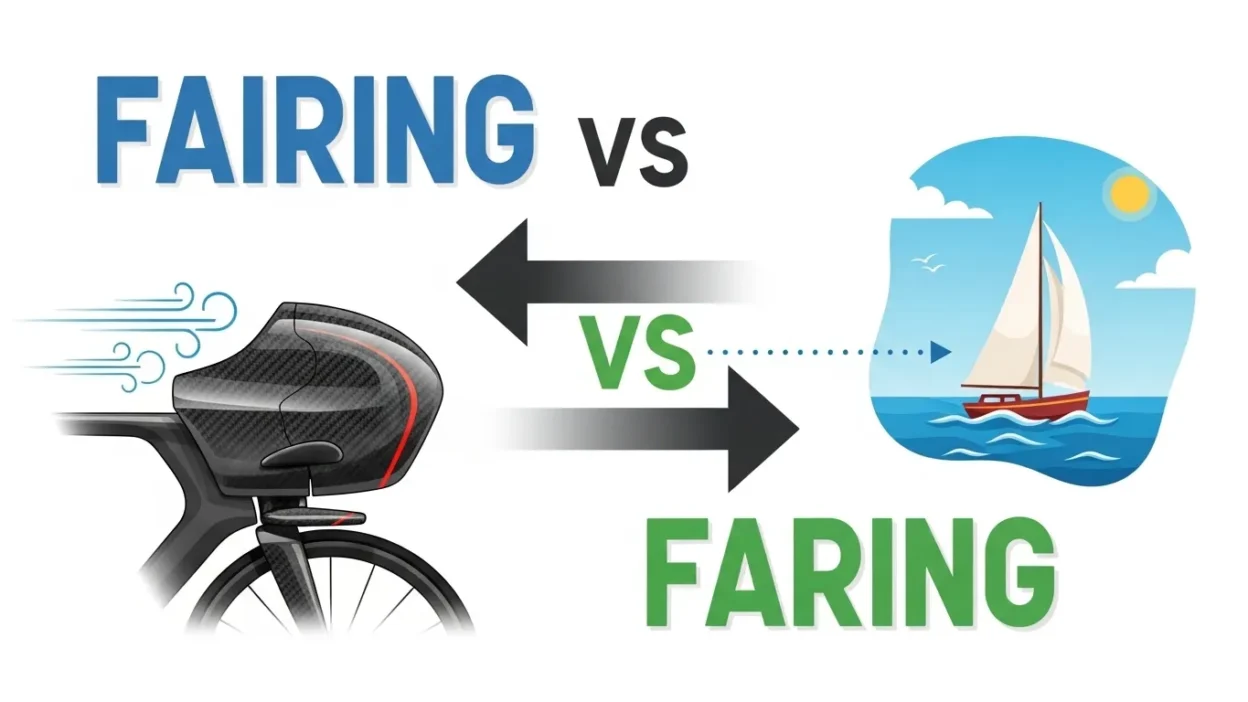
- Fairing = a noun referring to a structure or covering that improves aerodynamics or appearance (often used in engineering, aviation, or motorcycles).
- Faring = a verb form meaning getting along or doing well (or poorly).
👉 If you’re talking about progress or well-being, use faring.
👉 If you’re talking about a physical object or component, use fairing.
Meaning of “Fairing”
Fairing is primarily a technical noun. It refers to a smooth covering added to something to reduce drag, improve airflow, or enhance appearance. You’ll often see it in contexts related to:
- Aviation
- Motorcycles
- Bicycles
- Boats
- Engineering design
Examples
- The motorcycle’s fairing reduces wind resistance.
- The aircraft’s nose fairing protects internal components.
- Designers installed a wheel fairing for better aerodynamics.
Synonyms & related terms
- casing
- shell
- cover
- aerodynamic panel
- housing
LSI keywords: aerodynamic fairing, motorcycle fairing, aircraft fairing, protective casing, structural cover
Meaning of “Faring”
Faring is the present participle of the verb fare, which means to get along, to perform, or to experience something. It’s commonly used in questions or statements about someone’s condition or progress.
Examples
- How are you faring after the move?
- The company is faring well despite market changes.
- She’s faring better than expected in her new role.
Synonyms & related phrases
- doing
- managing
- coping
- progressing
- getting along
LSI keywords: how are you faring meaning, faring well definition, faring badly example, progress status phrase
Key Differences Between Fairing and Faring
| Word | Part of Speech | Meaning | Context | Example |
| Fairing | Noun | A covering or structure | Engineering, vehicles | The bike’s fairing cracked. |
| Faring | Verb form | Doing or progressing | Everyday conversation | He’s faring well. |
Simple rule:
If you can replace the word with “doing,” you want faring.
If you can replace it with “cover,” you want fairing.
Common Mistakes People Make
Even experienced writers mix these up. Here are the most frequent errors and how to fix them.
Mistake #1 — Using “fairing” when asking about someone
❌ How are you fairing?
✔ How are you faring?
Why: You’re asking about progress, not a mechanical component.
Mistake #2 — Using “faring” for mechanical parts
❌ The plane’s faring protects the engine.
✔ The plane’s fairing protects the engine.
Mistake #3 — Spell-check traps
Spell-check often won’t flag this error because both words are spelled correctly. Always double-check meaning, not just spelling.
Memory Tricks to Never Confuse Them Again
Try these easy associations:
- Fairing = Fair + ing → Fairings make things look fair/smooth.
- Faring = Fare → Like “farewell,” related to life’s journey.
Another quick mnemonic:
Fairing = machine
Faring = human
American vs British English Differences
Good news: there is no spelling difference between American and British English for fairing or faring. Both forms are identical in:
- spelling
- usage
- grammar
- meaning
The only variation you may notice is stylistic preference. British English sometimes uses “How are you faring?” slightly more in formal writing, while American English may prefer “How are you doing?” in casual speech. But both are correct and widely understood.
When to Use Fairing in Technical Writing
If you write about vehicles, engineering, or design, fairing is a crucial term. It’s often used in manuals, product descriptions, and technical specifications.
Professional examples
- The rocket fairing separates during stage two.
- Carbon-fiber fairings reduce drag at high speed.
- The prototype includes a redesigned tail fairing.
Using the correct word here boosts credibility and clarity—important for technical SEO and professional communication.
When to Use Faring in Conversation or Writing
Faring appears most often in:
- emails
- check-ins
- reports
- storytelling
- journalism
Natural sentence examples
- The project is faring better than expected.
- Farmers are faring poorly after the drought.
- Students are faring well in the new curriculum.
Because it relates to progress or condition, it often pairs with adverbs:
- faring well
- faring badly
- faring poorly
- faring better
Why These Words Get Confused So Often
There are three main reasons:
1. Identical pronunciation
Both words are homophones, meaning they sound exactly the same.
2. Similar spelling
Only one letter differs: fairing vs faring.
3. Rare everyday use of “fairing”
Most people rarely talk about aerodynamic structures, so they default to the more familiar spelling.
Understanding these causes helps you consciously choose the right word.
Quick Practice Quiz
Test yourself:
- How is your sister ___ after her surgery?
- The bike’s front ___ cracked during the crash.
- The company is ___ better than last year.
- The rocket’s nose ___ detached.
Answers
- faring
- fairing
- faring
- fairing
FAQs
1. Is “how are you fairing” ever correct?
No. When asking about someone’s condition, faring is always correct.
2. What part of speech is “fairing”?
It’s a noun referring to a structural covering or casing.
3. Can “faring” be used in formal writing?
Yes. It’s perfectly acceptable in both formal and informal contexts.
4. Is “fareing” a correct spelling?
No. That’s a misspelling. The correct form is faring.
5. Why is it called a fairing in engineering?
Because it “fairs” or smooths airflow, reducing drag and improving efficiency.
6. Do both words come from the same root?
No. Fairing comes from the verb fair (to smooth or streamline), while faring comes from fare (to go or get along).
7. Which word is more common in daily conversation?
Faring is more common because it relates to everyday experiences.
8. Are these considered homophones?
Yes. They sound identical but have different meanings and spellings.
Summary
Understanding the difference between fairing and faring comes down to context. Fairing is a technical noun describing a structural covering that improves aerodynamics or appearance, commonly used in engineering and vehicle design.
Faring, on the other hand, is a verb form that describes how someone or something is doing or progressing. Despite their identical pronunciation, their meanings live in completely different worlds.
Mastering this distinction improves your writing clarity, professionalism, and credibility. When you pause to choose the correct word, you show attention to detail and readers notice that.
Actionable takeaway:
Next time you write the word, ask yourself: Am I talking about progress or a physical object? Progress = faring. Object = fairing. One quick question prevents the mistake every time.