If you’ve ever paused mid-sentence wondering whether to write emersion or immersion, you’re not alone. These two words look similar, sound related, and even share Latin roots yet they mean almost opposite things.
Understanding the difference can instantly sharpen your writing, whether you’re crafting an essay, academic paper, blog post, or professional document.
In this guide, you’ll learn the exact meaning of emersion vs immersion, when to use each word, examples that make them crystal clear, and tips to avoid common mistakes. By the end, you’ll feel confident choosing the right word every time.
Quick Answer: Emersion vs Immersion
Immersion means being deeply involved or submerged in something.
Emersion means coming out of a liquid or emerging from a submerged state.
👉 Think: Immersion = going in, Emersion = coming out.
Meaning of Emersion
Emersion is a noun referring to the act of emerging or rising out of water or another liquid. It’s most commonly used in scientific, biological, or technical contexts.
Definition: The process of coming out of a submerged state.
Examples
- The turtle’s emersion from the sea signaled the start of nesting season.
- Astronomers recorded the moon’s emersion from behind the planet.
- The diver’s slow emersion ensured safe decompression.
Where you’ll see it used
- Marine biology
- Astronomy
- Environmental science
- Diving terminology
In everyday conversation, the word is rare. Many people have never encountered it outside academic or technical writing.
Meaning of Immersion
Immersion is far more common and versatile. It describes deep involvement, absorption, or submersion—physically, mentally, or emotionally.
Definition: The act of being completely surrounded or deeply engaged in something.
Examples
- Language learners improve through full immersion.
- The film created total immersion for viewers.
- The cloth was soaked through immersion in dye.
Common contexts
- Education (“language immersion programs”)
- Entertainment (“immersive gaming”)
- Psychology (“deep mental immersion”)
- Religion (“immersion baptism”)
Because of its metaphorical uses, immersion appears frequently in modern writing, marketing, and conversation.
Emersion vs Immersion: Side-by-Side Comparison
| Feature | Emersion | Immersion |
| Core meaning | Coming out of liquid | Going into liquid or deep involvement |
| Usage frequency | Rare | Very common |
| Typical context | Scientific/technical | Everyday + academic |
| Memory tip | E = Exit | I = In |
| Example | Fish emersion | Language immersion |
Key Difference Explained Simply
The easiest way to remember the difference:
- Immersion = entering or being submerged
- Emersion = emerging or rising out
They’re conceptual opposites.
This contrast mirrors their Latin roots:
- immergere = to plunge into
- emergere = to rise out
Understanding this root relationship helps you instantly recognize which word fits your sentence.
Real-Life Examples for Clarity
Seeing words in context is the fastest way to master them.
Scientific context
- Incorrect: The frog’s immersion from the pond marked spring.
- Correct: The frog’s emersion from the pond marked spring.
Learning context
- Incorrect: Students improved through Spanish emersion.
- Correct: Students improved through Spanish immersion.
Creative writing
- “After hours beneath the waves, her emersion felt like rebirth.”
- “The novel’s vivid imagery created total immersion.”
Common Mistakes and How to Avoid Them
Many writers confuse these terms because they look and sound similar. Here are the most frequent errors:
1. Using emersion when you mean immersion
This happens because immersion is far more common. If you’re describing deep involvement, immersion is almost always correct.
2. Assuming emersion is a typo
It’s not. Emersion is a legitimate word—it’s just specialized and less widely used.
3. Mixing them in academic writing
Scientific fields require precise terminology. Using immersion instead of emersion can change meaning entirely.
Quick fix rule:
If the subject is entering or being surrounded, use immersion.
If the subject is exiting or emerging, use emersion.
American vs British English Differences
Good news: there’s no spelling difference between American and British English for these words. Both dialects use:
- immersion
- emersion
However, usage frequency differs slightly:
- Immersion is widely used in both.
- Emersion appears more often in British academic and scientific texts than in everyday American writing.
Still, this difference is about frequency—not spelling or meaning.
Synonyms and Related Terms (LSI Keywords)
Using related vocabulary can improve clarity and SEO value. Here are useful alternatives and closely related words:
For Immersion
- submersion
- absorption
- deep involvement
- engagement
- total focus
- envelopment
For Emersion
- emergence
- surfacing
- rising
- appearing
- ascent
Be careful: some synonyms overlap conceptually but not technically. For example, submersion is close to immersion, but emergence is more general than emersion.
When Should You Use Emersion?
Use emersion when precision matters and the context involves literal or scientific emergence.
Best situations:
- Academic research papers
- Marine biology descriptions
- Astronomy reports
- Technical diving explanations
- Environmental science writing
If you’re writing casual content, storytelling, or general nonfiction, you’ll rarely need this word.
When Should You Use Immersion?
Use immersion whenever you want to describe deep involvement or submersion—literal or metaphorical.
Best situations:
- Education and learning discussions
- Marketing and product descriptions
- Psychology or mindfulness topics
- Gaming and VR content
- Creative writing
In modern language, immersion is extremely versatile and widely understood.
Memory Tricks That Actually Work
Simple associations make these words stick:
- Immersion = In
- Emersion = Exit
Or visualize it:
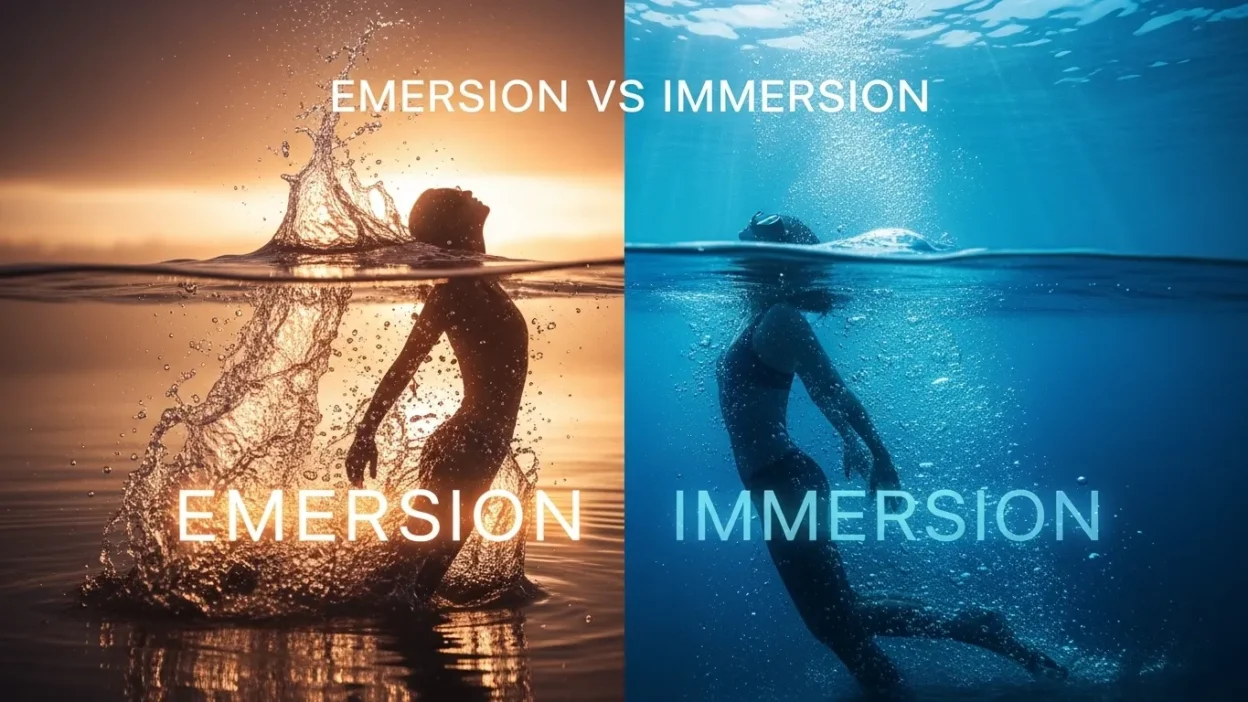
- A diver jumping into water → immersion
- A diver rising to the surface → emersion
Mental imagery is one of the most effective vocabulary retention tools.
FAQs
1. Is emersion a real word?
Yes. It’s a legitimate English word, mainly used in scientific or technical contexts.
2. Why is immersion more common?
Because it applies to both literal and metaphorical situations, making it useful in everyday speech.
3. Can emersion be used metaphorically?
Rarely. Most writers avoid metaphorical use because it can sound overly technical.
4. Are emersion and emergence the same?
Not exactly. Emergence is broader; emersion specifically refers to rising out of liquid.
5. Is immersion always physical?
No. It’s often metaphorical, such as emotional immersion or cultural immersion.
6. Do native speakers confuse these words?
Yes. Even fluent speakers sometimes mix them up due to similarity in spelling.
7. Which word should I use in essays?
Usually immersion. Use emersion only if discussing literal emergence from liquid.
8. Is one more formal than the other?
Emersion sounds more technical and formal. Immersion works in both formal and informal writing.
Final Summary
The distinction between emersion vs immersion comes down to direction and depth. Immersion means going in, being surrounded, or deeply engaged. Emersion means coming out or rising from a submerged state.
While immersion is common and widely used in everyday language, emersion is rare and typically reserved for scientific or technical contexts.
Mastering this pair is easier than it seems. Just remember: Immersion = In. Emersion = Exit. Once you link each word to its core idea, you’ll never mix them up again, and your writing will sound clearer, sharper, and more professional.
Actionable takeaway:
Before choosing between the two, ask yourself: Is something going in or coming out? Your answer reveals the correct word instantly.