When someone passes away, words become both powerful and delicate. Two terms often come up in such moments elegy and eulogy. While they may sound similar and are both connected to loss, they serve very different purposes. Understanding the difference helps you choose the right form of expression during emotional times.
In this guide, you’ll clearly learn the distinction between elegy vs eulogy, along with meanings, examples, common mistakes, and when to use each. If you’re writing, speaking, or simply trying to understand the nuance, this article gives you everything you need in a warm, human way.
Quick Answer: Elegy vs Eulogy
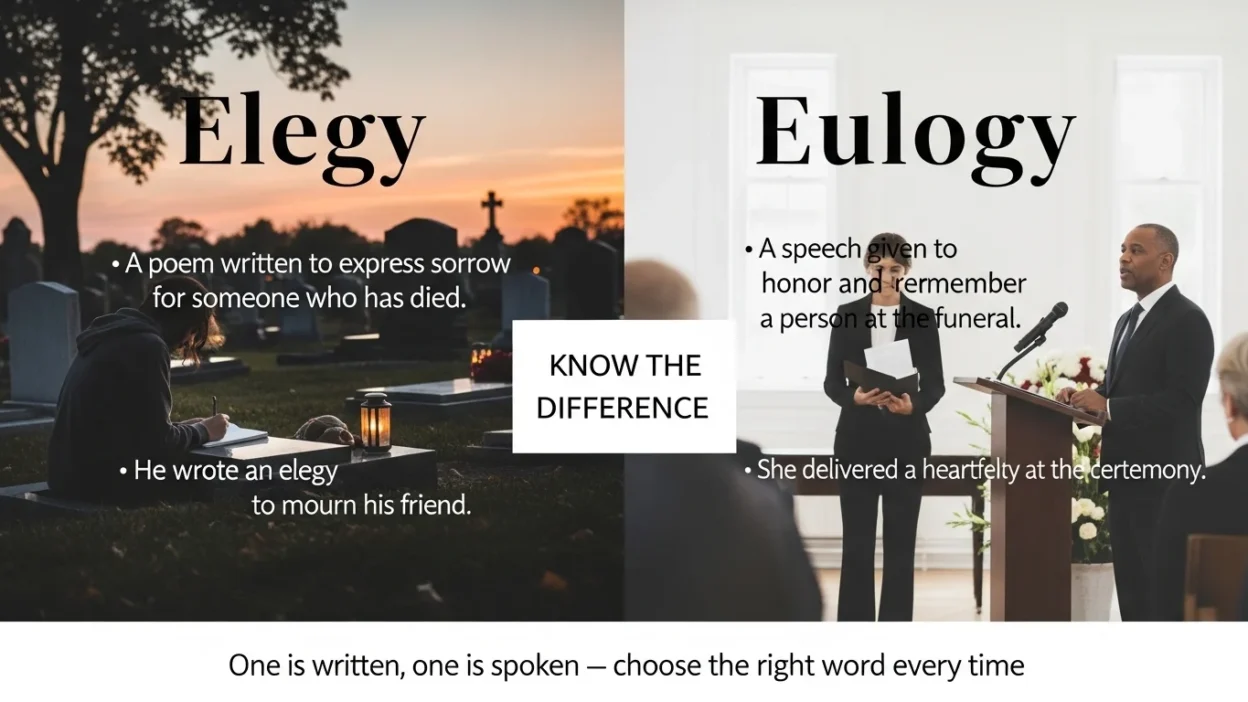
- Elegy: A written or poetic expression of grief, mourning, or reflection on death.
- Eulogy: A speech given at a funeral that honors and celebrates a person’s life.
In short:
👉 Elegy is written (often poetic), while a eulogy is spoken (formal speech).
What Is an Elegy?
An elegy is a form of writing usually a poem that expresses sorrow, loss, and reflection after someone’s death. It is deeply emotional and often explores themes of grief, memory, and acceptance.
Key Features of an Elegy
- Written, not spoken publicly (though it can be read aloud)
- Often poetic or literary in style
- Reflective and introspective tone
- Focuses on loss, mourning, and sometimes healing
Examples of Elegy
- A poem written for a deceased loved one
- Literary works like “O Captain! My Captain!”
- Personal journal entries expressing grief
Simple Example Sentence
- She wrote an elegy for her grandmother, capturing her love and sorrow in beautiful words.
What Is a Eulogy?
A eulogy is a speech delivered at a funeral or memorial service that honors the life of the deceased. Unlike an elegy, it often includes stories, achievements, and positive memories.
Key Features of a Eulogy
- Spoken aloud at funerals or memorials
- Structured like a speech
- Celebratory as well as emotional
- Focuses on the person’s life, character, and legacy
Examples of Eulogy
- A son speaking about his father at a funeral
- A friend sharing memories during a memorial service
- A formal tribute delivered in front of attendees
Simple Example Sentence
- He delivered a heartfelt eulogy that brought both tears and smiles to the audience.
Elegy vs Eulogy: Side-by-Side Comparison
| Feature | Elegy | Eulogy |
| Format | Written (often poetic) | Spoken (speech) |
| Purpose | Express grief and reflection | Honor and celebrate a life |
| Tone | Sad, reflective, emotional | Warm, respectful, sometimes uplifting |
| Setting | Literature, personal writing | Funeral or memorial service |
| Audience | Readers or personal reflection | Funeral attendees |
| Structure | Flexible, artistic | Structured speech |
When to Use Elegy vs Eulogy
Choosing between these depends on your intention and context.
Use an Elegy When:
- You want to express personal grief privately
- You are writing poetry or literary work
- You want a reflective and artistic outlet
- You’re processing loss emotionally
Use a Eulogy When:
- You are speaking at a funeral or memorial
- You want to honor someone’s life publicly
- You aim to comfort others
- You want to share memories and stories
Common Mistakes to Avoid
Even though these terms are distinct, people often mix them up. Here are common errors to watch out for:
1. Using “Elegy” for a Speech
❌ He gave a beautiful elegy at the funeral.
✔️ He gave a beautiful eulogy at the funeral.
👉 Elegy is not typically a speech it’s written.
2. Thinking Both Are Always Sad
- Elegies are mostly sorrowful
- Eulogies can include humor and uplifting stories
3. Assuming They Are Interchangeable
They are related but not identical. One is literary, the other ceremonial.
4. Overlooking Context
Using the wrong term in formal writing or speaking can sound awkward or incorrect.
Elegy vs Eulogy in Real-Life Context
Understanding these terms becomes easier when you see them in real situations:
- A poet writes about loss → Elegy
- A daughter speaks at her mother’s funeral → Eulogy
- A published piece mourning a public figure → Elegy
- A tribute speech in a ceremony → Eulogy
American vs British English Differences
Good news there’s no major difference between American and British English when it comes to elegy and eulogy.
- Both terms are spelled and used the same way
- Pronunciation differences are minimal
- Context and meaning remain identical
👉 This makes them easy to use globally without confusion.
Related Words and Synonyms (LSI Keywords)
To improve understanding and SEO relevance, here are related terms:
- Tribute
- Memorial speech
- Funeral address
- Mourning poem
- Obituary
- Remembrance
- Commemoration
- Reflection on death
- Funeral tribute
These words often appear in similar contexts but don’t replace elegy or eulogy directly.
FAQs
1. Can a eulogy be written like an elegy?
Yes, a eulogy can include poetic elements, but it remains a speech intended for delivery.
2. Is an elegy always a poem?
Not always. While traditionally poetic, an elegy can also be a reflective essay or prose.
3. Can the same text be both an elegy and a eulogy?
Sometimes. If a written elegy is read aloud at a funeral, it may function as both.
4. Which is more formal: elegy or eulogy?
Both can be formal, but a eulogy is typically more structured due to its public setting.
5. Do eulogies have to be serious?
No. Many include light humor and uplifting stories to celebrate life.
6. Can anyone give a eulogy?
Yes. Family members, friends, or even colleagues can deliver one.
7. Are elegies still used today?
Absolutely. People still write elegies in poetry, blogs, and personal writing.
8. What is the main emotional difference?
Elegies focus on grief and reflection, while eulogies balance grief with celebration.
Summary
Understanding the difference between elegy vs eulogy helps you express emotions more appropriately and meaningfully. An elegy is a written, often poetic reflection on loss, while a eulogy is a spoken tribute delivered at a funeral. Both serve important roles, but they differ in format, tone, and purpose.
In real life, choosing the right one depends on whether you’re writing privately or speaking publicly. If you’re processing emotions through words, an elegy offers a personal outlet.
If you’re honoring someone in front of others, a eulogy becomes the right choice. Both forms carry deep emotional value and help keep memories alive.
Actionable Takeaway
- Use elegy when writing about loss in a reflective or poetic way
- Use eulogy when speaking at a funeral or memorial
- Remember: written vs spoken is the easiest way to distinguish them
- When in doubt, think about your audience and setting

Edward Axel is the administrator of SyntaxlyHub, responsible for overseeing site operations, content management, and technical performance. He ensures accuracy, consistency, and smooth functionality while supporting the team in delivering reliable, high-quality grammar resources and a user-friendly learning experience for readers worldwide.