Confused about “eaten” or “ate”? You’re not alone. These two forms of the verb eat often trip up learners and even native speakers because they look similar but follow different grammar rules.
The good news? Once you understand how verb tenses work, the difference becomes simple and intuitive. In this guide, you’ll learn exactly when to use ate vs eaten, with clear examples, common mistakes, and easy tips you can remember.
Quick Answer: Eaten vs Ate
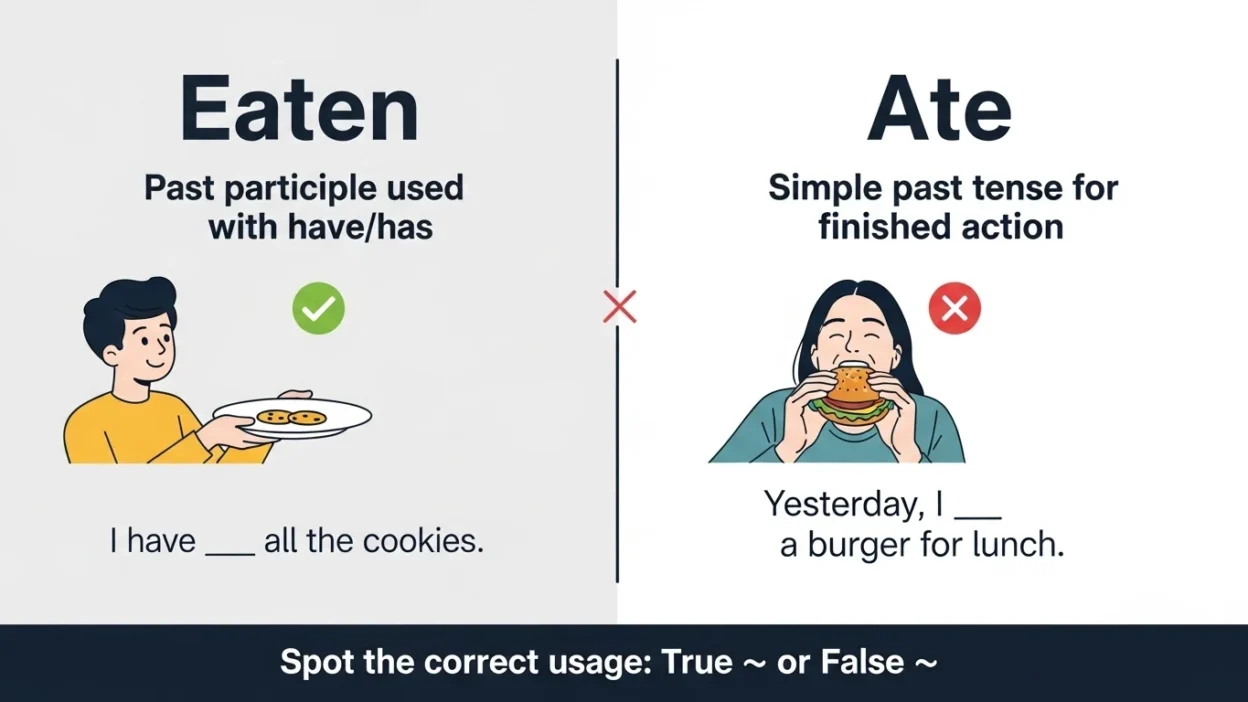
- Ate = simple past tense (used alone)
👉 Example: I ate dinner at 8 PM. - Eaten = past participle (used with helping verbs like have, has, had)
👉 Example: I have eaten dinner already.
If there’s no helping verb, use ate.
If there is a helping verb, use eaten.
Understanding the Meaning of Ate and Eaten
Both ate and eaten come from the base verb eat, which means to consume food. The difference is not in meaning but in grammar and structure.
What Does “Ate” Mean?
“Ate” is the simple past tense of eat. It describes an action that happened and finished in the past.
- She ate breakfast early.
- We ate at a new restaurant yesterday.
Use ate when:
- The time is finished (yesterday, last night, earlier)
- There is no helping verb
What Does “Eaten” Mean?
“Eaten” is the past participle of eat. It must be used with auxiliary (helping) verbs such as:
- have
- has
- had
- be (in passive voice)
Examples:
- I have eaten lunch.
- He has eaten all the cake.
- The food was eaten quickly.
Use eaten when:
- You are using perfect tenses
- You are forming the passive voice
Ate vs Eaten: Side-by-Side Comparison
| Feature | Ate | Eaten |
| Verb Form | Simple past | Past participle |
| Used Alone? | Yes | No |
| Needs Helping Verb? | No | Yes |
| Example | I ate dinner | I have eaten dinner |
| Tense Type | Past | Perfect / Passive |
Examples of Ate and Eaten in Sentences
Examples with “Ate”
- I ate too much at the party.
- They ate lunch together.
- She ate an apple before leaving.
Examples with “Eaten”
- I have eaten already.
- They have eaten all the snacks.
- He had eaten before we arrived.
- The cake was eaten by the kids.
Common Mistakes to Avoid
Even advanced learners make mistakes with eaten and ate. Here are the most common ones:
❌ Using “Eaten” Without a Helping Verb
- Incorrect: I eaten dinner.
- Correct: I ate dinner. OR I have eaten dinner.
👉 Rule: Eaten always needs a helper.
❌ Using “Ate” with “Have/Has/Had”
- Incorrect: I have ate lunch.
- Correct: I have eaten lunch.
👉 Rule: After have/has/had, always use the past participle (eaten).
❌ Mixing Tenses Incorrectly
- Incorrect: She has ate yesterday.
- Correct: She ate yesterday. OR She has eaten already.
👉 Avoid mixing past time words with present perfect tense.
Easy Trick to Remember the Difference
Here’s a simple shortcut:
👉 If you see have / has / had, use eaten
👉 If not, use ate
Think of it like this:
- “Ate” stands alone
- “Eaten” needs a partner
American vs British English Usage
Good news there’s no difference between American and British English when it comes to ate vs eaten. Both follow the same grammar rules.
However, in informal speech:
- Americans may say: I already ate.
- British speakers may prefer: I’ve already eaten.
Both are correct just slightly different stylistically.
Related Grammar Concepts (LSI Keywords)
To fully master eaten vs ate, it helps to understand these related terms:
- Irregular verbs (eat–ate–eaten)
- Past tense vs past participle
- Present perfect tense
- Auxiliary verbs
- Verb conjugation in English
These concepts all play a role in choosing the correct form.
When to Use Ate vs Eaten in Real Life
Let’s look at real-world situations:
Talking About Yesterday
- I ate pizza last night. ✅
Talking About Experience
- I have eaten sushi before. ✅
Talking About Order of Events
- She had eaten before the meeting started. ✅
Passive Voice
- The meal was eaten quickly. ✅
FAQs
1. Is “I have ate” correct?
No. The correct form is “I have eaten.”
2. Can “eaten” be used alone?
No. It must always be used with a helping verb.
3. Why is “ate” used without “have”?
Because ate is the simple past tense and does not require auxiliary verbs.
4. Which is more common: ate or eaten?
Both are common but used in different contexts:
- Ate → past actions
- Eaten → perfect tenses or passive voice
5. Is “had ate” correct?
No. The correct form is “had eaten.”
6. How do I know which tense to use?
Look for:
- Time words → use ate
- Helping verbs → use eaten
7. Is this correct: “I already ate”?
Yes, especially in American English. It’s informal but correct.
8. What type of verb is “eat”?
It’s an irregular verb (eat–ate–eaten).
Final Summary
Understanding the difference between eaten and ate comes down to one key idea: grammar structure matters more than meaning. While both words relate to eating, ate works as a standalone past tense verb, while eaten depends on helping verbs to complete the sentence.
If you remember just one thing, let it be this: “ate” works alone, “eaten” needs help. Once you start noticing helping verbs like have, has, or had, choosing the correct form becomes almost automatic. Practice with real sentences, and you’ll build confidence quickly.
Actionable Takeaway
Next time you write or speak:
- Scan your sentence for helping verbs
- If you see one → use eaten
- If not → use ate
Try writing 3–5 sentences using both forms today it’s the fastest way to lock in the rule.