If you’ve ever paused mid-sentence wondering whether to write “do not” or “dont,” you’re not alone. This small but important distinction often trips up writers, especially in emails, texts, and formal writing. Choosing the right form can affect clarity, tone, and even how professional your writing appears.
In this guide, you’ll learn the exact difference between do not vs dont, when to use each, and how to avoid common mistakes. If you’re writing casually or professionally, this article will help you use these forms confidently and correctly.
Quick Answer
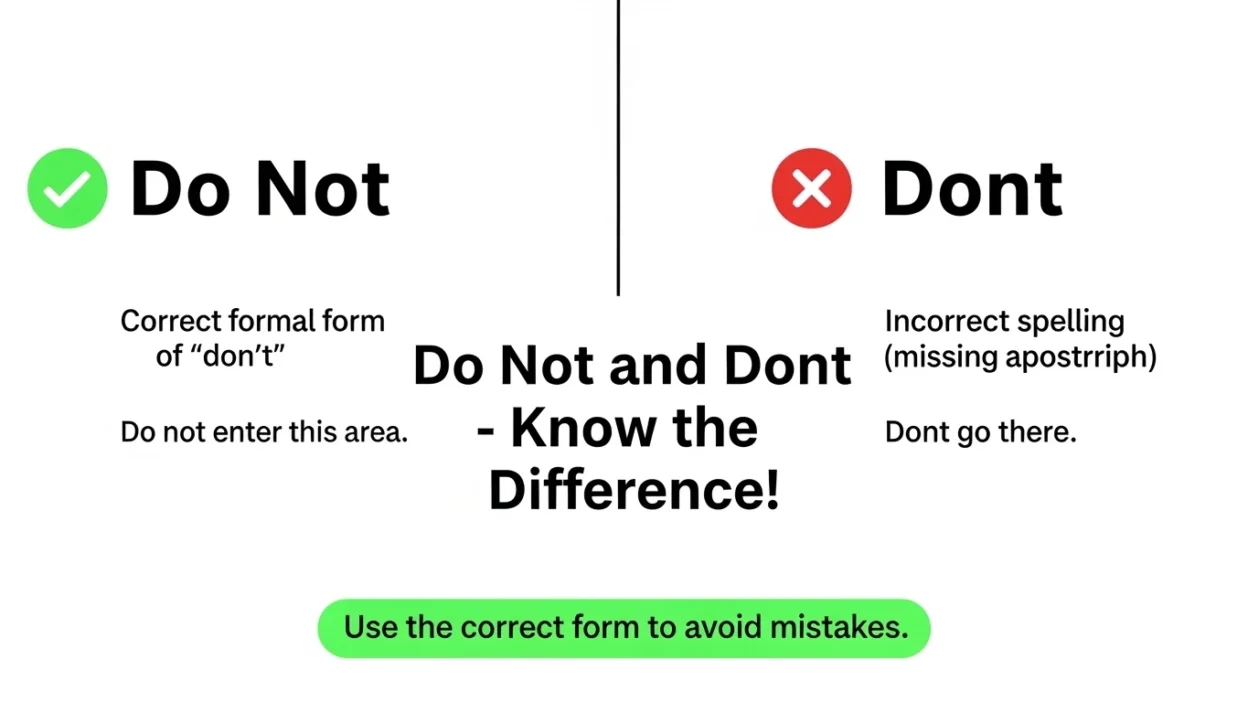
- “Do not” is the correct, formal, and grammatically complete form.
- “Dont” is incorrect it’s a misspelling of “don’t.”
- The correct contraction is “don’t”, which is informal and widely used in everyday writing.
What Does “Do Not” Mean?
“Do not” is the full form of a negative verb phrase used to express prohibition, refusal, or negation.
Examples:
- Do not enter this area.
- Please do not forget your assignment.
- I do not agree with that decision.
Key Features:
- Formal tone
- Used in academic, professional, and official writing
- Clear and unambiguous
What Does “Dont” Mean?
Technically, “dont” has no meaning in standard English. It is simply an incorrect spelling of the contraction “don’t.”
Why It Happens:
- Missing apostrophe (’)
- Typing quickly in informal contexts
- Lack of proofreading
Incorrect Examples:
- Dont worry about it. ❌
- I dont understand. ❌
Corrected Versions:
- Don’t worry about it. ✔
- I don’t understand. ✔
What Is the Correct Contraction?
The correct contraction of “do not” is:
👉 Don’t
The apostrophe replaces the missing letter “o” in “not.”
Examples:
- Don’t touch that!
- I don’t like spicy food.
- Don’t be late.
Do Not vs Dont: Key Differences
| Feature | Do Not | Dont |
| Correct spelling | ✔ Yes | ❌ No |
| Formality | Formal | Not applicable |
| Usage | Professional writing | Incorrect usage |
| Contraction | No | Incorrect form |
| Proper alternative | Don’t |
When to Use “Do Not”
Use “do not” when clarity and professionalism matter most.
Ideal Situations:
- Academic essays
- Business emails
- Legal or official documents
- Instructions and warnings
Example Sentences:
- Do not use your phone during the exam.
- Employees must not (do not) disclose confidential information.
- Do not disturb the patient.
When to Use “Don’t”
“Don’t” is perfect for informal or conversational contexts.
Ideal Situations:
- Text messages
- Social media posts
- Casual emails
- Dialogue writing
Example Sentences:
- Don’t stress too much about it.
- I don’t think that’s a good idea.
- Don’t forget to call me.
Why “Dont” Is a Common Mistake
The confusion around do not vs dont usually comes from missing punctuation.
Common Causes:
- Forgetting the apostrophe
- Autocorrect errors
- Fast typing habits
- Lack of grammar awareness
Tip:
Always double-check contractions and apostrophes matter!
Common Mistakes to Avoid
1. Writing “Dont” Instead of “Don’t”
- ❌ I dont know the answer.
- ✔ I don’t know the answer.
2. Using “Don’t” in Formal Writing
- ❌ Don’t submit late assignments. (in formal notice)
- ✔ Do not submit late assignments.
3. Overusing Contractions
In professional writing, too many contractions can sound overly casual.
4. Ignoring Apostrophes
Missing apostrophes can change meaning or make writing look careless.
American vs British English Usage
Good news there’s no difference between American and British English when it comes to “do not” and “don’t.”
Both Variants:
- Use “do not” in formal contexts
- Use “don’t” in informal communication
- Consider “dont” incorrect in all cases
Related Keywords and Synonyms
To improve your writing and SEO understanding, here are some related terms:
- Do not contraction
- Don’t meaning
- Apostrophe rules
- Formal vs informal English
- Grammar mistakes
- English writing tips
- Correct spelling in English
Practical Tips for Choosing the Right Form
Use “Do Not” When:
- Writing professionally
- Giving instructions
- Wanting emphasis or seriousness
Use “Don’t” When:
- Writing casually
- Speaking or texting
- Creating a conversational tone
Never Use “Dont”:
- Always correct it to “don’t”
FAQs
1. Is “dont” ever correct in English?
No, “dont” is always incorrect. The correct form is “don’t.”
2. What is the difference between “do not” and “don’t”?
“Do not” is formal, while “don’t” is an informal contraction.
3. Can I use “don’t” in professional writing?
It’s best to avoid it. Use “do not” for a more formal tone.
4. Why is the apostrophe important in “don’t”?
The apostrophe replaces the missing “o” in “not,” making it grammatically correct.
5. Is “do not” more polite than “don’t”?
Yes, “do not” often sounds more polite and formal, especially in instructions.
6. Are contractions acceptable in academic writing?
Generally, no. Most academic styles prefer full forms like “do not.”
7. How can I avoid writing “dont” by mistake?
Proofread your work and watch for missing apostrophes, especially in contractions.
Summary
Understanding the difference between do not vs dont is simpler than it seems. “Do not” is the correct and formal version, while “don’t” is its informal contraction used in everyday communication. On the other hand, “dont” is simply a spelling error that should always be avoided.
By choosing the right form based on context, you improve not just your grammar but also your credibility as a writer. Small details like apostrophes can make a big difference in how your message is received.
Actionable Takeaway
- Use “do not” in formal, academic, or professional writing
- Use “don’t” in casual and conversational contexts
- Never write “dont” always include the apostrophe
Make it a habit to proofread your writing carefully. One small correction can instantly make your writing clearer, more polished, and more professional.

Edward Axel is the administrator of SyntaxlyHub, responsible for overseeing site operations, content management, and technical performance. He ensures accuracy, consistency, and smooth functionality while supporting the team in delivering reliable, high-quality grammar resources and a user-friendly learning experience for readers worldwide.