When people hear the terms cartel and mafia, they often picture organized crime, power, and secrecy but are they actually the same thing? Not quite. Understanding the difference between a cartel and a mafia helps you better interpret news, crime stories, and even historical contexts.
In this guide, we’ll break down the meaning of both terms in a simple, human-friendly way. You’ll learn how they operate, where they overlap, and why confusing them can lead to misunderstandings.
Let’s clear it up once and for all.
Quick Answer
A cartel is usually a group of independent organizations that collaborate to control markets (often drugs), while a mafia is a structured criminal organization with a hierarchy, code of conduct, and long-term control over territories and activities.
What Does “Cartel” Mean?
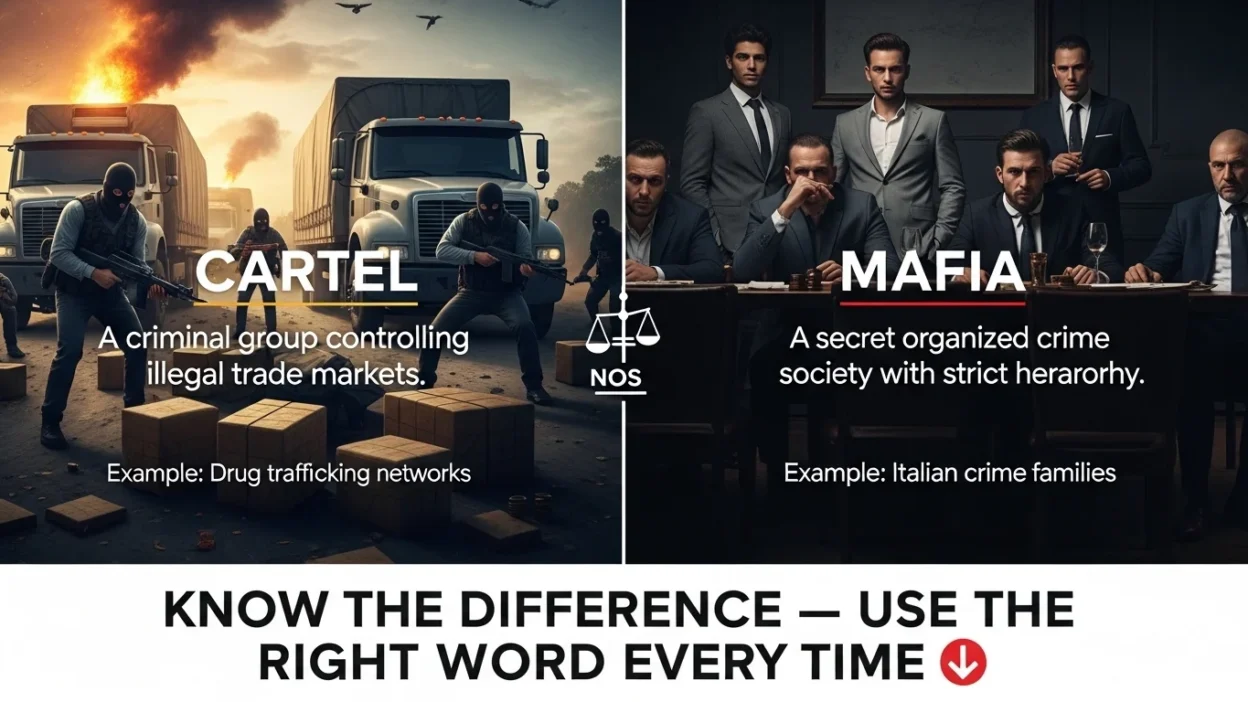
A cartel refers to a group of separate entities that come together to coordinate activities for mutual benefit often to control supply, prices, or territories.
In crime-related contexts, cartels are most commonly associated with drug trafficking networks. These groups are typically:
- Loosely structured compared to mafias
- Focused on economic control (e.g., drug distribution)
- Made up of multiple independent groups working together
Example of Cartel Use
- “The cartel controls drug routes across the border.”
Here, the focus is on collaboration and market control rather than a single unified organization.
What Does “Mafia” Mean?
A mafia is a highly organized and hierarchical criminal group. It operates like a structured institution with rules, ranks, and long-term influence.
Key characteristics of a mafia include:
- Strong leadership and chain of command
- Deep-rooted traditions and codes of silence (like omertà)
- Involvement in various illegal activities (extortion, gambling, etc.)
- Territorial control and long-term influence
Example of Mafia Use
- “The mafia controlled businesses in the city for decades.”
This shows a stable, organized group with long-term authority.
Key Differences Between Cartel and Mafia
Here’s a clear comparison to make things easier:
| Feature | Cartel | Mafia |
| Structure | Loose alliance of groups | Strict hierarchy |
| Main Goal | Market control (often drugs) | Power, control, and profit |
| Organization Type | Collaborative network | Single unified group |
| Activities | Drug trafficking primarily | Diverse crimes (extortion, fraud, etc.) |
| Stability | Can be unstable alliances | Long-term, stable organization |
| Origin | Often modern, especially in Latin America | Historical roots (e.g., Italy) |
Common Mistakes People Make
Even though the terms are related, mixing them up can lead to confusion. Here are some common mistakes:
1. Using Them Interchangeably
Many people think cartel and mafia mean the same thing but they don’t. One is a network; the other is a structured organization.
2. Assuming All Criminal Groups Are Mafias
Not every organized crime group follows a mafia-style hierarchy. Many modern groups operate more like cartels.
3. Ignoring Context
The meaning can shift depending on whether you’re talking about economics or crime. “Cartel” can also refer to legal business cooperation (though often controversial).
Cartel vs Mafia in Everyday Language
In casual conversations, people often blur the line between the two. However:
- Use cartel when referring to drug networks or market control groups
- Use mafia when referring to traditional, structured crime families
Understanding this difference makes your communication clearer and more accurate.
American vs British English Differences
There’s no major spelling difference between American and British English for these terms. Both use:
- Cartel (same spelling and meaning)
- Mafia (same spelling and meaning)
However, usage frequency can differ slightly:
- In American English, “cartel” is more commonly associated with drug-related news
- In British English, “mafia” might be used more broadly to describe organized crime groups
Related Terms and Synonyms
To deepen your understanding, here are some related words:
- Organized crime
- Crime syndicate
- Drug trafficking network
- Criminal organization
- Underworld group
These terms sometimes overlap but don’t always mean the same thing.
FAQs
1. Is a cartel more dangerous than a mafia?
Not necessarily. Both can be extremely dangerous. It depends on the group’s size, influence, and activities.
2. Can a cartel become a mafia?
In some cases, a cartel can evolve into a more structured organization, but they are fundamentally different in design.
3. Are all mafias from Italy?
No. While the term originated in Italy, it’s now used globally to describe similar structured crime groups.
4. Do cartels only deal with drugs?
Mostly, yes in modern usage. However, technically, cartels can exist in legal industries too (like price-fixing groups).
5. Why are cartels often in the news?
Because of their involvement in large-scale drug trafficking and international crime operations.
6. What is the main goal of a mafia?
To gain power, control territories, and generate long-term profit through various illegal activities.
7. Can one country have both cartels and mafias?
Yes, different types of criminal organizations can exist within the same country.
8. Is the word “mafia” always negative?
Yes, it usually carries a negative meaning tied to criminal activity.
Final Thoughts
Understanding the difference between a cartel and a mafia isn’t just about vocabulary it’s about recognizing how different criminal systems operate. A cartel is typically a network focused on market control, while a mafia is a deeply structured organization with long-term influence and authority.
When you use these terms correctly, you communicate more clearly and avoid common misunderstandings. If you’re reading the news or writing content, knowing this distinction adds accuracy and credibility.
Actionable Takeaway
Next time you come across these terms, pause and ask: Is this a network of groups working together, or a single organized hierarchy? That simple question will help you choose the right word every time.
Also, try using both terms in your own sentences to reinforce your understanding it’s one of the fastest ways to learn and remember.

Edward Axel is the administrator of SyntaxlyHub, responsible for overseeing site operations, content management, and technical performance. He ensures accuracy, consistency, and smooth functionality while supporting the team in delivering reliable, high-quality grammar resources and a user-friendly learning experience for readers worldwide.