Words carry emotion, and few pairs feel as close yet subtly different as “beloved” vs “loved.” If you’ve ever paused mid-sentence wondering which one sounds more natural, heartfelt, or appropriate, you’re not alone. These two words overlap in meaning, but they don’t always feel the same in tone, depth, or context.
In this guide, you’ll learn exactly how beloved and loved differ, when to use each, and how to avoid common mistakes. If you’re writing a message, an article, or simply aiming to express yourself more clearly, this breakdown will help you choose the right word with confidence.
Quick Answer:
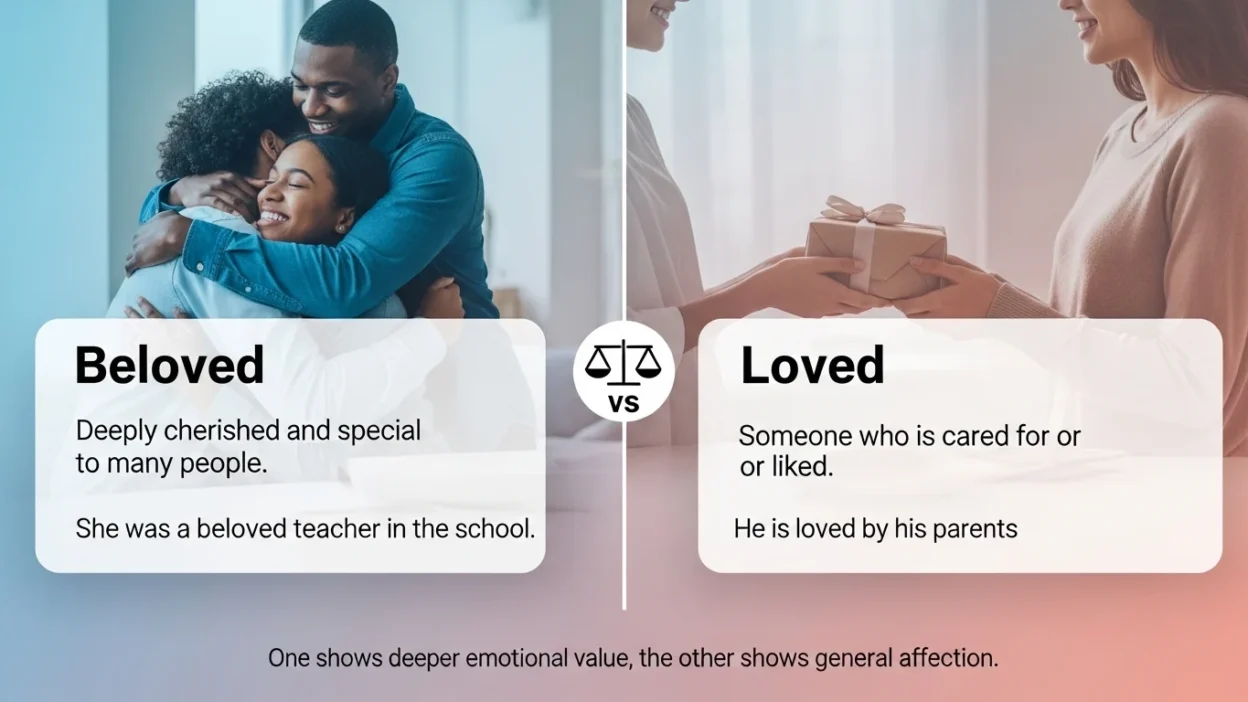
- Loved = A general, widely used term meaning someone or something is cared for or cherished.
- Beloved = A deeper, more formal or emotional term, often used to express profound affection or admiration.
👉 In simple terms: All beloved things are loved, but not everything loved is “beloved.”
What Does “Loved” Mean?
The word “loved” is the past tense or past participle of love. It describes a feeling of affection, care, or attachment toward someone or something.
Key Characteristics of “Loved”
- Common and everyday usage
- Works in casual and formal contexts
- Can describe a wide range of emotions (from mild to deep affection)
Examples of “Loved”
- She loved spending time with her family.
- He was deeply loved by his friends.
- That movie is widely loved by audiences.
Here, “loved” communicates genuine affection but it doesn’t necessarily emphasize intensity or uniqueness.
What Does “Beloved” Mean?
“Beloved” is an adjective (and sometimes a noun) that conveys deep, enduring, and often special affection. It carries a sense of emotional weight, respect, or even reverence.
Key Characteristics of “Beloved”
- More formal and expressive
- Suggests deep emotional attachment
- Often used in meaningful, sentimental, or respectful contexts
Examples of “Beloved”
- She wrote a letter to her beloved husband.
- The author remains a beloved figure in literature.
- Our beloved teacher will be greatly missed.
“Beloved” feels more intimate and elevated, often reserved for situations where emotion runs deeper or is meant to sound more poetic.
Beloved vs Loved: Key Differences
Here’s a side-by-side comparison to make things clearer:
| Feature | Loved | Beloved |
| Meaning | Felt affection for | Deeply cherished or adored |
| Tone | Neutral to warm | Emotional, formal, poetic |
| Usage | Everyday conversations | Special, sentimental contexts |
| Intensity | Moderate to strong | Strong and profound |
| Common contexts | Friends, hobbies, memories | Partners, respected figures, tributes |
When to Use “Loved”
Use “loved” when:
- You’re speaking casually or conversationally
- You want a natural, simple tone
- The emotional intensity doesn’t need emphasis
Practical Use Cases
- Daily conversations: “I loved that meal.”
- General writing: “He was loved by everyone.”
- Reviews or opinions: “The book is loved worldwide.”
When to Use “Beloved”
Use “beloved” when:
- You want to express deep emotional significance
- The context is formal, poetic, or sentimental
- You’re referring to someone highly cherished or respected
Practical Use Cases
- Romantic writing: “My beloved partner”
- Memorials: “Our beloved friend”
- Tributes: “A beloved leader”
Common Mistakes to Avoid
Even though the words are similar, using them incorrectly can affect tone and clarity.
1. Using “Beloved” in Casual Contexts
❌ “This is my beloved pizza place.”
✔ Better: “This is my favorite pizza place” or “I love this pizza place.”
👉 “Beloved” can sound overly dramatic in casual situations.
2. Underusing “Beloved” in Emotional Writing
❌ “She was a loved grandmother.”
✔ Better: “She was a beloved grandmother.”
👉 In emotional or tribute contexts, “beloved” feels more fitting and respectful.
3. Assuming They Are Fully Interchangeable
While similar, swapping them without thinking can change the tone significantly.
- “Loved teacher” = well-liked
- “Beloved teacher” = deeply admired and cherished
Tone and Emotional Impact
The biggest difference between beloved vs loved lies in emotional depth.
- Loved = Warm, genuine, but neutral
- Beloved = Deep, meaningful, and often heartfelt
Think of it this way:
- “Loved” speaks from the heart
- “Beloved” speaks from the soul
American vs British English Usage
Good news there’s no major difference between American and British English when it comes to beloved vs loved.
However, slight tendencies exist:
- American English: Uses “loved” more frequently in everyday speech
- British English: Slightly more comfortable using “beloved” in formal or literary contexts
Still, both words are widely understood and used the same way in both varieties.
Synonyms and Related Words (LSI Keywords)
To enrich your vocabulary, here are some alternatives:
Synonyms for “Loved”
- Adored
- Cherished
- Cared for
- Appreciated
- Valued
Synonyms for “Beloved”
- Dear
- Treasured
- Precious
- Esteemed
- Revered
These related words can help vary your writing while maintaining emotional clarity.
Real-Life Usage Examples
Everyday Context
- I loved the way the story ended.
- That park is loved by locals.
Emotional or Formal Context
- He said goodbye to his beloved family.
- The community honored their beloved leader.
Writing Tip
If your sentence feels too plain, try “beloved.”
If it feels too dramatic, switch to “loved.”
FAQs
1. Is “beloved” stronger than “loved”?
Yes, “beloved” expresses deeper emotional attachment and carries more intensity than “loved.”
2. Can I use “beloved” in everyday conversation?
You can, but it may sound overly formal or poetic in casual situations.
3. Is “loved” less meaningful than “beloved”?
Not necessarily it’s just more general. The meaning depends on context and tone.
4. Can “beloved” be used as a noun?
Yes. For example: “He mourned his beloved.”
5. Which word is better for writing?
It depends on tone. Use “loved” for simplicity and “beloved” for emotional depth.
6. Is “beloved” outdated?
No, but it’s more formal and less common in everyday speech.
7. Can I say “very beloved”?
It’s grammatically correct, but often unnecessary “beloved” already implies strong emotion.
8. Which is better in a tribute?
“Beloved” is usually more appropriate for memorials and heartfelt messages.
Summary
Understanding beloved vs loved comes down to recognizing subtle differences in tone and emotional weight. “Loved” is versatile, natural, and widely used in everyday language.
It expresses genuine affection without sounding overly intense. On the other hand, “beloved” carries deeper emotional resonance and is often reserved for meaningful, formal, or sentimental contexts.
Choosing the right word depends on what you want your audience to feel. If your goal is clarity and simplicity, “loved” works perfectly.
If you want to evoke warmth, depth, and lasting affection, “beloved” is the better choice. Being intentional with your wording can make your message more powerful and authentic.
Actionable Takeaway
- Use “loved” for everyday communication and natural tone
- Use “beloved” when expressing deep emotion, respect, or tribute
- Always consider context, audience, and emotional impact before choosing
Mastering small word differences like this can instantly elevate your writing and help you connect more deeply with your readers.