Language can be tricky, especially when two phrases look almost identical but only one is truly correct. Many writers pause when deciding between “as evidenced by” and “as evident by.” At first glance, both seem logical, but only one fits proper grammar rules in standard English.
If you’ve ever wondered which phrase is correct, when to use it, and why the other version sounds awkward, this guide will help. By the end of this article, you’ll clearly understand the meaning, usage, examples, and common mistakes surrounding “as evidenced by or as evident by.”
Quick Answer
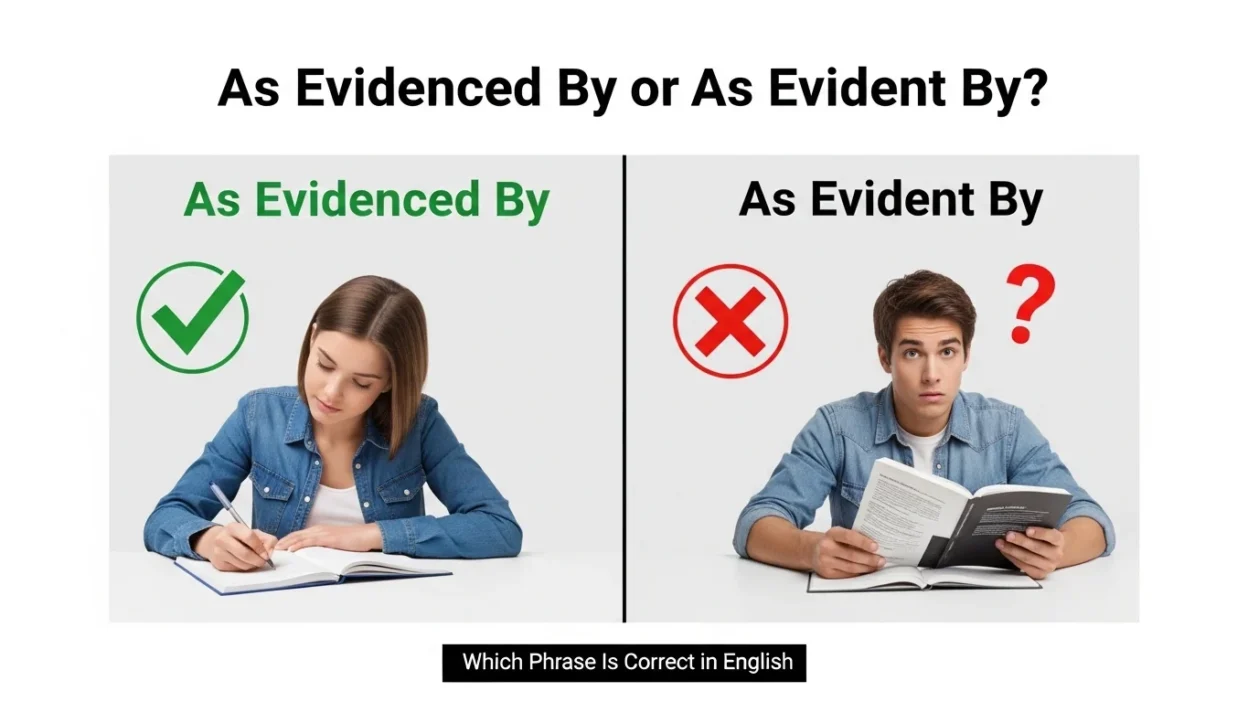
The correct phrase is “as evidenced by.”
- Correct: Her dedication was clear, as evidenced by her long hours of practice.
- Incorrect: Her dedication was clear, as evident by her long hours of practice.
Why?
The phrase “as evidenced by” uses the past participle “evidenced,” which properly introduces proof or supporting information.
The phrase “as evident by” is generally considered grammatically incorrect because “evident” is an adjective and doesn’t fit naturally in this structure.
Meaning of “As Evidenced By”
The phrase “as evidenced by” means:
- as shown by
- as demonstrated by
- as proven by
- as indicated by
It introduces evidence, proof, or an example that supports a statement. Writers often use it in academic writing, professional communication, journalism, and everyday language.
Simple Definition
“As evidenced by” means that something proves or clearly shows another statement is true.
Example
- The company is growing quickly, as evidenced by its rising sales numbers.
- She is a talented musician, as evidenced by her award-winning performances.
- Climate change is accelerating, as evidenced by the increasing number of extreme weather events.
In each sentence, the phrase introduces supporting evidence.
Why “As Evident By” Is Usually Incorrect
The phrase “as evident by” appears logical but does not follow standard grammar patterns.
The word “evident” is an adjective, meaning clear or obvious. Adjectives typically describe nouns rather than introduce evidence.
Correct grammar requires a verb or participle form, which is why “evidenced” works better.
Compare the Structures
Incorrect structure:
- The improvement is clear, as evident by the results.
Correct structure:
- The improvement is clear, as evidenced by the results.
The second version works because “evidenced” functions like a verb phrase meaning “shown by.”
Examples of “As Evidenced By” in Sentences
Here are more natural examples showing how the phrase works in everyday writing.
In Academic Writing
- The theory gained acceptance, as evidenced by numerous peer-reviewed studies.
In Business Communication
- Customer satisfaction improved significantly, as evidenced by positive survey feedback.
In Everyday Conversation
- He loves cooking, as evidenced by the variety of dishes he prepares every weekend.
In Journalism
- The city’s population is increasing rapidly, as evidenced by new housing developments.
In Personal Writing
- Her kindness is obvious, as evidenced by the way she helps others.
Synonyms and Similar Phrases
Sometimes you may want variety instead of repeating the same phrase. Here are useful alternatives.
Common Alternatives
- as shown by
- as demonstrated by
- as proven by
- as indicated by
- as revealed by
- as illustrated by
Example Comparison
- The policy was successful, as evidenced by lower unemployment.
- The policy was successful, as demonstrated by lower unemployment.
Both sentences communicate the same idea but with slightly different tone.
Comparison Table: “As Evidenced By” vs “As Evident By”
| Phrase | Correct? | Reason | Example |
| As evidenced by | ✅ Correct | Uses participle form that introduces proof | Her skill is clear, as evidenced by her achievements. |
| As evident by | ❌ Incorrect | “Evident” is an adjective and doesn’t fit grammatically | Her skill is clear, as evident by her achievements. |
Key Tip
Whenever you want to introduce supporting proof, use “as evidenced by.”
Common Mistakes Writers Make
Even experienced writers occasionally misuse these phrases. Here are some common errors to avoid.
1. Using “As Evident By”
Incorrect:
- The problem is serious, as evident by the declining numbers.
Correct:
- The problem is serious, as evidenced by the declining numbers.
2. Overusing the Phrase
While useful, repeating “as evidenced by” too often can make writing feel repetitive.
Instead, mix in synonyms like “as shown by” or “as demonstrated by.”
3. Using It Without Clear Evidence
Incorrect:
- She is hardworking, as evidenced by.
Always include specific proof after the phrase.
Correct:
- She is hardworking, as evidenced by her consistent performance.
4. Misplacing the Phrase
Ensure the phrase clearly connects to the evidence.
Confusing:
- He improved, as evidenced by quickly finishing the project yesterday.
Clear:
- His efficiency improved, as evidenced by how quickly he finished the project.
American vs British English Usage
Good news: there is no difference between American and British English for this phrase.
Both varieties of English prefer:
- as evidenced by
You will find it widely used in:
- academic papers
- news articles
- business writing
- professional reports
The incorrect phrase “as evident by” is generally avoided in both dialects.
When Should You Use “As Evidenced By”?
This phrase works best when you want to support a claim with proof or an example.
Ideal Situations
Use it when:
- presenting data or statistics
- showing real-world proof
- citing research or evidence
- explaining results or outcomes
Example
Claim:
- The product is popular.
Supported statement:
- The product is popular, as evidenced by its record-breaking sales.
Writing Tips for Using the Phrase Naturally
To make your writing smoother and more engaging, follow these simple tips.
Keep Sentences Clear
Avoid overly long sentences when using the phrase.
Provide Specific Evidence
General statements are weaker than concrete examples.
Weak:
- The system works well, as evidenced by results.
Strong:
- The system works well, as evidenced by a 40% increase in efficiency.
Use It Sparingly
Too many instances in one paragraph may feel repetitive.
FAQs
1. Is “as evident by” ever correct?
Generally no. Standard grammar prefers “as evidenced by.” The adjective “evident” doesn’t fit well in that structure.
2. What does “as evidenced by” mean?
It means “as shown by,” “as demonstrated by,” or “as proven by.” It introduces supporting proof or examples.
3. Can I replace “as evidenced by” with “because of”?
Not exactly. “Because of” shows cause, while “as evidenced by” shows proof or supporting information.
4. Is “as evidenced by” formal?
Yes. It is common in academic writing, professional communication, and journalism, though it also works in everyday language.
5. What part of speech is “evidenced”?
In this phrase, “evidenced” acts as a past participle meaning “shown” or “demonstrated.”
6. Are there shorter alternatives?
Yes. You can use:
- shown by
- demonstrated by
- proven by
- illustrated by
7. Can I start a sentence with “as evidenced by”?
Yes, but it must clearly connect to the statement.
Example:
- As evidenced by recent studies, the treatment is highly effective.
8. Is the phrase common in academic writing?
Yes. Researchers frequently use “as evidenced by” when presenting data, findings, or supporting studies.
Summary
The confusion between “as evidenced by or as evident by” comes from their similar appearance. However, only “as evidenced by” follows correct grammar rules. It uses the participle “evidenced” to introduce proof, examples, or supporting information that strengthens a statement.
Writers across academic, professional, and everyday contexts rely on this phrase to present evidence clearly and persuasively.
Avoid using “as evident by,” and instead choose “as evidenced by” or a suitable alternative like “as demonstrated by” or “as shown by.”
Actionable takeaway:
Whenever you want to support a statement with proof, remember this simple rule:
👉 Use “as evidenced by” to introduce the evidence that backs up your claim.

Edward Axel is the administrator of SyntaxlyHub, responsible for overseeing site operations, content management, and technical performance. He ensures accuracy, consistency, and smooth functionality while supporting the team in delivering reliable, high-quality grammar resources and a user-friendly learning experience for readers worldwide.