Choosing between “an hilarious” and “a hilarious” can feel surprisingly tricky, even for fluent English speakers. You might have seen both versions used in books, movies, or online and wondered which one is actually correct.
Don’t worry, you’re not alone. This small grammar detail comes down to pronunciation, not just spelling. Once you understand the simple rule behind it, you’ll never second-guess yourself again.
Quick Answer
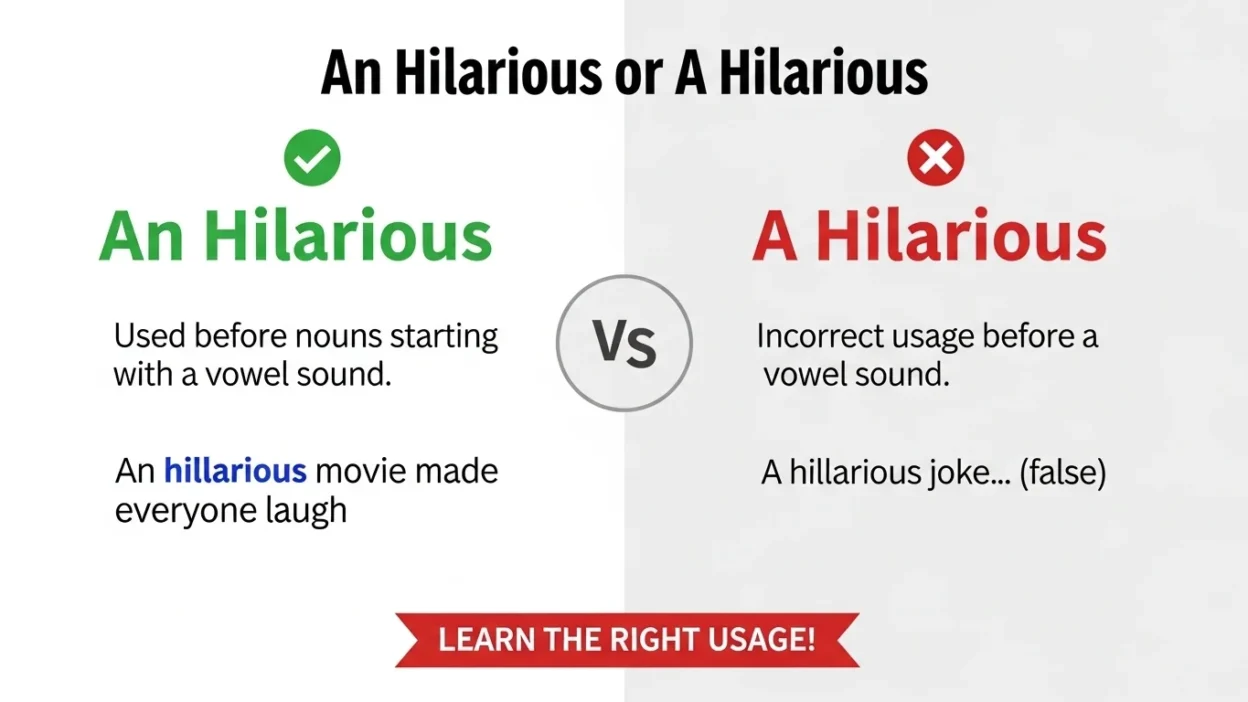
- ✅ “A hilarious” is correct in modern English.
- ❌ “An hilarious” is considered outdated or formal.
- ✔ Use “a” because hilarious begins with a pronounced “h” sound.
Example:
- ✔ She told a hilarious joke.
- ❌ She told an hilarious joke.
Understanding the Rule Behind “A” vs “An”
The choice between “a” and “an” depends on sound, not just the first letter.
- Use “a” before words that begin with a consonant sound
- Use “an” before words that begin with a vowel sound
Why “A Hilarious” Is Correct
The word hilarious is pronounced:
👉 /hɪˈleə.ri.əs/ (starts with a clear “h” sound)
Because the “h” is pronounced, it behaves like a consonant sound. That’s why we say:
- ✔ a hilarious moment
- ✔ a hilarious story
Why Do Some People Say “An Hilarious”?
You might still come across “an hilarious” in older texts or formal writing. This happens because:
- In older British English, the “h” in some words was silent or weakly pronounced
- Writers followed a rhythmic or stylistic preference
- It sounded smoother in certain accents
Today, however, this usage is:
- ❌ Considered old-fashioned
- ❌ Rare in modern spoken English
- ❌ Not recommended for SEO or everyday writing
Examples of Correct Usage
Here are some natural, real-life examples using “a hilarious”:
- That was a hilarious movie I couldn’t stop laughing!
- He shared a hilarious meme in the group chat.
- We had a hilarious conversation last night.
- She wrote a hilarious caption on her photo.
More Contextual Examples
- The comedian delivered a hilarious performance.
- It turned into a hilarious misunderstanding.
Common Mistakes to Avoid
Let’s clear up some frequent errors learners make:
❌ Using “An” Just Because the Word Starts with “H”
- ❌ an hilarious joke
✔ Correct: a hilarious joke
❌ Ignoring Pronunciation
Always ask yourself:
👉 Does it sound like it starts with a vowel?
If not, use “a.”
❌ Overgeneralizing the Rule
Some words with “h” actually do take “an” because the “h” is silent:
- ✔ an honest person (silent “h”)
- ✔ an hour (silent “h”)
But:
- ✔ a hilarious story (pronounced “h”)
Comparison Table: A vs An with “H” Words
| Word | Pronunciation | Correct Article | Example |
| hilarious | h sound | a | a hilarious joke |
| happy | h sound | a | a happy child |
| honest | silent h | an | an honest man |
| hour | silent h | an | an hour later |
| historic | mixed usage | a/an (rare) | a historic day (modern) |
American vs British English Usage
There’s a slight variation between American and British English, but it’s becoming less noticeable today.
American English
- Strongly prefers “a hilarious”
- Rarely uses “an hilarious”
- Focuses strictly on pronunciation
British English
- Traditionally allowed “an hilarious”
- Sometimes used for stylistic flow
- Modern usage now aligns with American English
👉 Bottom line:
Both dialects now mostly agree on “a hilarious”.
Related Grammar Tips (LSI Keywords)
Understanding this rule helps with many similar words:
- a historical event (modern usage)
- an honorable gesture
- a huge success
- an heir to the throne
These examples show how article usage depends on sound, not spelling.
FAQs
1. Is “an hilarious” ever correct?
It’s not grammatically wrong historically, but it’s outdated and rarely used today. Stick with “a hilarious.”
2. Why do we say “an hour” but “a hilarious”?
Because “hour” has a silent “h”, while “hilarious” has a pronounced “h.”
3. Can I use “an hilarious” in formal writing?
It’s better not to. Modern grammar standards recommend “a hilarious.”
4. What is the easiest way to choose between “a” and “an”?
Focus on how the word sounds, not how it’s spelled.
5. Is this rule important for SEO writing?
Yes. Using correct grammar like “a hilarious” improves:
- Readability
- Trust (E-E-A-T)
- Search engine ranking
6. Do native speakers ever make this mistake?
Yes, especially in writing. But in speech, most people naturally say “a hilarious.”
7. What about “historic” a or an?
- Modern: a historic moment
- Older style: an historic moment
Both exist, but “a historic” is now preferred.
8. Does accent affect this rule?
Yes, slightly. Some accents soften the “h,” but standard English still uses “a hilarious.”
Summary
Choosing between “an hilarious” and “a hilarious” comes down to one simple principle: sound matters more than spelling. Since hilarious begins with a clearly pronounced “h,” the correct and modern form is “a hilarious.” While you may occasionally see “an hilarious” in older texts, it’s no longer standard in everyday English.
Understanding this rule helps you avoid common grammar mistakes and write with more confidence. It also improves clarity, professionalism, and SEO performance especially if you’re creating content for a wider audience.
Actionable Takeaway
Next time you’re unsure, say the word out loud.
👉 If it starts with a consonant sound, use “a”
👉 If it starts with a vowel sound, use “an”
Stick with “a hilarious” in all modern writing it’s clear, correct, and widely accepted.