Confused about affirm vs confirm? You’re not alone. These two words often appear in professional emails, legal documents, and everyday conversations and while they seem similar, they aren’t interchangeable.
If you’ve ever paused before writing “Please affirm” instead of “Please confirm,” this guide will clear things up in minutes.
We’ll break down meanings, examples, common mistakes, and even subtle usage differences so you can use both words confidently and correctly.
Quick Answer:
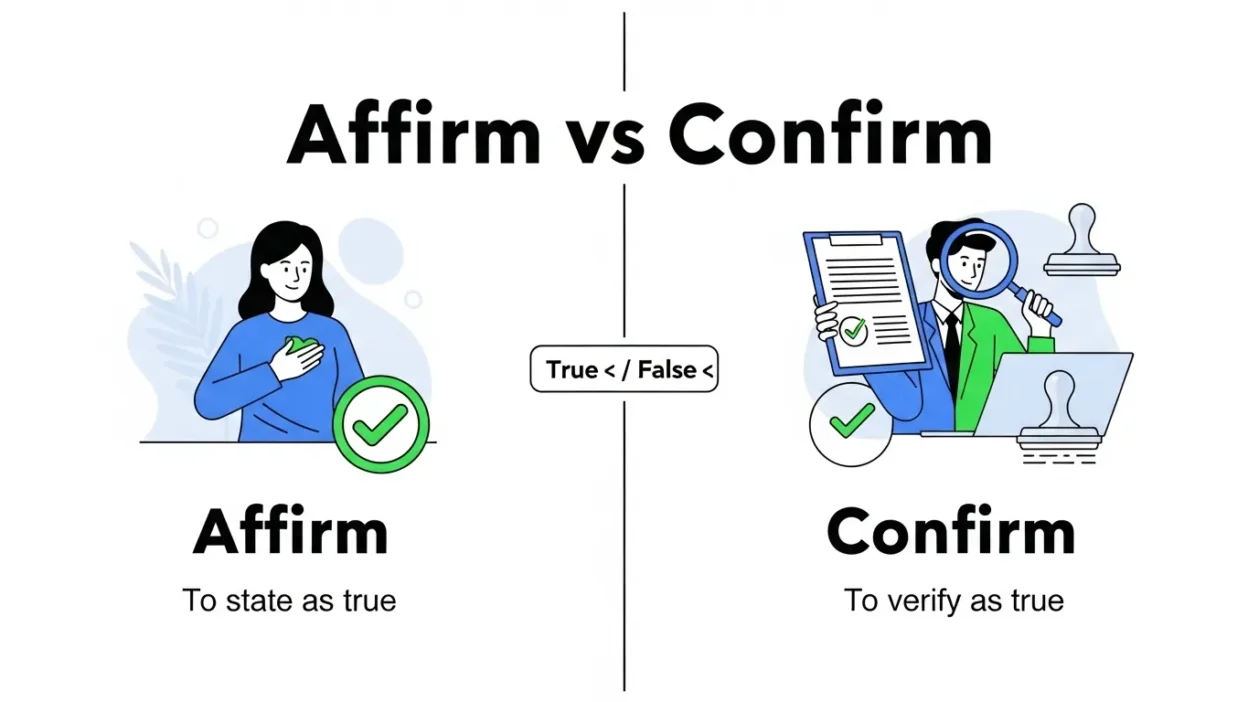
- Affirm means to state something strongly, formally, or publicly as true.
- Confirm means to verify, validate, or make sure something is true or correct.
In short:
- Use affirm when declaring belief or commitment.
- Use confirm when verifying information or checking details.
What Does “Affirm” Mean?
Affirm is a formal verb that means to declare something positively or assert it as true. It often implies confidence, conviction, or public support.
Common Uses of Affirm
- To express strong agreement
- To declare something officially
- To reinforce a belief or decision
- In legal or formal contexts
Examples of Affirm
- She affirmed her commitment to the project.
- The court affirmed the lower court’s decision.
- He affirmed that he would attend the ceremony.
- I affirm that the information provided is accurate.
Notice how affirm feels strong, intentional, and sometimes formal.
Synonyms for Affirm
- Assert
- Declare
- State firmly
- Uphold
- Ratify
- Support
These synonyms show that affirm often carries emotional or official weight.
What Does “Confirm” Mean?
Confirm means to verify, validate, or ensure something is true. It’s commonly used in daily communication and business settings.
Common Uses of Confirm
- To verify details
- To validate information
- To approve arrangements
- To double-check accuracy
Examples of Confirm
- Please confirm your attendance.
- The doctor confirmed the diagnosis.
- I can confirm that the payment was received.
- Can you confirm the meeting time?
Unlike affirm, confirm is practical and factual.
Synonyms for Confirm
- Verify
- Validate
- Check
- Approve
- Authenticate
- Corroborate
These words focus on evidence and accuracy rather than belief.
Affirm vs Confirm: Side-by-Side Comparison
| Feature | Affirm | Confirm |
| Core Meaning | Declare strongly | Verify or validate |
| Tone | Formal, confident | Practical, factual |
| Common Context | Legal, personal beliefs, commitments | Business, scheduling, checking details |
| Emotional Weight | Often emotional or official | Usually neutral |
| Example | She affirmed her loyalty. | She confirmed her booking. |
This table makes it clear: affirm expresses belief, while confirm checks facts.
Key Differences Between Affirm and Confirm
Let’s look deeper at what separates these two words.
1. Declaration vs Verification
- Affirm = stating something is true.
- Confirm = proving something is true.
Example:
- He affirmed his innocence. (He declared it.)
- Evidence confirmed his innocence. (Proof verified it.)
2. Emotional vs Practical Tone
Affirm often carries conviction.
Confirm is more procedural and factual.
3. Legal Usage
In legal language:
- A higher court may affirm a ruling (meaning it agrees and upholds it).
- Authorities confirm evidence or statements after investigation.
Common Mistakes with Affirm vs Confirm
Even experienced writers mix these up. Here are common errors:
Mistake 1: Using Affirm in Business Emails
❌ Please affirm your appointment.
✔ Please confirm your appointment.
In everyday scheduling, confirm is correct.
Mistake 2: Using Confirm for Strong Personal Belief
❌ She confirmed her dedication to the cause.
✔ She affirmed her dedication to the cause.
When expressing conviction or loyalty, affirm works better.
Mistake 3: Assuming They’re Interchangeable
While sometimes they may seem similar, context matters. Swapping them blindly can sound unnatural.
Affirm vs Confirm in American and British English
Good news: There is no major difference between American and British English when it comes to affirm vs confirm. Both are used in the same way in:
- 🇺🇸 American English
- 🇬🇧 British English
However, in legal contexts, British courts more frequently use “affirm” when upholding a decision, while “confirm” may appear more in administrative language.
But overall, the meaning remains consistent across regions.
When Should You Use Affirm?
Use affirm when:
- You are expressing belief or conviction.
- You’re making a formal declaration.
- You’re speaking in legal or official contexts.
- You want to emphasize commitment or support.
Example Sentences
- The CEO affirmed the company’s long-term vision.
- She affirmed her support for the proposal.
- The witness affirmed that his testimony was truthful.
When Should You Use Confirm?
Use confirm when:
- You are verifying facts.
- You’re double-checking arrangements.
- You need written validation.
- You are responding to a request for clarification.
Example Sentences
- Can you confirm your email address?
- The hotel confirmed our reservation.
- Scientists confirmed the discovery through testing.
Real-Life Scenario Comparison
Imagine this situation:
You book a flight and receive an email.
- The airline asks you to confirm your booking.
- Later, the airline may affirm its commitment to passenger safety.
See the difference?
Confirm handles logistics.
Affirm handles values or declarations.
Affirm vs Confirm in Professional Writing
In business communication, confirm is far more common.
Common phrases:
- Confirm receipt
- Confirm attendance
- Confirm details
- Confirm appointment
Affirm appears more in:
- Legal statements
- Corporate values
- Public speeches
- Policy declarations
If you’re unsure in professional emails, confirm is usually the safer choice.
FAQs
1. Can affirm and confirm mean the same thing?
Not exactly. Both relate to truth, but affirm means to declare something true, while confirm means to verify it with evidence.
2. Is affirm stronger than confirm?
Yes. Affirm often carries emotional or formal strength. Confirm is more neutral and factual.
3. Can I say “Please affirm your attendance”?
Grammatically yes, but it sounds unnatural. “Please confirm your attendance” is correct in everyday usage.
4. What is the noun form of affirm and confirm?
- Affirm → Affirmation
- Confirm → Confirmation
5. Which word is more formal?
Affirm is generally more formal and often used in legal or official settings.
6. Is affirm used in court?
Yes. Courts may affirm a decision, meaning they uphold it.
7. Does confirm always require proof?
Usually yes. Confirm implies that evidence or verification exists.
8. Is there a difference in pronunciation?
Yes:
- Affirm: uh-FIRM
- Confirm: kuhn-FIRM
The stress pattern differs slightly.
Pro Writing Tips for Using Affirm vs Confirm
Here’s a simple memory trick:
- Affirm = Assertion
- Confirm = Check
If you’re asserting a belief → affirm.
If you’re checking information → confirm.
Another tip:
If you can replace the word with “verify,” use confirm.
If you can replace it with “declare,” use affirm.
Summary:
Understanding affirm vs confirm comes down to recognizing the difference between declaring something and verifying it.
Affirm is about expressing belief, commitment, or official support. Confirm is about checking facts and validating information.
Both words deal with truth but from different angles. One is about conviction.
The other is about confirmation through evidence. Knowing when to use each helps you sound clear, confident, and professional.
Actionable Takeaway
Before choosing between affirm and confirm, ask yourself:
Am I declaring something strongly? → Use affirm.
Am I verifying or checking details? → Use confirm.
Making this small distinction can instantly improve your writing clarity and credibility.