Confused about acception vs exception? You’re not alone. These two words look similar, sound slightly related, and often trip up writers especially in formal writing, emails, and exams.
But here’s the truth: one of them is commonly used, and the other is rarely appropriate in everyday English.
If you’ve ever paused mid-sentence wondering which one is correct, this guide will clear it up fast.
We’ll break down the meanings, examples, common mistakes, and even look at usage differences. By the end, you’ll never mix them up again.
Quick Answer:
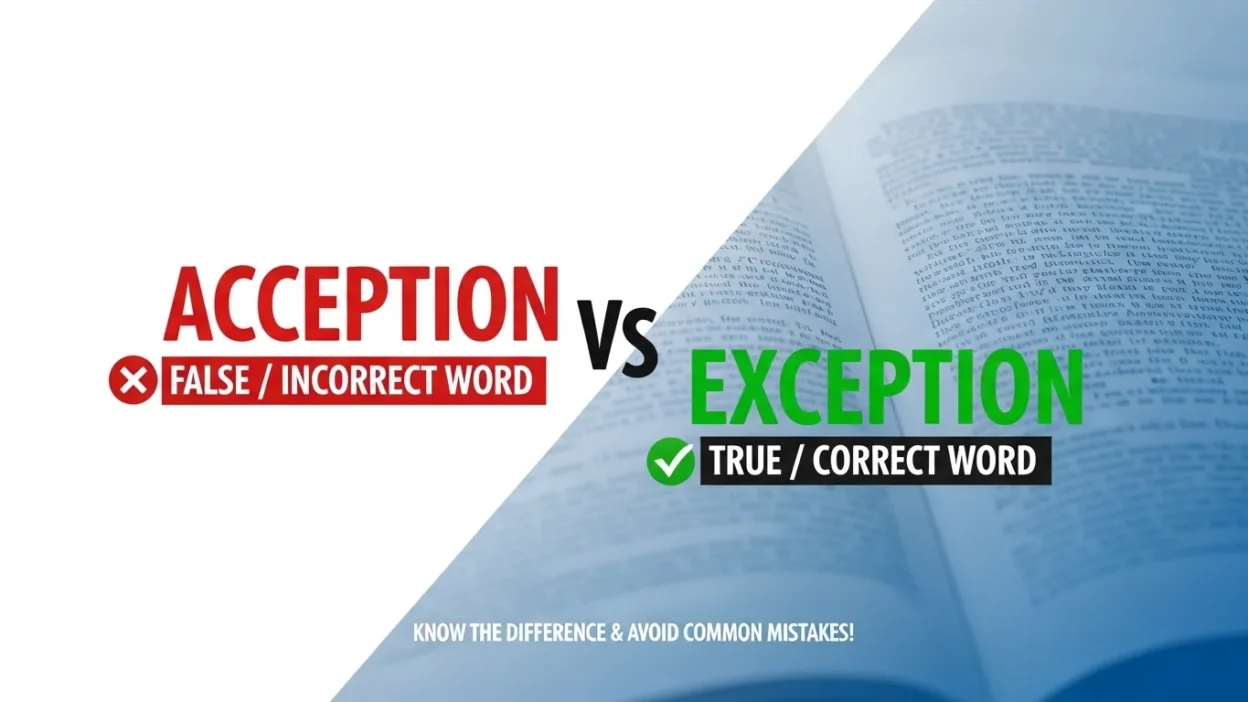
- Exception is a common English noun meaning something that does not follow a rule.
- Acception is a rare and formal word meaning the act of accepting or a specific meaning of a word.
In modern everyday English, “exception” is almost always the word you need.
What Does “Exception” Mean?
Exception refers to something or someone that is excluded from a general rule or statement.
Simple Definition:
An exception is something that does not follow the usual pattern.
Examples of “Exception”
- Everyone passed the test with one exception.
- I don’t eat sweets, except on holidays.
- The rule applies to all students, no exceptions.
In each case, the word shows something that is left out or different from the rule.
Common Phrases With “Exception”
- Make an exception
- With the exception of
- No exceptions
- An exception to the rule
These phrases are very common in both American and British English.
What Does “Acception” Mean?
Here’s where things get interesting.
Acception is a real English word but it’s extremely rare and mostly used in academic, philosophical, or linguistic contexts.
Definition of “Acception”
- The act of accepting something (archaic usage)
- A specific meaning of a word in a particular context
Example of “Acception” (Linguistic Use)
- In one acception of the word “light,” it means illumination.
This usage appears mainly in dictionaries, theology, or linguistic discussions.
In everyday English? You probably never need it.
Important Note
Many people think “acception” is just another spelling of “acceptance.” It’s not.
- Acceptance = the act of agreeing or receiving something
- Acception = a rare word about meaning or old-style acceptance
If you mean “acceptance,” always use acceptance, not acception.
Acception vs Exception: Side-by-Side Comparison
Here’s a clear comparison table to remove all confusion:
| Feature | Acception | Exception |
| Commonly Used? | Very rare | Very common |
| Meaning | Specific meaning of a word or act of accepting (archaic) | Something excluded from a rule |
| Everyday Writing | Almost never used | Frequently used |
| Formal Context | Academic/linguistic | Legal, academic, casual |
| Example | A rare acception of the term | An exception to the rule |
Bottom line: If you’re unsure, you almost certainly need an exception.
Why People Confuse Acception and Exception
There are a few reasons this word confusion happens:
1. Similar Spelling
Both words end in -ception, which makes them look related.
2. Sound Similarity
When spoken quickly, they can sound close.
3. Confusion With “Acceptance”
Many people actually mean:
- acceptance
- exception
But accidentally write:
- acception
This is a classic spelling mistake in English writing.
Common Mistakes (And How to Fix Them)
Let’s look at real-life errors people make.
❌ Incorrect:
Everyone was invited with no acception.
✅ Correct:
Everyone was invited with no exception.
❌ Incorrect:
There was one acception to the policy.
✅ Correct:
There was one exception to the policy.
❌ Incorrect:
She showed acceptance of the offer.
✅ Correct:
She showed acceptance of the offer.
The key lesson:
If you’re talking about rules, exclusions, or something different from the norm, use exceptions.
If you’re talking about agreeing to something, use acceptance.
American vs British English Differences
Good news: There is no spelling difference between American and British English for these words.
- Exception (US & UK)
- Acceptance (US & UK)
- Acception (rare in both)
Both American and British English treat “acception” as outdated or highly specialized.
So no regional confusion here just a vocabulary clarity issue.
When Should You Actually Use “Acception”?
Honestly? Almost never.
But here are rare cases where it may appear:
- Academic linguistics papers
- Theological discussions
- Historical English texts
- Dictionary definitions
If you’re writing blog posts, business emails, student essays, or website content, avoid it.
Clarity beats complexity every time.
Real-World Usage Scenarios
Let’s apply this to real-life situations.
In Business Writing
Correct:
- This discount applies to all items without exception.
- We do not make exceptions to this policy.
Wrong:
- We do not make acception.
Using the wrong word here makes your writing look unprofessional.
In Academic Writing
Correct:
- There are few exceptions to this theory.
- In one acception of the term, it implies authority.
Notice how “acception” only works in a very specific context about word meaning.
Synonyms and Related Words
To strengthen your vocabulary, here are related terms:
Synonyms for Exception
- Exclusion
- Anomaly
- Irregularity
- Special case
- Deviation
Related Words
- Except
- Exceptional
- Exceptionally
- Acceptance
- Accept
Using these correctly improves clarity and SEO strength in writing.
Quick Memory Trick
Here’s an easy way to remember:
- Exception = Exit from the rule
(Both start with EX)
If something “exits” the rule, it’s an exception.
Simple and powerful.
FAQs
1. Is “acception” a real word?
Yes, but it’s extremely rare and mostly used in academic or linguistic contexts.
2. What is the difference between acception and acceptance?
Acceptance means agreeing or receiving something.
Acception refers to a specific meaning of a word and is rarely used.
3. Can I use acception instead of exception?
No. They do not mean the same thing. In almost all everyday cases, you need “exception.”
4. Why does my spell checker flag “acception”?
Because it’s rarely used and often mistaken for “acceptance” or “exception.”
5. Is exception used the same in American and British English?
Yes. The spelling and meaning are the same in both varieties.
6. What does “exception to the rule” mean?
It means something that does not follow a general pattern.
7. Is acception outdated?
In most modern contexts, yes. It’s considered archaic or highly specialized.
8. Which word should I use in SEO writing?
Use “exception” unless you’re writing about linguistic definitions.
Final Summary:
Let’s simplify everything.
Exception is the word you need 99% of the time. It means something that doesn’t follow a rule. It’s common, correct, and widely used in both American and British English.
Acception, on the other hand, is rare and mostly limited to academic discussions about word meanings.
If you use it in everyday writing, it will likely confuse readers or appear as a spelling mistake.
Actionable Takeaway
Before you publish or submit your writing:
- If you’re talking about rules or exclusions → use exception
- If you mean agreeing to something → use acceptance
- Avoid “acception” unless you’re writing advanced linguistic content
Clear writing builds authority. Small word choices matter more than you think.