Confused by accent vs ascent vs assent? You’re not alone. These three words sound almost identical, yet they have completely different meanings and using the wrong one can change your sentence entirely. Whether you’re writing an essay, email, or social post, knowing the difference helps you sound clear, confident, and polished.
In this guide, we’ll break down each word in simple terms, show real-life examples, and help you avoid common mistakes. By the end, you’ll never mix them up again.
Quick Answer
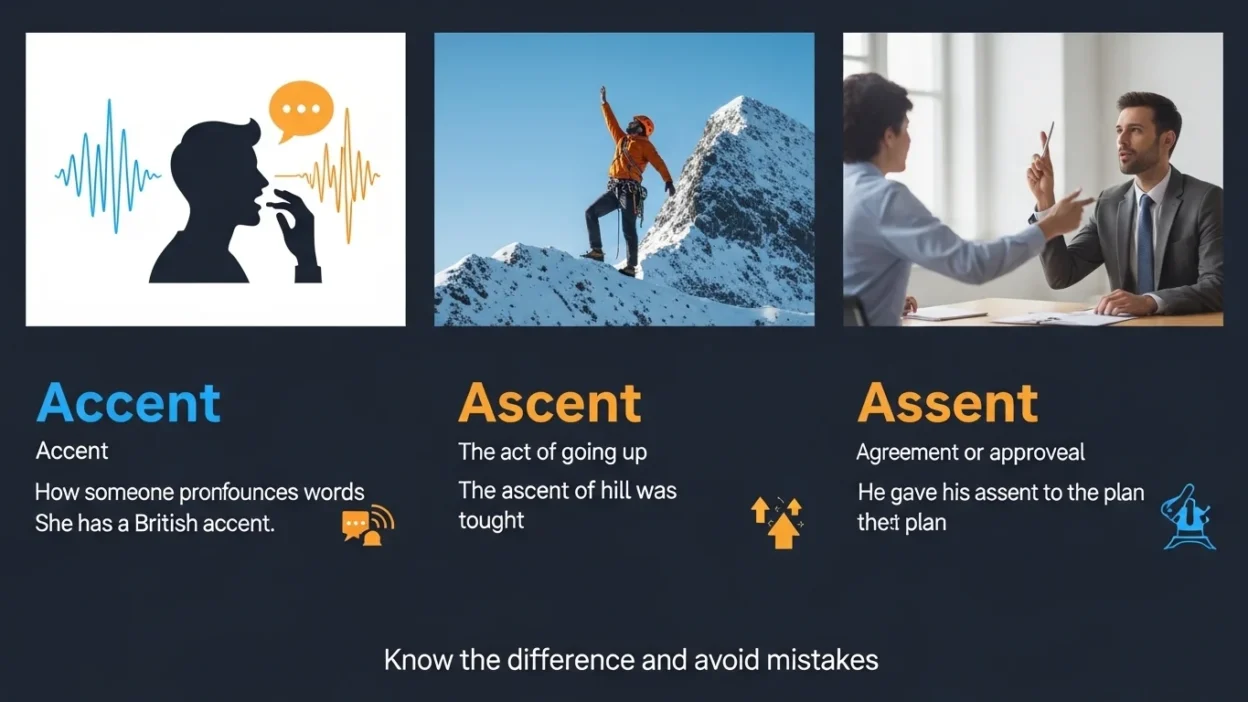
- Accent = the way someone pronounces words or emphasizes speech
- Ascent = the act of going up (climbing or rising)
- Assent = agreement or approval
What Does “Accent” Mean?
Accent refers to how people pronounce words, often influenced by their region, culture, or native language.
Examples:
- She has a strong British accent.
- His French accent makes his English sound charming.
- The teacher asked students to focus on correct accent and pronunciation.
Key idea:
Think of accent as related to speech and sound.
Related terms (LSI keywords):
- pronunciation
- dialect
- speech pattern
- intonation
What Does “Ascent” Mean?
Ascent means the act of going up physically or metaphorically.
Examples:
- The hikers began their ascent up the mountain at dawn.
- His ascent to success was inspiring.
- The airplane started its ascent shortly after takeoff.
Key idea:
Think of ascent as climbing or rising upward.
Related terms:
- climb
- rise
- elevation
- upward movement
What Does “Assent” Mean?
Assent means agreement, approval, or giving permission.
Examples:
- She nodded in assent.
- The manager gave his assent to the proposal.
- They waited for official assent before proceeding.
Key idea:
Think of assent as saying yes or agreeing.
Related terms:
- agreement
- approval
- consent
- acceptance
Accent vs Ascent vs Assent: Comparison Table
| Word | Meaning | Usage Context | Example Sentence |
| Accent | Way of speaking/pronunciation | Language & speech | He has a Spanish accent. |
| Ascent | Going upward | Movement & growth | The ascent was exhausting. |
| Assent | Agreement or approval | Decisions & opinions | She gave her assent. |
How to Remember the Difference
Here are simple memory tricks to keep them straight:
- Accent → A for आवाज (sound)
- Ascent → S for sky (going up)
- Assent → Agree (both start with “ass”)
Or try this:
- Accent = sound
- Ascent = climb
- Assent = agree
Common Mistakes to Avoid
Even experienced writers mix these up. Here are typical errors and how to fix them:
❌ Incorrect:
- He nodded his accent.
✔ Correct: He nodded his assent.
❌ Incorrect:
- The plane began its accent.
✔ Correct: The plane began its ascent.
❌ Incorrect:
- Her ascent is difficult to understand.
✔ Correct: Her accent is difficult to understand.
Tip:
Always check the context are you talking about speech, movement, or agreement?
Accent vs Ascent vs Assent in Everyday Use
Let’s see how these words appear in daily communication:
- In conversations: “I love your accent!”
- In travel: “The mountain ascent took hours.”
- In meetings: “We need your assent to move forward.”
Using the correct word improves clarity and professionalism, especially in writing.
American vs British English Differences
Good news there’s no spelling difference between American and British English for these three words.
However:
- The meaning of “accent” may vary culturally (e.g., American vs British accents).
- Usage of assent might appear more formal in both dialects.
So while spelling stays the same, context and tone may differ slightly.
When to Use Each Word
Use this quick guide:
- Choose accent when talking about speech or pronunciation
- Choose ascent when describing upward movement or progress
- Choose assent when referring to agreement or approval
Practice Sentences
Test your understanding:
- The climbers started their ______ early.
- She spoke with a soft Italian ______.
- He gave his ______ to the final decision.
Answers:
- ascent
- accent
- assent
FAQs
1. What is the main difference between accent, ascent, and assent?
The difference lies in meaning: accent is about speech, ascent is about rising, and assent is about agreement.
2. Are accent, ascent, and assent homophones?
Yes, they are homophones words that sound the same but have different meanings and spellings.
3. Can “assent” be used as a verb?
Yes, though less common. Example: “He assented to the plan.”
4. Is “ascent” only used for mountains?
No, it can also describe career growth, success, or any upward movement.
5. Why is “accent” important in communication?
Accent reflects identity and can influence how speech is perceived or understood.
6. Are these words commonly confused in writing?
Yes, especially because they sound identical but have very different meanings.
7. How can I avoid mixing them up?
Focus on context and use memory tricks like:
- Accent = sound
- Ascent = climb
- Assent = agree
Summary
Understanding accent vs ascent vs assent becomes easy once you connect each word to its core meaning. Accent relates to how we speak, ascent refers to moving upward, and assent means agreeing with something. Though they sound alike, their uses are completely different.
To use them correctly, always look at the context of your sentence. Are you talking about pronunciation, climbing, or agreement? That one question can instantly guide you to the right word.
Actionable Takeaway
Next time you write or speak, pause for a second and identify the context:
- Speech → accent
- Upward movement → ascent
- Agreement → assent
Practice with a few sentences daily, and soon these commonly confused words will feel natural and effortless.